
For professionals and precision crafters alike, few workshop experiences are as frustrating as a rotary tool that stalls, loses torque, or overheats the moment it meets resistance during critical cutting or engraving tasks.
When seeking to resolve these performance bottlenecks, operators often rely on standard equipment procurement budgets to simply replace worn-out units with traditional, off-the-shelf corded models. Yet, upgrading to modern motor topologies grants users unprecedented torque stability and thermal efficiency, dramatically reducing downtime.
However, optimizing these gains requires the stipulation that raw voltage specs alone do not dictate real-world performance under load. For example, commercial fabricators utilizing advanced brushless rotary tools for continuous metal deburring report significantly sustained RPM compared to legacy brushed counterparts.
This article will analyze the core mechanical differences between brushed and brushless systems, evaluate their direct impact on power transfer, and outline how to select the right tool to maximize your operational efficiency.
| Factor | Summary |
|---|---|
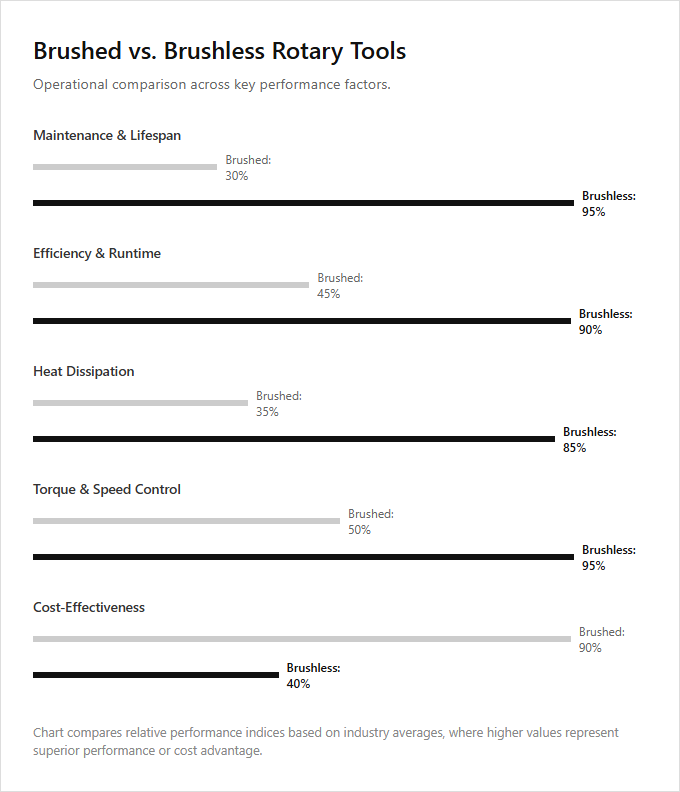
| Maintenance and Lifespan | Brushless motors eliminate the need to replace wearing carbon brushes, significantly extending the tool's operational lifespan. |
| Efficiency and Runtime | Brushless rotary tools leverage electronic commutation to optimize power delivery, resulting in superior battery runtime. |
| Heat Dissipation | Brushed motors generate significant thermal energy due to physical friction on the commutator, whereas brushless designs run much cooler. |
| Torque and Speed Control | Brushless motors utilize a dedicated electronic speed controller to continuously adjust torque and maintain constant RPM under heavy loads. |
| Cost and Complexity | Brushed rotary tools remain highly cost-effective due to their simpler physical construction and lack of complex integrated circuitry. |
Electronic commutation versus mechanical brush friction for maximizing peak RPM
Rotary tools utilizing brushed motors rely on physical carbon brushes contacting a spinning commutator to deliver power. This mechanical friction generates significant heat and physical resistance, which inherently limits the tool's maximum achievable RPM and accelerates component wear under heavy loads.
Brushless motors employ electronic commutation, using intelligent circuitry instead of physical brushes to manage the electromagnetic field. Eliminating mechanical friction allows these tools to achieve much higher peak RPMs with superior thermal efficiency and minimal energy loss.
Brushed models remain ideal for budget-conscious DIYers undertaking occasional household projects, whereas brushless systems are suited for precision craftsmen and industrial professionals who require sustained high-speed operation and tool longevity.
Closed-loop feedback control to sustain constant torque under variable workloads
In rotary tools, the distinction between brushed and brushless motors lies in how they manage variable workloads. Brushed motors rely on mechanical carbon brushes to deliver current, which often results in significant RPM drops when encountering material resistance. Conversely, brushless motors utilize electronic controllers featuring closed-loop feedback systems. These sensors continuously monitor the shaft speed and dynamically adjust power input to sustain constant torque, preventing the tool from stalling during heavy carving, routing, or grinding tasks.
This digital regulation ensures consistent cutting speed and optimal efficiency, even when transitioning between materials of varying densities. Traditional brushed models are highly suited for casual hobbyists performing light, intermittent crafting, whereas advanced brushless tools are designed for industrial professionals requiring sustained precision under demanding, continuous workloads.
Stator Cooling for High-Torque Durability
In rotary tools, brushless motors offer superior thermal management compared to their brushed counterparts. Brushless designs position the copper windings on the stationary outer stator, allowing heat to dissipate directly through the tool's outer housing. This structural configuration prevents thermal degradation and maintains operating efficiency during prolonged, high-torque applications.
Brushed motors generate significant heat within the inner rotating armature, trapping thermal energy inside the motor assembly and accelerating component wear under heavy loads. Brushed rotary tools are ideal for budget-conscious DIY hobbyists performing intermittent, light-duty crafting, whereas brushless models are best for high-demand professionals requiring sustained performance during continuous, heavy-duty tasks.
High torque-to-weight ratio achieved via permanent magnet rotor configuration
In rotary tools, the transition from brushed to brushless motor technology represents a significant engineering advancement. Brushless motors utilize a permanent magnet rotor configuration, eliminating the physical brushes and commutator found in traditional designs. This layout optimizes magnetic efficiency, delivering a remarkably high torque-to-weight ratio. These brushless systems provide superior rotational power and sustained speed under load without adding unnecessary bulk to the handpiece.
Traditional brushed motors rely on physical carbon brushes to deliver current, which generates more heat and friction over time. Brushless models are best suited for professional artisans requiring sustained, high-torque precision, while budget-conscious DIY hobbyists will find brushed tools perfectly adequate for occasional, light-duty crafting tasks.
Eliminating Carbon Brush Arcing to Reduce Loss and EMI
When selecting a rotary tool, the choice between brushed and brushless motor technologies significantly impacts operational efficiency. Traditional brushed motors rely on physical carbon brushes sliding against a commutator to deliver current, a process that inherently generates friction and electrical arcing. This arcing leads to notable energy loss through heat dissipation and creates electromagnetic interference (EMI) that can disrupt sensitive electronics in the workspace.
Brushless motors eliminate physical brushes entirely, utilizing electronic circuitry to manage the electrical field. Removing this contact point prevents arcing, optimizes energy transfer to the spindle, and drastically reduces EMI. This design yields a cooler-running, more durable tool that maintains consistent speed under load.
Brushed rotary tools remain a practical, cost-effective choice for occasional hobbyists undertaking light crafting, while brushless models are suited for professionals and precision artisans who demand maximum runtime, minimal maintenance, and an interference-free work environment.
Optimizing Back EMF for Efficiency Across RPMs
In rotary tools, maintaining power efficiency across a wide RPM spectrum depends heavily on the management of back electromotive force (EMF). Traditional brushed motors operate with fixed commutator timing, meaning back EMF inherently limits efficiency and increases thermal energy loss as rotational speeds climb. Conversely, brushless motors utilize digital controllers to continuously monitor back EMF feedback, dynamically adjusting phase timing in real time to sustain optimal energy conversion and consistent torque output across the entire speed range.
This precise electronic regulation prevents voltage drops under load, ensuring the tool draws only the necessary current to maintain performance. Simplistic, cost-effective brushed rotary tools are ideal for occasional hobbyists performing light, intermittent crafting, whereas highly efficient brushless models are designed for demanding professionals requiring sustained power and prolonged tool life under continuous duty.
PWM Control for Precise Torque and Battery Optimization
In cordless rotary tools, the choice between brushed and brushless motor technology dictates efficiency and performance. Brushless motors utilize advanced electronic controllers to employ pulse-width modulation (PWM), adjusting the power duty cycle dynamically based on real-time load feedback. This closed-loop regulation ensures precise torque delivery by maintaining constant rotational speed under resistance, while simultaneously optimizing battery runtime by minimizing energy waste. Conversely, brushed motors rely on physical carbon brushes, which introduce mechanical friction and heat, leading to greater power dissipation and less responsive speed regulation.
Selecting the appropriate motor configuration depends on the user's operational demands and frequency of use. Brushed models are well-suited for budget-conscious hobbyists undertaking occasional, light-duty crafting, while brushless rotary tools are ideal for trade professionals and demanding creators who require sustained torque, maximum battery efficiency, and tool longevity.
Leave a comment