
Woodworkers and shop managers frequently struggle with fine, invisible dust escaping their air cleaners, settling on surfaces and compromising respiratory health despite running their filtration systems constantly. When addressing these air quality issues, facilities often look to standard equipment funding sources-such as safety compliance grants or annual maintenance budgets-to replace entire machinery lines. However, simply upgrading your existing unit's filter media grants immediate, cost-effective access to superior air quality without the capital expense of a new system.
Crucially, this efficiency upgrade is stipulated on maintaining proper seal integrity; even a sub-micron filter fails if air bypasses the housing. For example, retrofitting a standard 1.5 HP dust collector with a canister upgrade provides a practical blueprint for this transition. Below, we examine the critical differences between Pleated Cartridge Filters and Polyester Filter Bags, comparing their micron ratings, airflow resistance, and long-term value.
| Factor | Summary |
|---|---|
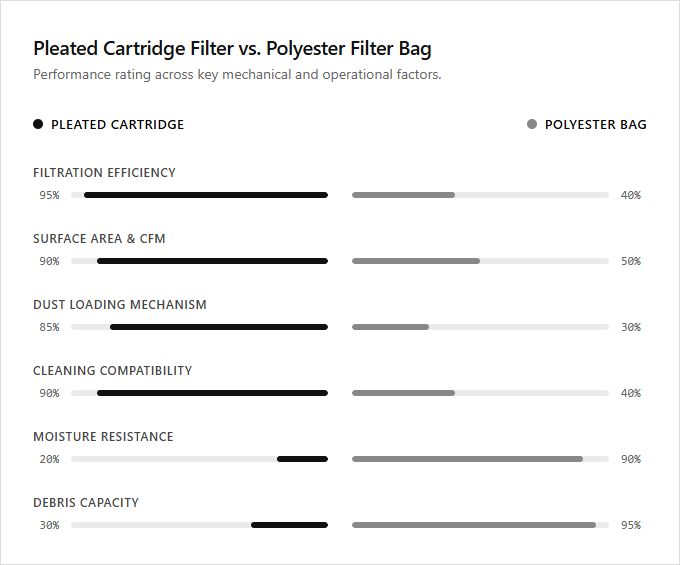
| Filtration Efficiency | Pleated cartridge filters achieve superior filtration down to sub-micron levels often meeting HEPA standards, whereas polyester filter bags typically capture larger particulate matter down to 5 microns. |
| Surface Area and CFM | The pleated geometry of cartridge filters vastly increases the total surface area to maintain optimal CFM (cubic feet per minute) airflow, while polyester bags offer less surface area per unit volume. |
| Dust Loading Mechanism | Cartridge filters primarily utilize surface filtration which allows for easy dust cake release, whereas polyester filter bags rely on depth filtration where fine particles can become embedded in the media. |
| Cleaning Compatibility | Pleated cartridges are highly compatible with automated reverse pulse-jet cleaning systems, while polyester bags usually require manual mechanical shaking to dislodge accumulated dust. |
| Moisture Resistance | Polyester filter bags exhibit excellent hydrostatic resistance against damp dust and moisture, whereas standard paper-based pleated cartridges are prone to blinding and tearing when wet. |
| Debris Capacity | Polyester filter bags excel at handling high-volume, abrasive wood chips and large debris, whereas pleated cartridges are easily clogged by coarse materials and are strictly optimized for fine dust extraction. |
Superior filtration surface-area-to-volume ratio of pleated media
When selecting filtration media for industrial air cleaners, the primary differentiator lies in geometric design. Pleated cartridge filters utilize a folded configuration that vastly increases the active filtration surface area within a compact spatial footprint. This superior surface-area-to-volume ratio allows for a lower face velocity, capturing finer particulate matter more efficiently and extending the service life of the filter element under heavy dust loads.
In contrast, polyester filter bags rely on a traditional depth-filtration mechanism, offering robust structural durability in high-moisture environments but with a significantly lower surface-area-to-volume ratio. High-capacity pleated cartridges are ideal for precision woodwork or CNC shops handling ultra-fine, hazardous dust, whereas washable polyester bags best serve general contractors requiring rugged, reusable containment for coarse debris.
Significant reduction in static pressure drop across the ventilation system
In industrial woodshops and dust collection systems, maintaining optimal airflow depends heavily on minimizing resistance. Pleated cartridge filters significantly reduce static pressure drop across the ventilation system by utilizing a folded design that vastly maximizes surface area. This increased surface area allows air to pass through more freely, sustaining high cubic feet per minute (CFM) performance and reducing strain on the air cleaner's motor.
Polyester filter bags offer a traditional alternative but typically experience a higher static pressure drop as dust cakes on the fabric surface. Pleated cartridges are ideal for high-production professionals requiring maximum fine-particle filtration and consistent airflow, whereas polyester bags are best suited for hobbyists or light-duty workshops handling coarser debris on a limited budget.
Enhanced capture of sub-micron particulates achieving high MERV ratings
When selecting filtration for industrial air cleaners, the choice between pleated cartridge filters and polyester filter bags directly impacts workshop air quality. Pleated cartridge filters offer an engineered surface area that captures sub-micron particulates with exceptional efficiency, often achieving MERV 15 or higher ratings. In contrast, polyester filter bags utilize a depth-filtration method, which is highly effective for bulk dust containment but typically yields lower MERV ratings for microscopic particles.
The tightly folded media of pleated cartridges creates a dense barrier that traps hazardous fine dust down to 0.3 microns. Polyester bags employ a felted material that allows higher airflow and resists moisture, making them durable under heavy debris loads. Pleated cartridges are ideal for technicians requiring pristine, high-efficiency air filtration in electronics labs or fine woodworking shops, while polyester bags suit high-volume operators handling coarse materials in heavy manufacturing environments.
From Depth Felt to Spunbond Surface Filtration
Modern air filtration in power tools is shifting from traditional depth filtration to advanced surface loading. Standard polyester felt filter bags rely on depth filtration, trapping dust particles throughout the thickness of the media. Over time, this embedded dust restricts airflow, leading to premature clogging and more laborious cleaning cycles.
Transitioning to pleated cartridge filters made of spunbond polyester utilizes surface loading. The tight, uniform fibers capture fine dust directly on the outer surface of the pleats, preventing particles from penetrating the substrate. This geometry maximizes surface area, ensures easier dust release during maintenance, and maintains consistent system airflow. Traditional felt bags are suitable for casual DIYers collecting coarse wood chips, whereas pleated spunbond cartridges are essential for professionals demanding high-efficiency capture of hazardous fine dust.
Optimized pulse-jet cleaning efficiency for lower dust cake retention
Pleated cartridge filters maximize pulse-jet cleaning efficiency through a rigid, high-surface-area design that allows pressurized air blasts to uniformly dislodge surface dust. This structural stability prevents the pleats from collapsing during cleaning cycles, ensuring minimal dust cake retention and maintaining consistent system airflow.
Polyester filter bags utilize fabric flexibility to release accumulated dust cake. The mechanical movement of the bag expanding and contracting during the pulse-jet blast sheds the dust layer, though the porous textile fibers naturally retain more residual particulate than smooth pleated media.
Pleated cartridges are best suited for precision technicians requiring high-efficiency filtration of fine, dry dust, whereas polyester bags are ideal for industrial operators managing heavy, abrasive, or high-moisture waste.
Elimination of bypass leakage through integrated compression gaskets
Pleated cartridge filters offer superior surface area and frequently feature integrated compression gaskets that establish a positive seal against the air cleaner housing. This airtight interface eliminates bypass leakage, ensuring all airborne particulates are forced through the filtration media rather than escaping through gaps around the frame.
In contrast, polyester filter bags rely on tension rings or snap-bands, which can allow minor bypass leakage if the bag is not seated perfectly. While polyester bags excel in high-volume, coarse dust collection, pleated cartridges with compression gaskets provide the critical sealing necessary for fine-particle capture. Pleated cartridges suit industrial professionals handling hazardous fine dust like silica, whereas polyester bags are ideal for workshop hobbyists managing high-volume wood shavings.
Drastic PM2.5 reduction under heavy dust loads
When managing heavy dust loads in industrial environments, selecting the right filtration media is critical for controlling hazardous PM2.5 emissions. Pleated cartridge filters offer superior fine-particle containment due to their expanded surface area, which captures microscopic particulates before they can bypass the system. In contrast, standard polyester filter bags rely on a dust cake buildup to achieve peak efficiency, leaving workers vulnerable to fine respirable dust during initial cycles and high-surge conditions.
The engineered pleats maintain low resistance and consistent airflow, drastically reducing the escape of PM2.5 matter into the breathing zone. While polyester bags provide a durable, cost-effective option for bulk waste, they lack the tight pore structure of pleated alternatives. Pleated cartridges are ideal for precision fabricators and laboratory technicians requiring maximum respiratory protection, whereas polyester bags are best suited for high-volume lumber yards handling coarse timber chips.
Leave a comment