

Achieving flawless profiles with a high-RPM wood router is often undermined by premature bit wear, leaving woodworkers struggling with unsightly burn marks and ruined workpieces. While standard workshop funding sources and equipment budgets naturally prioritize the horsepower of the router itself, the true bottleneck to quality lies in cutter metallurgy.
Selecting the correct material grants your workshop unparalleled edge longevity and cleaner shears, saving costly project remakes. However, this selection comes with the stipulation that high-RPM operations demand a strict balance between heat resistance and impact durability. For instance, professional shops utilizing Freud or Whiteside Roman ogee profiles must weigh these metallurgic factors carefully to maintain production standards.
In this guide, we will analyze the physical properties of Carbide-Tipped (TCT) and High-Speed Steel (HSS) bits, evaluate their performance under extreme thermal stress, and provide a definitive framework to help you select the optimal cutter for your specific routing applications.
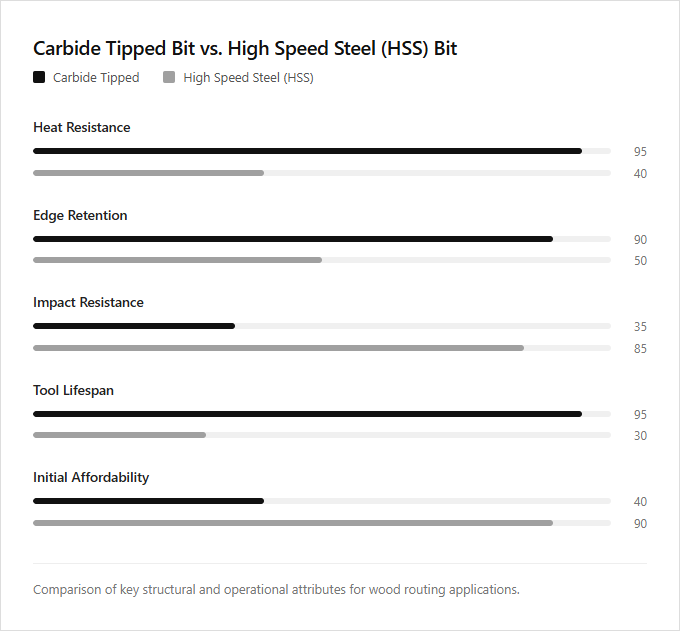
| Factor | Summary |
|---|---|
| Material Composition | Carbide tipped bits fuse tungsten carbide to a steel body, whereas HSS bits are machined from a single monolithic carbon steel alloy. |
| Heat Resistance | Carbide bits withstand higher thermal degradation at high RPM, while HSS bits can lose their temper and soften under intense heat. |
| Edge Retention | HSS bits allow for a sharper initial cutting edge, but carbide tipped bits maintain their cutting geometry far longer when routing abrasive materials. |
| Impact Resistance | Carbide is brittle and susceptible to micro-chipping upon hitting foreign objects, whereas HSS possesses superior tensile strength to withstand shock. |
| Cost-Effectiveness | HSS bits require less initial capital investment, but carbide tipped bits offer a better long-term return on investment due to extended tool life. |
Carbide Bits: Superior Heat Resistance for High-RPM Routing
In high-speed routing, selecting the appropriate cutting tool material is critical for maintaining edge retention and finish quality. Carbide-tipped bits possess superior hot-hardness to withstand the intense thermal degradation of high-RPM routing. High-Speed Steel (HSS) bits, while exceptionally sharp, degrade rapidly when subjected to the extreme frictional heat generated during prolonged, high-speed operations.
Carbide's structural integrity allows it to maintain a clean cut through dense hardwoods and abrasive composites without dulling prematurely. High-speed steel bits are ideal for budget-conscious hobbyists working primarily with softwoods on occasional projects, whereas carbide-tipped bits are essential for professional fabricators and CNC operators requiring maximum durability in high-production environments.
Keener HSS Bits for Cleaner Softwood Profiles
When selecting router bits, the choice between carbide-tipped and high-speed steel (HSS) options directly impacts finish quality and tool longevity. High-speed steel bits possess a metallurgical structure that allows them to be ground to a much keener cutting edge radius than carbide. This superior sharpness is highly advantageous when routing softwoods, as it cleanly shears the wood fibers to produce exceptionally smooth profiles with minimal tear-out.
Carbide-tipped bits feature a harder composition that maintains its cutting edge significantly longer when working with dense hardwoods and abrasive composites, though they cannot achieve the absolute razor sharpness of HSS. While production-oriented woodworkers and CNC operators benefit most from the extreme durability of carbide, traditional craftsmen prioritizing flawless, intricate detail in softwoods find HSS to be the superior choice.
Carbide Tips Resist Abrasive Wear in Composites
When selecting router bits, understanding the material composition of the cutting edge is crucial for tool longevity and project quality. High-Speed Steel (HSS) bits provide excellent initial sharpness and flexibility, but they dull quickly under high heat. In contrast, carbide-tipped bits offer superior hardness and thermal stability. Specifically, carbide tips resist the rapid abrasive wear caused by glues, resins, and binders found in engineered composite substrates like MDF, plywood, and particleboard.
While HSS is easily sharpened and highly effective for clean cuts in natural timbers, it degrades rapidly when routing manufactured materials. Hobbyists working occasionally with softwoods and intricate detail work will find high-speed steel highly suitable, whereas high-production professionals and CNC operators processing dense composites require the enduring durability of carbide-tipped tooling.
High-Speed Steel: Superior Toughness and Chip Resistance
When selecting router bits, understanding the metallurgical differences between Carbide Tipped and High-Speed Steel (HSS) is essential for optimizing performance. Carbide is extremely hard and maintains its sharp edge under high-heat conditions, but its crystalline structure makes it inherently brittle. High-speed steel offers significantly higher impact toughness, making it less prone to catastrophic chipping than brittle carbide when encountering knots or sudden vibrations during operation.
This resilience allows HSS to flex slightly under stress where carbide would simply fracture. High-production cabinet shops processing abrasive man-made materials demand the long-lasting edge of carbide-tipped bits, while weekend DIYers and hand-held routing enthusiasts working with unpredictable solid hardwoods will find the forgiveness and safety of HSS better suited to their needs.
Carbide-Tipped Cutters: Long-Lasting Precision
When selecting router bits for woodworking and manufacturing, the choice between carbide-tipped and high-speed steel (HSS) options significantly impacts performance. Carbide-tipped cutters are engineered for demanding applications, maintaining precise dimensional stability and profile geometry over a vastly longer tool life cycle compared to steel alternatives. Their extreme hardness resists wear and thermal degradation, ensuring that intricate profiles remain consistent over extended production runs.
High-speed steel bits offer sharper initial cutting edges and greater elasticity at a lower price point, though they dull much faster under continuous use. Professional woodworkers and high-production manufacturers require the durability of carbide-tipped bits for repetitive tasks, whereas hobbyists and DIY enthusiasts working with softwoods find high-speed steel bits ideal for occasional, light-duty projects.
Carbide Prevents Edge Dulling in High-Speed Rotation
Woodworking routers operate at extremely high rotational velocities, often exceeding 20,000 RPM. This intense speed generates significant friction-induced heat at the cutting edge. While High-Speed Steel (HSS) bits perform well under moderate conditions, the extreme thermal stress of high-speed routing rapidly dulls their cutting edges, compromising cutting precision and workpiece finish.
Carbide-tipped bits excel in these demanding environments. The superior thermal resistance and hardness of tungsten carbide allow the tooling to maintain a sharp edge far longer than HSS under sustained high RPMs. HSS bits remain a cost-effective choice for hobbyists working occasionally with softwoods, whereas carbide-tipped bits are indispensable for professionals and high-volume woodworkers requiring durability and precision across hardwoods and composite materials.
Optimized Shear Angles Reduce End-Grain Wood Tear-Out
When selecting router bits, the choice between carbide-tipped and high-speed steel (HSS) options directly impacts edge retention and finish quality. Carbide-tipped tooling excels in demanding applications due to its superior hardness and thermal resistance. Optimizing the shear angle on carbide-tipped bits reduces tear-out on complex end-grain wood profiles, slicing through fibers at an angle to prevent chipping on intricate moldings.
High-speed steel bits provide a sharper initial edge for delicate tasks but wear down rapidly under high friction. High-speed steel remains the preferred choice for occasional hobbyists focusing on softwoods, whereas carbide-tipped bits are ideal for professional furniture makers requiring long-term durability on dense hardwoods and composites.
Leave a comment