

Achieving a flawless edge during template routing is notoriously difficult, especially when fluctuating grain directions lead to catastrophic tear-out and ruined workpieces. While woodworkers often rely on standard straight-flute flush-trim bits or basic carbide-tipped cutters to manage these profiles, these conventional tooling options frequently fall short on complex grain structures.
However, upgrading to specialized geometry-specifically comparing compression spiral bits to premium solid-carbide flush-trim bits-grants craftsmen unmatched edge quality and virtually eliminates grain blowouts. Of course, maximizing this performance stipulates that operators also maintain proper feed rates, correct template offset, and machine stability.
This is especially critical when routing highly sensitive materials, such as double-sided veneered plywood or figured curly maple. In this guide, we will dissect the mechanical differences between compression and flush-trim bits, evaluate their tear-out prevention capabilities, and provide a clear roadmap for selecting the optimal router bit for your next template project.
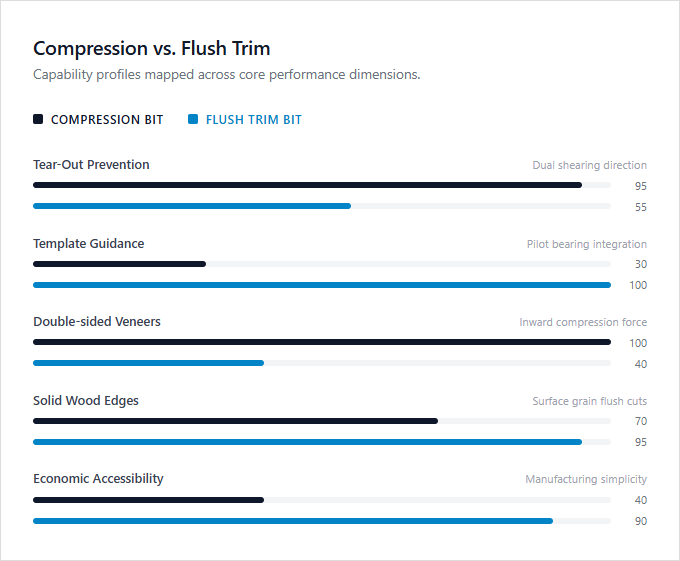
| Factor | Summary |
|---|---|
| Flute Geometry | Compression bits combine opposing upcut and downcut spiral flutes to compress wood fibers toward the center, whereas flush trim bits feature straight or spiral flutes aligned with a guide bearing. |
| Tear-out Prevention | Compression bits prevent delamination on double-sided laminates by shearing inward, while flush trim bits rely on shear angle and rotational speed to minimize chipping along a template edge. |
| Guidance System | Flush trim bits utilize a ball-bearing pilot to replicate a template shape, whereas compression bits typically rely on CNC toolpaths or physical fences for directional guidance. |
| Material Suitability | Compression bits excel on veneered plywood and MDF where face-chipping is a risk, while flush trim bits are ideal for trimming solid wood overhangs and laminates flush to a substrate. |
| Primary Application | Flush trim bits are optimized for pattern routing and template replication, whereas compression bits are primarily used in high-efficiency nested-based manufacturing. |
| Tool Complexity and Cost | Due to their intricate dual-helix geometry, compression bits command a higher price point and require specialized sharpening compared to standard bearing-guided flush trim bits. |
How Compression Bits Eliminate Wood Tear-Out
When trimming veneered materials, selecting the correct router bit is critical for edge quality. The compression bit utilizes a specialized dual-action design, combining opposing up-cut and down-cut spiral flute geometry. This configuration compresses the wood fibers toward the center of the workpiece, effectively eliminating tear-out on both the top and bottom faces of laminated panels.
Standard flush trim bits feature straight or single-direction spiral flutes aligned with a pilot bearing to replicate template profiles. While efficient for solid wood, they lack the dual-compression action required to prevent chipping on delicate veneers. Cabinetmakers working extensively with double-sided laminates benefit from the chip-free precision of compression bits, whereas general carpenters and hobbyists performing standard template replication will find flush trim bits highly practical.
How Pilot Bearings Guide Flush Trim Bits
Traditional flush trim bits utilize a pilot bearing, mounted at either the top or bottom of the cutter, to guide straight flutes precisely along a template profile. This physical guide ensures a uniform cut matching the template exactly, though straight cutters can sometimes cause tear-out on figured grain or end grain.
In contrast, compression bits feature opposing up-shear and down-shear spiral flutes. This specialized design pulls the wood fibers toward the center of the material from both the top and bottom faces, virtually eliminating chipping on delicate veneered or laminated surfaces.
Standard flush trim bits are ideal for hobbyists replicating simple templates in solid wood, whereas compression bits are suited for high-production professionals working with double-sided laminates and veneered plywood.
Prevent Chipping: Position Compression Bit Transition Below Surface
When selecting between a compression bit and a flush trim bit, understanding their cutting geometry is essential for achieving clean, professional edges. Flush trim bits utilize straight or spiral flutes guided by a bearing to duplicate templates accurately. In contrast, compression bits combine upcut and downcut spirals to compress wood fibers toward the center of the material, preventing tear-out on both the top and bottom faces of veneered plywood.
To achieve the flawless finish that compression bits promise, precise height adjustment is critical. The transition point where the upcut and downcut spirals meet must be positioned entirely below the workpiece surface to prevent top-edge chipping. Flush trim bits are best suited for general hobbyists routing standard timber templates, while compression bits are ideal for CNC operators and professional cabinetmakers processing double-sided laminates.
Dual-Veneer Protection with Compression Bits
Choosing between a compression bit and a flush trim bit depends heavily on your material and the required edge quality. Solid carbide compression bits feature a unique dual-flute geometry where the top spiral forces chips downward and the bottom spiral pulls them upward. This design generates opposing axial shear forces that compress the workpiece toward its center, protecting both the top and bottom veneers simultaneously from chipping or tear-out during high-speed routing.
Standard flush trim bits utilize straight or single-direction spiral flutes guided by a pilot bearing to trim materials flush with a template. While highly effective for straightforward profiling, they lack the dual-action shear forces needed to protect delicate laminate faces on both sides. Cabinetmakers working with double-sided veneered plywood benefit most from the chip-free performance of compression bits, whereas general carpenters shaping solid wood templates are ideal candidates for traditional flush trim bits.
Straight-Flute Flush Trim Bits: The Risk of Blowout
When duplicating templates or finishing edges, selecting the correct router bit geometry is critical for material integrity. Standard straight-flute flush trim bits cut perpendicular to the wood, lacking a shear angle to slice through fibers. This limitation significantly increases the risk of tearout and severe blowout when transitioning against the grain direction on complex curves.
Compression bits resolve this issue by combining opposing spiral flutes-an upcut design at the bottom and a downcut design at the top-which compress the wood fibers toward the center of the stock. This dual-action cutting prevents chipping on both the top and bottom faces of veneered or laminated materials. Standard flush trim bits are ideal for hobbyists working primarily with simple, straight-grained solid woods, while compression bits are best suited for professional cabinetmakers requiring pristine, chip-free edges on double-sided sheet goods.
Why Spiral Flush Trim Bits Outperform Straight Flutes
When selecting router bits for precise edge profiling, the choice between compression and flush trim configurations significantly impacts the final finish. Flush trim bits featuring spiral flutes and ball bearing guides offer a distinct advantage over traditional straight-flute designs. The continuous shearing action of the spiral geometry ensures superior chip evacuation and minimizes tool chatter, resulting in an exceptionally smooth edge along the template guide.
While compression bits employ opposing up-cut and down-cut spirals to prevent tear-out on veneered faces, spiral flush trim bits excel at executing clean, rapid cuts on solid stock. Cabinetmakers processing double-sided laminates will find compression bits indispensable for chip-free edges, whereas furniture makers focused on template routing and curved profiles will achieve the best results using spiral flush trim bits.
Preventing Tear-Out When Climb Cutting Curves
When routing curved profiles, choosing between a compression bit and a flush trim bit directly impacts the quality of the finished edge. Flush trim bits are highly effective for matching templates, but they require careful grain management along curved geometries. To prevent severe grain tear-out where the wood grain changes direction, woodworkers must carefully manage climb cutting techniques. This strategic feed-direction adjustment ensures the cutting edge shears the wood fibers down into the stock rather than lifting and lifting them away from the template.
Conversely, compression bits utilize opposing spiral flutes that pull the top and bottom fibers toward the center of the material, virtually eliminating tear-out on laminated or veneered sheet goods. Production CNC operators prioritizing flawless double-sided veneer cuts benefit most from compression bits, whereas custom furniture makers executing complex, curved template shaping find the flush trim bit indispensable.
Leave a comment