
Achieving a flawless, tear-out-free edge profile is a persistent challenge for woodworkers. Maintaining consistent pressure and speed with a tool spinning at 20,000 RPM often leads to workpiece burning, gouging, or hand fatigue.
To address this, craftsmen typically rely on standard shop investments, such as basic handheld routers and standard pilot-bearing bits. However, selecting the precise guiding method-table-mounted versus hand-guided-grants you unmatched control over cut depth, safety, and finish quality.
Under the stipulation that workpiece dimensions and bit diameters strictly dictate safety limits, operators must evaluate each project individually. For example, routing a delicate cherry Roman ogee profile demands a different control setup than shaping a robust white oak roundover.
This article compares the stability of router table configurations against the maneuverability of freehand routing, outlining a clear decision framework to help you select the optimal method for your next edge-profiling task.
| Factor | Summary |
|---|---|
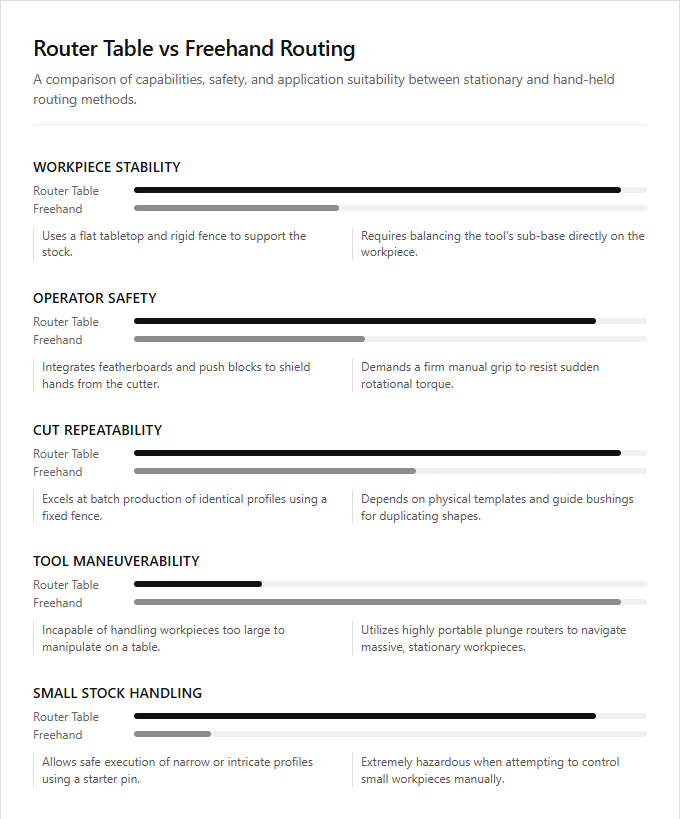
| Workpiece Stability | While a router table uses a flat tabletop and rigid fence to support the stock, freehand routing requires the user to balance the tool's sub-base directly on the workpiece. |
| Operator Safety | Router tables allow the integration of featherboards and push blocks to keep hands away from the spinning cutter, whereas freehand routing demands a firm manual grip to resist sudden rotational torque. |
| Cut Repeatability | A router table excels at batch production of identical profiles using a fixed fence, while freehand routing depends on physical templates and guide bushings for duplicating shapes. |
| Tool Maneuverability | Freehand routing utilizes highly portable plunge routers to navigate massive, stationary workpieces that are too large to manipulate on a standard table surface. |
| Small Stock Handling | Shaping narrow or intricate workpieces is extremely hazardous when done freehand, but can be safely executed on a router table by utilizing a starter pin for leverage and guidance. |
Stabilizing Narrow Stock with Split Fences and Featherboards
When machining narrow wood stock, a router table provides superior workpiece stability and control compared to freehand routing. Mounting the router inverted in a table allows the use of a split fence to support the wood before and after the cut, minimizing the risk of snipe. Integrating featherboards exerts constant downward and inward pressure, keeping the operator's hands safely away from the spinning bit while ensuring consistent depth and profile accuracy. Freehand routing on narrow stock lacks these physical guides, making it difficult to balance the tool base securely on thin edges.
While freehand routing offers mobility for edge-profiling large, pre-assembled structures, the router table setup excels in high-precision, repetitive tasks on small components. Router tables are ideal for production woodworkers requiring precise joinery on narrow stock, whereas freehand routing suits mobile carpenters and installers working on-site with oversized workpieces.
Edge guidance and profile consistency utilizing a pilot bearing
When utilizing a router bit with a pilot bearing, both router tables and freehand methods offer distinct approaches to edge profiling. A router table provides excellent stability by keeping the tool stationary, allowing the workpiece to glide smoothly against the bearing. This configuration ensures exceptional profile consistency across long, straight stock, as the flat table surface eliminates any risk of the router tipping during operation.
Freehand routing relies on the operator guiding the tool directly along the workpiece, using the pilot bearing to trace curved or irregular edges. This method offers superior maneuverability for oversized workpieces that cannot safely fit on a table. Stationary table routing is ideal for production woodworkers requiring rapid, highly repetitive edge work, whereas freehand routing is best suited for installers and custom builders needing on-site flexibility for large-scale projects.
Preventing Climb Cutting with Proper Feed Direction
In a router table setup, managing feed direction is critical for operator safety. Because the table-mounted bit rotates counterclockwise, the workpiece must be fed from right to left. This orientation ensures the cutting edge opposes the wood's movement, eliminating the risk of climb cutting, where the spin of the blade violently pulls the material forward.
During handheld freehand routing, the tool itself moves along the workpiece. To maintain control and resist the clockwise rotation of the handheld bit, the operator must guide the router from left to right along an external edge. This counteracts the bit's rotation, preventing the tool from climbing and kicking back.
Router tables are best suited for high-precision woodworkers crafting repetitive, small components, while freehand routing is ideal for mobile carpenters performing onsite edge profiling on large, stationary workpieces.
Precise depth-of-cut adjustments enabled by a mechanical router lift
Selecting between a router table and freehand routing depends largely on the required precision of the application. A router table equipped with a mechanical router lift allows for exceptionally precise, micro-adjustable depth-of-cut settings from above the tabletop. This mechanical advantage eliminates the tedious trial-and-error process of manual motor adjustments, securing the spindle firmly to prevent any vertical slippage during heavy operations.
Conversely, freehand routing offers unmatched maneuverability for edge profiling on large, immobile workpieces where a table is impractical. While freehand operation relies on manual guidance and built-in turret stops, the table-mounted lift provides repeatable, engineering-grade accuracy. Router tables with mechanical lifts are ideal for precision woodworkers demanding flawless joinery, whereas freehand routing suits versatile carpenters performing on-site installations.
Safe operation of large-diameter profiling bits using a variable-speed motor
When operating large-diameter profiling bits, selecting the correct routing method is critical for safety and workpiece control. These substantial cutters require a variable-speed motor to significantly reduce the rotations per minute (RPM), which prevents dangerous tool chatter, burning, and potential workpiece ejection.
A stationary router table offers maximum stability, allowing the fence, featherboards, and safety guards to support the wood during heavy stock removal. Freehand routing with large bits poses severe kickback risks, because guiding a high-torque, spinning motor manually demands immense physical control and increases the likelihood of gouging.
Router tables are best suited for production woodworkers requiring precise, repetitive profiling, while freehand routing remains the choice for experienced on-site installers needing to shape fixed, architectural elements.
Reduction of end-grain blowout and tearout with a zero-clearance insert
A router table offers superior control over wood fibers compared to freehand routing, particularly when machining fragile end grain. The stability of a fixed tabletop allows for the integration of a zero-clearance insert, which provides direct physical support to the workpiece right at the point of cutter exit. Freehand routing lacks this built-in backing, which significantly increases the risk of splintering and grain blowout as the rotating bit exits the stock.
By minimizing the gap around the router bit, a zero-clearance insert on a table acts as a chip-breaker, keeping wood fibers pressed firmly in place to ensure clean, crisp edges. Stationary router tables are ideal for precision woodworkers crafting intricate joints and small parts, while freehand routing suits mobile carpenters and builders shaping large, pre-installed architectural elements.
Handheld maneuverability on oversized workpieces using an auxiliary sub-base
While a router table offers unmatched stability and precision for small to medium-sized components, freehand routing excels when maneuvering around massive or fixed workpieces. Attempting to guide an oversized panel across a stationary table can be awkward and unsafe. Guiding a handheld router equipped with an oversized auxiliary sub-base provides a stable, balanced platform directly on the workpiece face, preventing tipping and ensuring a consistent depth of cut across expansive surfaces.
Selecting between these methods depends heavily on the project scale and shop workflow. Router tables are ideal for production-oriented woodworkers requiring high repeatability on small components, whereas handheld routing with an auxiliary sub-base is best suited for custom furniture makers and on-site carpenters handling large, architectural installations.
Leave a comment