
Selecting the right air-handling technology is a persistent challenge for facility engineers who must constantly balance high-volume displacement against mounting maintenance costs and system downtime. While standard industrial procurement budgets historically default to traditional rotary vane setups for any vacuum or pressure application, the regenerative blower-or side channel blower-grants operations a highly efficient, oil-free alternative that delivers continuous, pulsation-free airflow with minimal mechanical wear.
To manage expectations, a crucial stipulation must be made: regenerative blowers are engineered specifically for high-volume, low-to-medium pressure applications and are not intended for deep-vacuum requirements. However, in applications such as municipal wastewater aeration and bulk pneumatic conveying, this technology consistently delivers superior reliability over high-maintenance alternatives.
Below, we compare regenerative blowers directly with rotary vane vacuum pumps, examining operating principles, efficiency curves, and total cost of ownership to guide your next system integration.
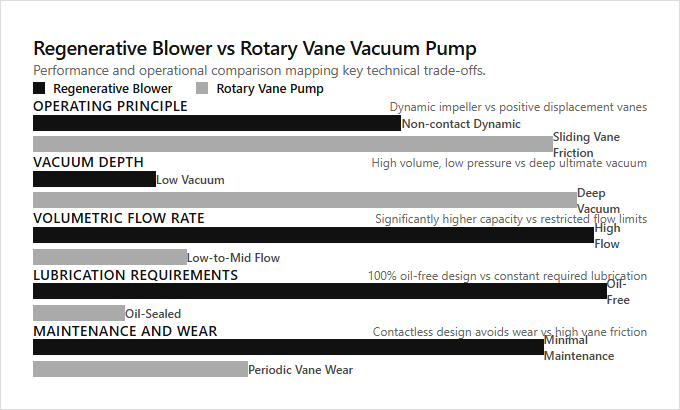
| Factor | Summary |
|---|---|
| Operating Principle | Regenerative blowers utilize dynamic compression through a non-contacting impeller, whereas rotary vane pumps rely on positive displacement via sliding vanes. |
| Vacuum Depth | Rotary vane pumps are capable of achieving a much higher ultimate vacuum, while regenerative blowers are limited to low-pressure, high-volume applications. |
| Volumetric Flow Rate | Regenerative blowers deliver a significantly higher volumetric flow rate compared to the more restricted flow capacity of rotary vane pumps. |
| Lubrication Requirements | Regenerative blowers provide completely oil-free operation, whereas oil-sealed rotary vane pumps require constant lubrication and exhaust filtration to prevent contamination. |
| Maintenance and Wear | The contactless impeller design of regenerative blowers virtually eliminates mechanical wear, unlike rotary vane pumps where sliding vanes experience friction and require periodic replacement. |
Regenerative Blowers Outperform Rotary Vane Pumps in Flow
When comparing regenerative blowers to rotary vane vacuum pumps, the primary distinction lies in their operational efficiency across different pressure regimes. Regenerative blowers are engineered specifically for high-volume, low-vacuum applications where moving vast amounts of air is critical. Their dynamic, non-contact impeller design allows them to deliver volumetric flow rates that vastly exceed those of rotary vane pumps at lower pressure differentials.
Rotary vane vacuum pumps excel in creating deeper vacuum levels but are physically limited in the volume of air they can displace. These positive displacement machines rely on sliding vanes to trap and compress air, restricting their overall flow capacity. Regenerative blowers are ideal for industrial operators requiring rapid material transport or bulk aeration, while rotary vane pumps are best suited for laboratory technicians or precision manufacturers needing deep, stable vacuum pressures.
Frictionless Dynamic Compression in Regenerative Blowers
When evaluating air-moving technologies, the fundamental distinction between regenerative blowers and rotary vane vacuum pumps lies in their compression mechanisms. Regenerative blowers operate on dynamic compression using a non-contact impeller, which entirely eliminates the friction, heat, and wear associated with the sliding vanes of positive displacement rotary vane pumps. This contactless design ensures an oil-free output and significantly reduces the need for routine maintenance.
While rotary vane pumps are highly effective at achieving deep vacuum levels, they require continuous lubrication and vane replacement over time. In contrast, regenerative blowers excel in applications requiring high-flow, continuous duty at lower differential pressures.
Engineers and facility managers seeking maintenance-free, high-volume aeration will find regenerative blowers highly suitable, while laboratory technicians and industrial specialists requiring deep, high-precision vacuum levels are better served by rotary vane systems.
Oil-Free Regenerative Blowers Eliminate Contamination and Filters
When selecting between a regenerative blower and a rotary vane vacuum pump, the mechanism of compression is a critical differentiator. Regenerative blowers utilize a completely oil-free compression process, which inherently prevents downstream process contamination. In contrast, oil-sealed rotary vane pumps require constant lubrication, necessitating the use of complex exhaust aerosol filters to capture oil mist before discharge.
Eliminating these filters reduces ongoing maintenance overhead and ensures a cleaner overall operating environment. Regenerative blowers are ideal for facility managers seeking low-maintenance, contaminant-free air delivery in food or medical packaging, while rotary vane pumps are best suited for laboratory technicians requiring deeper vacuum levels where oil management is acceptable.
Regenerative Blowers for Continuous Low-Pressure Duty
When selecting industrial air moving equipment, understanding the distinct operational profiles of regenerative blowers and rotary vane vacuum pumps is essential for system efficiency. Regenerative blowers are thermodynamically optimized for continuous duty at low differential pressure levels, utilizing a non-contact, frictionless impeller design to move large volumes of air reliably over long periods. This design minimizes wear and tear, ensuring consistent performance without the need for constant maintenance.
In comparison, rotary vane vacuum pumps rely on mechanical positive displacement with sliding vanes to achieve much deeper vacuum levels, though they generate higher internal friction and require regular lubrication. Facilities requiring high-volume, oil-free continuous aeration or exhaust are best suited for regenerative blowers, while operators needing deep, precise vacuum pressure for laboratory or heavy manufacturing applications will find rotary vane pumps more appropriate.
Why Side Channel Blowers Outlast Rotary Vane Pumps
When evaluating industrial air-moving technologies, the mechanical design of the equipment dictates its long-term reliability. Side channel regenerative blowers operate using a non-contacting impeller, which eliminates internal friction and wear. In contrast, rotary vane vacuum pumps rely on sliding vanes that maintain constant physical contact with the chamber wall, leading to gradual degradation of the components over time.
The absence of contacting wear parts in side channel blowers results in a significantly higher mean time between failures than rotary vane pumps. This frictionless operation minimizes maintenance requirements and extends service life in continuous-duty applications. Regenerative blowers are ideal for operators requiring low-maintenance, high-flow continuous systems, while rotary vane pumps suit technicians needing deep vacuum capabilities with tolerance for scheduled servicing.
Regenerative Blowers: Damage-Free Particulate Air Handling
Regenerative blowers and rotary vane vacuum pumps offer distinct mechanical advantages depending on the operational environment. Regenerative blowers utilize kinetic energy transfer from the blades to handle particulate-laden air without the risk of vane breakage or stator scoring. Because the non-contacting impeller operates without physical wear, these systems tolerate airborne contaminants that would otherwise compromise the tight tolerances of a positive displacement pump.
Rotary vane vacuum pumps rely on sliding seals to achieve much deeper vacuum pressures, though they remain highly sensitive to debris and require consistent lubrication. Industrial operators managing continuous, high-volume airflow in dusty or harsh environments benefit most from regenerative blowers, while technicians requiring precise, deep vacuum levels in pristine laboratory conditions are best served by rotary vane systems.
Regenerative Compression Maximizes Bulk Handling Energy Efficiency
In industrial fluidics, selecting between a regenerative blower and a rotary vane vacuum pump depends heavily on the specific demands of the application. Regenerative blowers excel in high-volume, low-pressure scenarios. Their unique regenerative compression cycle continuously accelerates air using non-contact impellers, which drastically reduces power consumption when moving large volumes of air. This design maximizes energy efficiency during high-volume bulk material handling and pneumatic conveying operations.
Rotary vane vacuum pumps rely on sliding vanes to create positive displacement, delivering deeper vacuum levels at lower flow rates. While highly effective for packaging and hold-down tasks, they consume more energy when tasked with continuous, high-volume flow. Regenerative blowers are best suited for plant engineers managing continuous, large-scale bulk transfers, whereas rotary vane pumps are ideal for precision technicians requiring deep, stable vacuum pressures for localized workpieces.
Leave a comment