
Selecting the ideal oscillating multi-tool often leaves contractors and dedicated DIYers facing a frustrating cycle of stalled cuts, rapid battery drain, and overheated motors. While standard, budget-friendly brushed kits offer an accessible starting point for basic home maintenance, relying solely on upfront cost overlooks critical operational differences that impact long-term productivity.
Securing the right motor technology grants users unprecedented runtime, cooler operation, and superior torque transfer under heavy load. However, this efficiency gain is subject to a vital stipulation: tool performance must directly align with your project demands. For example, continuous flush-cutting of seasoned oak framing requires a vastly different power delivery than occasional drywall trimming.
To help you optimize your toolkit, this article provides a comprehensive comparison of brushed versus brushless oscillating tools, examining power-to-weight ratios, thermal management, maintenance cycles, and overall return on investment to ensure you select the right tool for maximum efficiency.
| Factor | Summary |
|---|---|
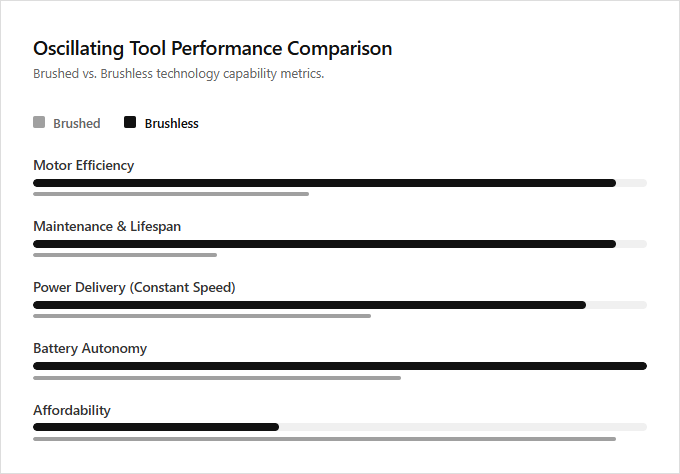
| Motor Efficiency | Brushless motors eliminate physical friction, utilizing electronic controllers to optimize energy transfer and reduce heat generation compared to brushed alternatives. |
| Maintenance and Lifespan | Brushed motors require periodic carbon brush replacement, whereas brushless motors lack wearing parts, significantly extending the tool's mean time between failures (MTBF). |
| Power Delivery | Brushless oscillating tools adjust torque dynamically to maintain constant speed under load, preventing stalling during heavy-duty cutting. |
| Battery Autonomy | The superior energy efficiency of brushless circuitry reduces current draw from the lithium-ion battery, yielding up to 50% longer run-time per charge. |
| Cost and Complexity | Brushed tools feature simpler analog circuitry making them highly affordable, while brushless models command a premium due to integrated microcontrollers and electronic speed control (ESC) systems. |
Electronic Commutation: Eliminating Brushless Motor Friction and Voltage Drop
When selecting an oscillating multi-tool, the distinction between brushed and brushless motor technology directly impacts performance efficiency. Brushless motors utilize electronic commutation, which replaces the physical carbon brushes found in traditional designs. By eliminating physical contact, this electronic control removes mechanical friction and voltage drops across the commutator, resulting in optimal energy transfer, reduced heat generation, and extended tool longevity.
Conversely, brushed oscillating tools rely on mechanical contact, which leads to gradual wear and energy loss during operation. While brushed models remain a cost-effective option for standard applications, brushless designs deliver superior torque and runtime under heavy loads. Budget-conscious DIYers typically benefit from the affordability of brushed models for occasional home repairs, whereas professional contractors require the sustained power and durability of brushless tools for daily, heavy-duty job site use.
Brushless Tools: Higher Torque and Sustained Speed
When selecting an oscillating multi-tool, the choice between brushed and brushless motors determines overall performance. Brushless tools deliver a higher torque-to-weight ratio for sustained oscillations per minute under load. By eliminating the friction and heat of carbon brushes, these advanced motors optimize power transfer, keeping accessory speeds consistent even when cutting through dense materials.
Standard brushed tools utilize physical carbon contacts, introducing mechanical resistance that can cause the tool to bog down under pressure. Brushed models are well-suited for budget-conscious DIY homeowners tackling occasional light repairs, whereas brushless models are the ideal choice for trade professionals requiring maximum durability and peak efficiency for daily, heavy-duty job site applications.
Integrated microprocessors provide closed-loop feedback to maintain constant speed control
When choosing between brushed and brushless oscillating multi-tools, internal electronic design represents the primary performance differentiator. Brushed motors rely on physical carbon brushes to transfer current, which inherently limits efficiency and responsiveness under load. In contrast, brushless models utilize integrated microprocessors that establish a closed-loop feedback system. This advanced digital control continuously monitors resistance on the accessory blade and dynamically adjusts power delivery to maintain a constant oscillation speed, preventing the tool from bogging down during demanding plunges.
This electronic speed regulation translates to cleaner cuts, reduced vibration, and significantly longer motor life. Brushed tools remain a cost-effective choice for occasional DIY enthusiasts undertaking light home maintenance, whereas brushless models are optimized for trade professionals who require sustained precision, efficiency, and durability for daily, heavy-duty renovation work.
Brushless Design Eliminates Heat and Thermal Throttling
When selecting an oscillating multi-tool, the choice between brushed and brushless motors significantly impacts performance and tool longevity. Traditional brushed motors rely on physical carbon brushes that create friction, generating substantial heat during prolonged operation. In contrast, brushless technology eliminates these mechanical components. The absence of carbon brushes prevents heat buildup and thermal throttling, allowing the tool to maintain maximum oscillation speed and torque under heavy loads without automatic shutdown or loss of power.
By mitigating thermal stress, brushless oscillating tools deliver superior energy efficiency, longer runtimes per battery charge, and an extended overall lifespan. Brushed models are well-suited for DIY hobbyists performing occasional home repairs, whereas brushless models are ideal for professional contractors who require continuous, heavy-duty cutting and sanding.
Optimizing Brushless Battery Runtime with PWM
When selecting an oscillating multi-tool, the choice between brushed and brushless motors significantly impacts efficiency. Brushed motors rely on physical carbon brushes to transfer current, which generates friction and heat. In contrast, brushless power circuitry utilizes pulse-width modulation to optimize battery energy density and runtime. By delivering precise power increments that match the workload, this advanced electronic control minimizes energy waste and extends the tool's operational life.
This technology ensures consistent oscillation speeds under heavy loads without overheating. Brushed models are best suited for budget-conscious DIY hobbyists tackling occasional household tasks, while brushless models are the superior choice for contractors and professionals who require high-endurance tools for daily, heavy-duty applications.
Eliminating Commutator Wear Extends Tool MTBF
When selecting an oscillating multi-tool, the choice between brushed and brushless motor designs directly impacts long-term operational reliability. Traditional brushed motors rely on physical carbon brushes and a spinning commutator to transfer electrical current, a process that inevitably generates friction, heat, and carbon dust. In contrast, brushless technology utilizes electronic circuitry to manage the electromagnetic field. Eliminating commutator wear significantly extends the tool's mean time between failures, ensuring a highly durable tool that requires zero brush maintenance over its lifespan.
This electronic efficiency also optimizes power delivery, resulting in longer battery runtimes and cooler operation under sustained heavy loads. Brushed oscillating tools remain a practical, cost-effective choice for occasional DIYers and hobbyists undertaking light home repairs, while brushless models are ideal for professional contractors and high-frequency users who require maximum durability and tool longevity on the jobsite.
Permanent Magnet Rotors Boost Brushless Motor Efficiency
When selecting an oscillating multi-tool, the choice between brushed and brushless motor technology significantly impacts long-term performance. Brushless motors leverage permanent magnet rotors to increase magnetic flux density and overall efficiency. By eliminating the friction, voltage drop, and heat generation associated with carbon brushes, these advanced systems deliver superior runtime, higher torque, and a longer tool lifespan under demanding workloads.
In contrast, traditional brushed models rely on physical contact to transfer electrical current, resulting in mechanical wear but offering a lower initial purchase price. Budget-conscious DIY enthusiasts undertaking occasional home repairs will find brushed oscillating tools highly cost-effective, whereas professional contractors and heavy-duty users requiring maximum endurance and continuous power will benefit most from brushless models.
Leave a comment