
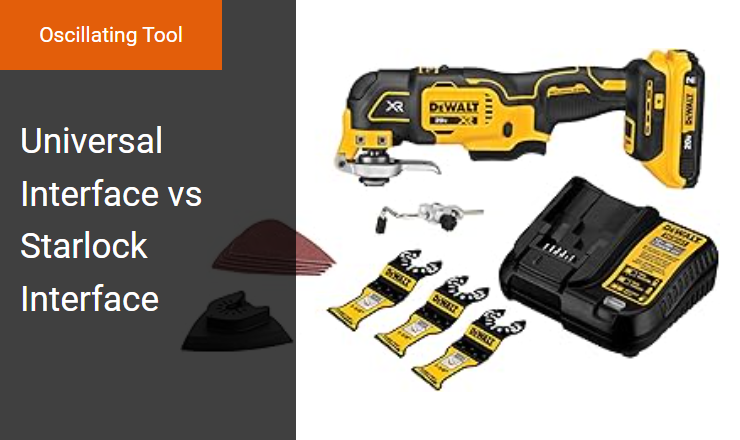
Many tradespeople and DIY enthusiasts regularly struggle with oscillating tool blade slippage and lost power mid-cut, a frustrating issue that compromises both precision and productivity. Traditionally, operators rely on standard, flat OIS (Oscillating Interface System) adapters as their baseline mounting solution to bridge compatibility gaps. However, upgrading to a high-efficiency interface grants users maximum torque transfer, faster cutting speeds, and significantly reduced tool wear.
To manage expectations, we must stipulate that accessory compatibility and lock-in limitations vary greatly depending on your specific tool brand and power class. Industry leaders like Bosch and Fein demonstrated this when they engineered the rigid, three-dimensional Starlock system to overcome traditional flat-mount limitations.
Below, we will analyze the mechanical differences between Universal and Starlock interfaces, compare their torque transmission efficiencies, and guide you toward the optimal mounting system for your daily application needs.
| Factor | Summary |
|---|---|
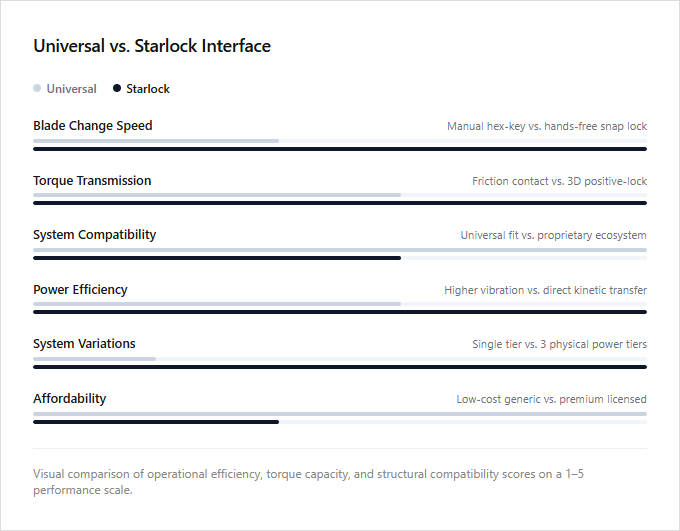
| Blade Change Mechanism | The Universal interface typically requires a hex key or manual tensioning lever to secure accessories, whereas the Starlock system utilizes a patented, hands-free snap-on mechanism for instantaneous accessory changes. |
| Torque Transmission | Starlock features a three-dimensional star-shaped recess that provides positive-lock engagement to eliminate slippage, while the flat Universal interface relies on friction and perimeter pins which can slip under high torque loads. |
| Compatibility | Universal blades fit a vast range of traditional multi-tool brands directly or via adapters, whereas Starlock blades are backward compatible with standard OIS machines but standard blades cannot fit onto Starlock-exclusive chucks. |
| System Variations | The Starlock ecosystem is divided into three distinct power tiers-Starlock, StarlockPlus, and StarlockMax-to match tool wattage and prevent overloading, while the Universal interface lacks integrated mechanical power-tiering. |
| Power Efficiency | The rigid, 3D seating of the Starlock interface minimizes kinetic energy loss and reduces tool vibration, whereas the flat contact profile of the Universal interface results in higher vibration and lower energy transfer efficiency. |
| Availability and Cost | Universal accessories are highly ubiquitous and cost-effective due to open manufacturing standards, while Starlock consumables are proprietary, more expensive, and manufactured primarily under Bosch or Fein licensing. |
Three-dimensional crown-shaped interface vs. flat OIS pattern
The evolution of oscillating multi-tools highlights two primary accessory mounting systems: the traditional Universal OIS (Oscillating Interface System) and the modern Starlock system. The flat OIS pattern features a circular, pin-based configuration that relies on friction and a central bolt to secure the blade, offering broad compatibility across various older tool brands.
In contrast, the Starlock interface utilizes a patented three-dimensional, crown-shaped design. This recessed, snap-in geometry creates a highly secure, positive-lock connection that eliminates play and maximizes torque transfer from the motor to the workpiece. Flat OIS interfaces are ideal for casual DIY enthusiasts seeking affordable, highly compatible accessories for light household repairs, whereas the Starlock system is best suited for trade professionals who require rapid, tool-free blade changes and peak performance during demanding demolition and remodeling tasks.
Rotational play reduction and torque transmission efficiency
Oscillating multi-tools rely heavily on the connection interface between the tool and the accessory to maximize performance. The traditional Universal Interface utilizes a flat, pin-based design that can permit minor rotational play under heavy loads, which slightly reduces torque transmission efficiency and increases vibration. In contrast, the Starlock Interface features a rigid, three-dimensional star-shaped connection. This geometry creates a tight, positive lock that eliminates rotational play entirely, ensuring direct, lossless transfer of energy from the motor to the blade for faster cutting speeds.
Budget-conscious DIY enthusiasts performing occasional home maintenance benefit from the highly compatible and economical Universal Interface, while trade professionals demanding maximum power transfer, high precision, and rapid tool-free accessory changes are best served by the Starlock system.
Friction-fit clamping force vs. positive-lock mechanical connection
The universal oscillating tool interface relies on a friction-fit clamping force. Users tighten a bolt or flange to compress the accessory against the tool's flat interface, securing it through surface friction. While this design offers high compatibility with various third-party brands, it is susceptible to slippage under heavy lateral loads and requires manual tools for blade changes.
The Starlock system utilizes a three-dimensional, positive-lock mechanical connection. The star-shaped recess snaps securely into the tool, creating a rigid, slip-free union that maximizes torque transfer and allows for rapid, hands-free accessory changes. Universal interfaces suit budget-conscious DIYers prioritizing accessory flexibility, whereas Starlock is ideal for trade professionals demanding high-torque performance and efficiency on demanding jobsites.
Kinetic energy loss and harmonic vibration mitigation
The interface design of an oscillating multi-tool directly dictates its operational efficiency and user comfort. The Starlock system utilizes a three-dimensional, snap-fit connection that virtually eliminates play between the tool and the accessory. This rigid coupling prevents kinetic energy loss, ensuring maximum power transfer to the work surface while significantly dampening the harmonic vibrations that cause hand fatigue and wear on internal tool components.
Standard universal interfaces rely on flat, friction-based clamping, which can permit microscopic slippage under high loads. This slippage converts valuable kinetic energy into heat and amplifies harsh harmonic vibrations throughout the tool handle. The universal interface is best suited for budget-conscious DIYers undertaking occasional light-duty home repairs, while the Starlock system is designed for professional tradespeople requiring maximum torque, rapid blade changes, and reduced physical strain during prolonged, heavy-duty applications.
Snap-on toolless mounting system vs. manual hex-bolt tensioning
The traditional universal interface utilizes a manual hex-bolt tensioning system to secure accessories. Users must manually loosen and tighten a flange bolt using an Allen key during every blade change. While this system offers broad compatibility with budget-friendly, third-party blades, the process is slow and carries the risk of losing mounting components on active jobsites.
The patented Starlock interface features a snap-on, toolless mounting system that enables hands-free blade changes in seconds. Users press the tool head onto the accessory to lock it securely, then pull a lever for instant release. This design ensures maximum torque transfer and eliminates slippage, though it limits accessory choices to Starlock-compatible options.
Manual hex-bolt systems suit occasional DIYers prioritizing affordability and broad blade compatibility, while Starlock systems excel for trade professionals requiring rapid blade changes and heavy-duty performance.
Oscillating Interface System backward compatibility limitations
The traditional universal oscillating tool interface, featuring a pinned or open-anchor design, offers broad compatibility across legacy brands. However, its primary limitation is the inability to support modern Starlock accessories. Users with standard universal interface tools cannot mount Starlock blades without third-party adapters, which often reduce torque transfer and overall operating efficiency.
The Starlock system utilizes a rigid, three-dimensional snap-fit design to maximize power transmission. While standard Starlock blades fit some older universal tools, high-performance Starlock Plus and Starlock Max tools strictly require matching proprietary accessories, preventing the use of standard OIS blades. The universal interface is best suited for casual DIYers seeking budget-friendly, highly accessible blade options, while the Starlock system is ideal for industrial professionals requiring rapid, tool-less changes and heavy-duty performance.
Torque output capacity classification across StarlockPlus and StarlockMax tiers
The traditional universal interface relies on friction-based mechanical clamping, which often slips under high-load applications. In contrast, the Bosch-Fein Starlock system utilizes a three-dimensional, snap-in design that eliminates play and ensures complete power transfer. This interface is categorized into distinct tiers based on torque capacity to prevent under-powered tools from using high-torque accessories, featuring standard Starlock, StarlockPlus, and StarlockMax levels.
StarlockPlus is engineered for medium-to-heavy duty tasks, safely handling increased torque and accommodating larger blades. StarlockMax represents the peak of torque output capacity, built specifically for extreme, heavy-duty applications like deep plunge cuts in hardwood or masonry grinding. Universal interfaces suit DIY homeowners seeking maximum accessory compatibility for light, occasional repairs, whereas StarlockPlus and StarlockMax systems are ideal for trade professionals requiring maximum power transfer and rapid blade changes on demanding jobsites.
Leave a comment