
Selecting the wrong angle grinder accessory often leads to stalled projects, wasted overhead, and compromised job site safety-a frustrating reality for fabrication and construction professionals alike. While standard project funding sources and procurement budgets typically account for routine consumable replacements, optimizing your tool's output requires a more strategic approach. Selecting the correct high-tier accessory grants operators unmatched cutting efficiency and a drastically reduced cost-per-cut over the life of the tool.
The stipulation, however, is that these performance gains hinge entirely on matching the blade's material properties to your specific substrate. For instance, utilizing a diamond blade to slice through reinforced concrete delivers rapid, clean results, whereas deploying an abrasive disc on structural steel demands a completely different approach to thermal tolerance and wear.
To help you maximize your tool investment, this article compares diamond blades and abrasive discs across durability, safety, and cost-efficiency, providing a clear roadmap for your next cutting application.
| Factor | Summary |
|---|---|
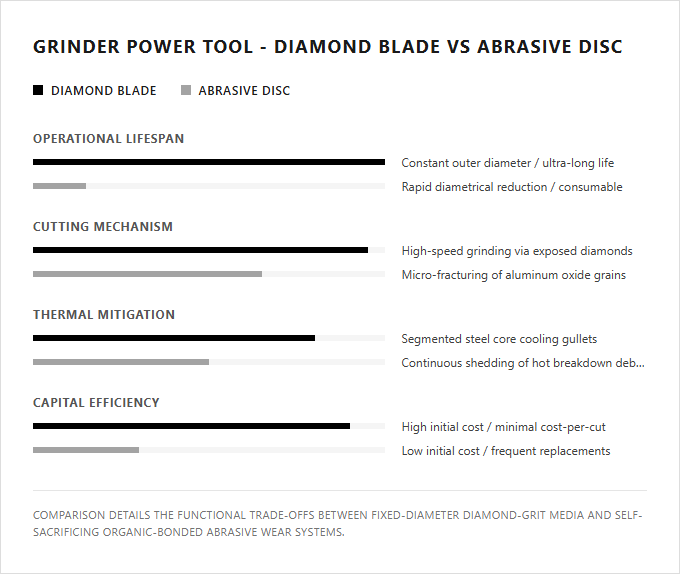
| Material Composition | Diamond blades utilize a steel core with a diamond-grit rim bonded via powder metallurgy, whereas abrasive discs consist of organic binders like resinoid mixing with fiberglass and mineral grains. |
| Cutting Mechanism | Diamond blades cut through hard masonry substrates using high-speed grinding with exposed industrial diamonds, while abrasive discs rely on the self-sharpening micro-fracturing of aluminum oxide grains to shear through metal. |
| Wear and Lifespan | Diamond blades maintain a constant outer diameter throughout their operational life, whereas consumable abrasive discs undergo rapid diametrical reduction as their binder matrix erodes during use. |
| Heat Generation | Diamond blades require segments or cooling gullets to mitigate thermal stress, whereas abrasive discs rely on the continuous shedding of hot kerf debris and the breakdown of the wheel itself to dissipate heat. |
| Cost-Efficiency | Although diamond blades require a higher initial capital expenditure, their low cost-per-cut ratio makes them highly economical compared to the frequent replacement cycles of cheaper abrasive discs. |
Steel-Core Diamond Blades vs. Fast-Wearing Resin Discs
Steel-core diamond blades maintain their original diameter throughout their operational lifespan. This structural rigidity ensures a constant cutting depth and preserves a stable peripheral speed, which maximizes cutting efficiency and reduces strain on the grinder motor during heavy-duty applications.
Resin-bonded abrasive discs experience rapid wear, continually shrinking in diameter during use. This reduction in size decreases the peripheral speed and limits the maximum depth of cut, which requires frequent disc replacements and constant adjustment of the working angle to achieve the desired results.
Heavy-duty industrial operators requiring precise, high-volume cuts benefit most from durable diamond blades, whereas occasional DIY hobbyists performing quick, varied metal repairs are better suited to economical abrasive discs.
Metal-Bonded Diamond vs. Resin-Bonded Abrasives
Diamond blades utilize a robust metal bond matrix to secure synthetic diamond grit. This engineering delivers exceptional durability and a consistent cutting depth, as the metal matrix slowly erodes to expose fresh, sharp diamond edges. These blades excel at cutting highly abrasive materials like concrete, stone, and masonry without losing their diameter over time.
In contrast, standard abrasive discs employ an organic resin bond to hold aluminum oxide or silicon carbide grains. These discs wear down during operation, continually discarding dulled grains to reveal sharp cutting edges. This sacrificial design makes them highly effective for cutting metals and alloys, albeit with a shorter overall lifespan.
Heavy-duty masonry professionals requiring longevity and depth consistency will find diamond blades indispensable, whereas metal fabricators and hobbyists seeking cost-effective, adaptable cutting tools are ideal candidates for abrasive discs.
Steel Cores Prevent Wheel Bursts Better Than Fiberglass
When selecting grinding wheels, the structural integrity of the core is a critical safety consideration. Diamond blades feature a high-tensile steel core that resists bending and prevents catastrophic wheel burst under extreme RPMs. In contrast, traditional abrasive discs rely on resin and fragile fiberglass-reinforced matrices, which are highly susceptible to shattering if damaged or bound during operation.
The solid steel construction of diamond blades ensures consistent cutting geometry and high-speed stability throughout their extended operational lifespan. Conversely, abrasive discs wear down during use, reducing their cutting depth but offering a lower initial cost for disposable tasks. High-volume industrial fabricators requiring maximum safety and longevity favor diamond blades, while budget-conscious operators performing occasional light maintenance find abrasive discs sufficient.
Heat Dissipation: Segmented Blades vs. Solid Abrasive Discs
When selecting grinding accessories, thermal management is a critical factor influencing both tool longevity and operator safety. Segmented diamond blades feature engineered gullets-slots cut into the perimeter-that facilitate advanced thermal dissipation by promoting airflow and clearing debris during operation. This design prevents localized heat buildup, allowing the blade to maintain its structural integrity and cutting efficiency during prolonged use on heavy masonry.
Solid abrasive discs lack these ventilation channels, leading to high heat accumulation at the contact point. This intense thermal energy can degrade the organic bonds within the disc, increasing the risk of premature wear or fracturing under heavy loads. Segmented diamond blades are ideal for professional masonry contractors requiring sustained, heavy-duty cutting, while standard abrasive discs are best suited for budget-conscious DIYers performing quick, intermittent metal fabrication tasks.
Diamond Tooling: Lower Cost-Per-Cut Than Abrasives
When selecting grinder consumables, evaluating the total cost-per-cut ratio is essential for operational efficiency. While abrasive discs present a very low initial purchase price, they wear down rapidly, requiring frequent replacements and causing cumulative downtime. In contrast, diamond blades utilize a robust steel core and industrial diamond segments, allowing them to maintain their diameter and cutting depth throughout an extended lifespan.
This durability results in a substantially lower cost-per-cut ratio for diamond tooling, as one diamond blade routinely outlasts dozens of bonded abrasive wheels. The higher upfront investment in diamond technology yields significant long-term savings through reduced labor costs and fewer consumable purchases. High-volume industrial fabricators requiring precision and speed benefit most from diamond blades, whereas occasional DIY hobbyists performing quick, light-duty tasks are well-suited for standard abrasive discs.
Wet-Cutting Reduces Silica Dust vs. Dry-Cutting
When selecting grinding attachments for masonry and concrete, the choice between diamond blades and abrasive discs significantly impacts workplace safety. Diamond blades often support wet-cutting systems, which utilize water to suppress dust at the cutting point. This wet-cutting capability dramatically reduces exposure to hazardous respirable crystalline silica. In contrast, traditional abrasive discs are highly friable, wearing down rapidly and generating substantial dry, airborne dust during operation.
Beyond safety, diamond blades offer superior longevity and consistent cutting depth, whereas abrasive discs provide a lower initial cost but require frequent replacement. Diamond blades are ideal for professional contractors requiring long-term durability and strict OSHA silica compliance, while abrasive discs suit DIY enthusiasts or occasional users performing quick, budget-conscious cutting tasks.
Continuous Rim: Chip-Free Finish on Brittle Substrates
When selecting grinder attachments for high-precision masonry, continuous rim diamond blades offer distinct advantages. This specific geometry eliminates segment gaps, providing constant contact with the workpiece. This design ensures clean, chip-free finishes on brittle substrates such as porcelain, glass, and delicate ceramics, where edge integrity is critical.
Traditional abrasive discs are engineered for rapid stock removal but present limitations on fragile materials. As these discs wear down, they often cause kerf widening and significant burring along the cut line, which requires extensive secondary finishing to smooth out the rough edges.
Continuous rim diamond blades are ideal for professional tile installers requiring pristine, exposed edges, while rugged abrasive discs are best suited for metal fabricators performing heavy-duty demolition and rough fabrication where speed is prioritized over aesthetic precision.
Leave a comment