
Selecting the wrong grinding configuration often leads to ruined workpieces, rapid abrasive wear, and costly operational bottlenecks in the workshop. While standard bench grinders and manual files serve as the traditional baseline for workshop material removal, they lack the maneuverability required for complex geometries. Fortunately, choosing the appropriate handheld power tool grants operators the precise torque, speed, and directional access needed to execute flawless finishes.
However, achieving this level of efficiency is strictly stipulated on matching the tool's drive geometry to the specific physical constraints of the task. For instance, finishing tight internal chambers requires precise axial collet detailing, whereas heavy weld dressing demands the leverage of right-angle spindle fabrication. In this article, we will analyze the key engineering distinctions between straight grinders and angle grinders, evaluating their ergonomics, torque profiles, and optimal applications to help you make an informed tooling decision.
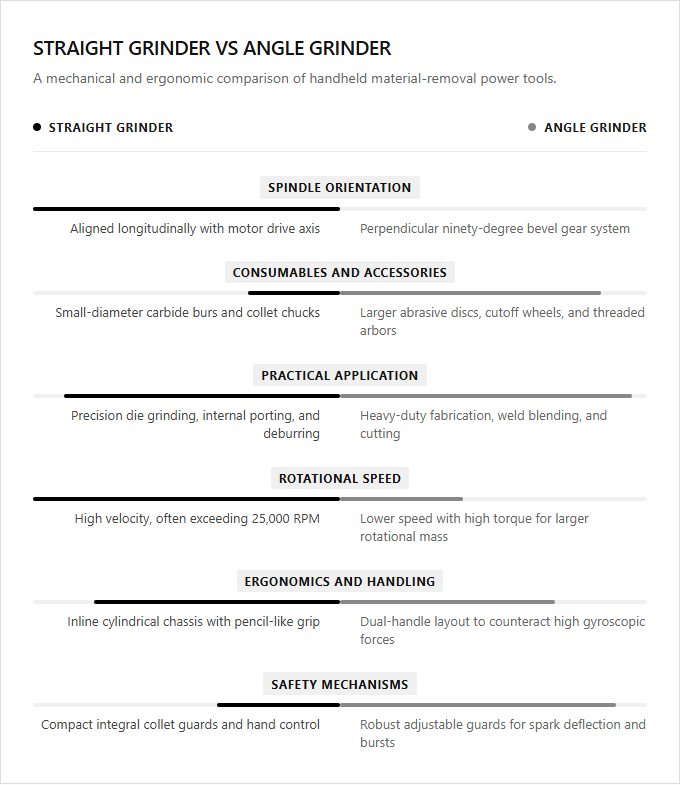
| Factor | Summary |
|---|---|
| Spindle Orientation | The straight grinder features an output shaft and collet aligned longitudinally with the motor drive axis, whereas the angle grinder utilizes a bevel gear system to orient the spindle at a perpendicular ninety-degree angle. |
| Consumables and Accessories | Straight grinders typically secure small-diameter carbide burs, mounted points, or flap wheels within a collet chuck, while angle grinders utilize a threaded arbor with flanges to mount larger abrasive grinding discs, cutoff wheels, or wire cup brushes. |
| Practical Application | Angle grinders excel at heavy-duty fabrication tasks like weld blending, surface grinding, and metal cutting, whereas straight grinders are preferred for high-precision die grinding, internal porting, and deburring in confined recesses. |
| Rotational Speed (RPM) | Straight grinders operate at much higher no-load speeds, often exceeding 25,000 RPM, to optimize the cutting velocity of small-diameter rotary files, while angle grinders run at lower RPMs with higher torque to handle the rotational mass of larger grinding wheels. |
| Ergonomics and Handling | The inline cylindrical chassis of a straight grinder allows for a pencil-like grip during delicate hand-guided operations, whereas the dual-handle configuration of an angle grinder provides the operator with maximum leverage to counteract high gyroscopic forces and torque reaction. |
| Safety Mechanisms | Angle grinders are equipped with robust, adjustable wheel guards to deflect high-velocity sparks and contain potential wheel bursts, while straight grinders rely on smaller integral collet guards and precise tool control due to the compact nature of their rotating accessories. |
Axial alignment versus right-angle bevel gear drivetrain configuration
Straight grinders utilize an axial alignment drivetrain, where the motor output shaft, spindle, and collet share a single, continuous linear path. This inline configuration allows for exceptionally high rotational speeds with minimal vibration, delivering precise, direct force along the longitudinal axis of the tool. It is highly effective for internal grinding, porting, and detailed deburring in narrow, hard-to-reach cavities.
Angle grinders employ a right-angle bevel gear drivetrain that redirects the motor's rotational power by ninety degrees. This perpendicular transmission provides superior leverage and allows for the mounting of larger grinding discs, optimizing the tool for heavy material removal and lateral surface preparation. Straight grinders are ideal for die makers and precision machinists requiring detailed internal access, while angle grinders best serve metal fabricators and construction professionals performing heavy-duty cutting, weld blending, and surface finishing.
Collet chuck shank engagement versus threaded arbor spindle mounting
Straight grinders utilize a collet chuck system to secure accessories through precise shank engagement. This design delivers exceptional concentricity and minimal runout at high rotational speeds. The collet compresses uniformly around the accessory shank, ensuring a highly stable grip that is essential for detailed, intricate work in confined spaces.
Angle grinders employ a threaded arbor spindle mounting mechanism to anchor grinding wheels and cutting discs. Accessories are threaded directly onto the spindle or clamped securely between heavy-duty flanges and a locking nut. This robust interface is engineered to withstand substantial lateral forces and high torque during aggressive material removal.
Precision machinists and mold makers benefit from the high-speed accuracy of straight grinders, while fabricators and demolition specialists require the rugged, heavy-duty capability of angle grinders.
High-RPM Burrs vs. High-Torque Flap Discs
Straight grinders, often referred to as die grinders, are engineered specifically for precision and speed. They deliver the exceptionally high-RPM thresholds necessary to drive carbide rotary burrs efficiently. This high-speed rotation allows the burr to cleanly shave metal rather than grinding it down, making these tools indispensable for detailed deburring, engraving, and intricate mold-making in confined spaces.
In contrast, angle grinders utilize a right-angle gear configuration to maximize torque output over pure rotational speed. This mechanical advantage is crucial when using flap discs, which require sustained downward pressure to blend welds and remove heavy material without stalling the motor. The broader surface area of these discs benefits significantly from this robust, torque-heavy delivery.
Fabricators and machinists requiring intricate, high-speed detail work will find the straight grinder indispensable, while heavy metalworkers and welders needing aggressive surface preparation will benefit most from the robust torque of an angle grinder.
Internal geometry profiling versus flat surface weld-prep and beveling
Straight grinders feature a spindle aligned inline with the motor shaft, making them highly effective for detailed internal geometry profiling. Their slender design allows operators to reach deep inside pipes, cylinders, and complex cavities to deburr, grind, or finish intricate internal contours with high precision.
Conversely, angle grinders position the wheel at a right angle to the motor, optimizing them for heavy-duty flat surface weld preparation and beveling. This configuration delivers superior leverage and torque, allowing for rapid material removal on flat plates and structural steel joints.
Heavy industrial fabricators requiring rapid surface prep favor the robust angle grinder, while precision machinists and tool-and-die makers rely on the agile straight grinder for detailed internal finishing.
Barrel-grip precision handling versus dual-hand auxiliary handle leverage
Straight grinders feature an inline design where the spindle aligns directly with the motor. This configuration utilizes a slender barrel-grip that allows operators to guide the tool with high precision. This design excels in detailed, single-handed control, enabling delicate grinding, deburring, and polishing in tight, restricted spaces where maneuverability is paramount.
In contrast, angle grinders employ a right-angle gear head configuration designed for dual-hand operation. By combining a rear barrel grip with an adjustable auxiliary side handle, this setup provides maximum leverage. The dual-hand grip allows operators to apply consistent downward pressure and safely manage high-torque forces during heavy-duty metal cutting and weld blending.
Detailed fabricators requiring intricate internal finishing will benefit most from the straight grinder, while construction professionals executing heavy material removal are ideally suited for the high-leverage control of the angle grinder.
Peripheral cutting contact area versus face-grinding surface contact area
Straight grinders operate utilizing the peripheral edge of the grinding accessory, creating a narrow, localized contact area. This concentrated radial contact allows for precise material removal in hard-to-reach spaces, such as internal pipe diameters and complex molds, without affecting the surrounding surfaces.
Angle grinders utilize the flat face of the grinding disc, which provides a significantly larger surface contact area. This broad contact zone distributes grinding force efficiently, making it the preferred choice for rapid material removal, surface preparation, and weld smoothing on flat metal plates.
Precision toolmakers and fabricators requiring detailed internal finishing benefit most from the straight grinder, whereas heavy-duty metalworkers and construction specialists favor the angle grinder for high-volume surface processing.
Pneumatic or electric micro-machining capability versus heavy-duty stock removal capacity
Straight grinders, powered by pneumatic or electric systems, are designed specifically for high-speed precision. Their inline configuration enables micro-machining, intricate deburring, and detailed engraving in confined spaces where control is paramount. These tools excel in fine-finishing applications that demand meticulous material removal.
Angle grinders are engineered for heavy-duty stock removal and robust cutting operations. Utilizing a right-angle gear design, they accommodate large abrasive discs to rapidly grind thick weld seams and cut structural metals. Precision-focused die-makers and detail woodworkers benefit most from the delicate maneuverability of a straight grinder, whereas industrial fabricators and demolition specialists require the high-torque capacity of an angle grinder.
Leave a comment