

For woodworkers and precision craftsmen alike, few frustrations match the sudden slip of a router bit mid-cut, or the tedious trial-and-error required to dial in an exact depth. While standard factory-default height adjusters bridge the gap for basic profiling, achieving flawless, repeatable joinery requires a more sophisticated mechanical interface.
Selecting the optimal adjustment mechanism grants operators absolute control over their tooling profile, virtually eliminating ruined workpieces. However, we must stipulate that no single adjustment style is a universal panacea; mechanical efficiency depends heavily on whether your workflow favors the micro-fine calibration seen in DeWalt's rack-and-pinion systems, or the rapid, vibration-resistant clamping of Bosch's cam lock designs.
This article will analyze both Rack and Pinion and Cam Lock systems, comparing their precision, setup speed, and long-term durability to help you choose the best depth-adjustment mechanism for your routing needs.
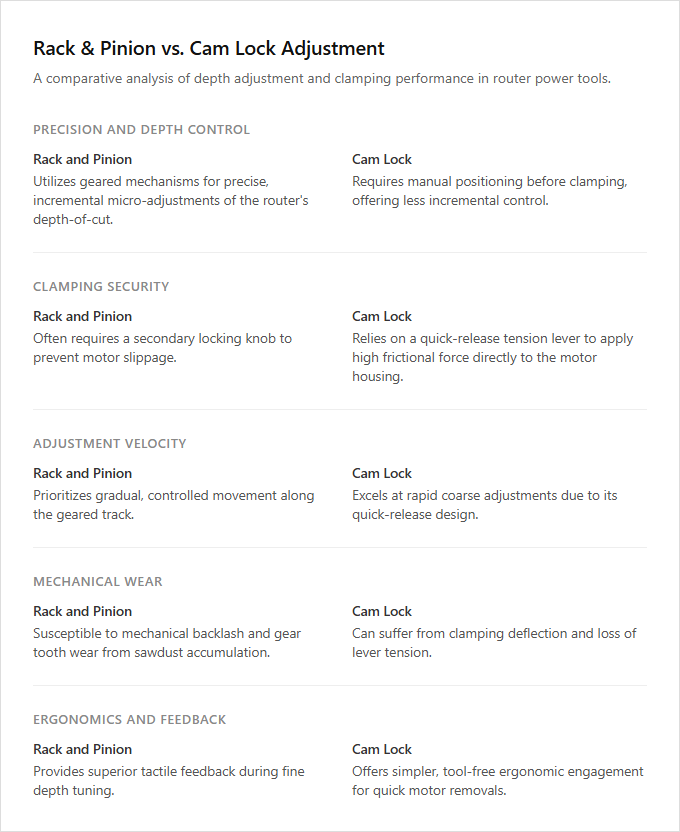
| Factor | Summary |
|---|---|
| Precision and Depth Control | Rack and pinion systems utilize geared mechanisms for precise, incremental micro-adjustments of the router's depth-of-cut, whereas cam locks require manual positioning before clamping. |
| Clamping Security | Cam lock systems rely on a quick-release tension lever to apply high frictional force directly to the motor housing, while rack and pinion setups often require a secondary locking knob to prevent motor slippage. |
| Adjustment Velocity | Cam locks excel at rapid coarse adjustments due to their quick-release design, whereas rack and pinion systems prioritize gradual, controlled movement along the geared track. |
| Mechanical Wear | Rack and pinion mechanisms are susceptible to mechanical backlash and gear tooth wear from sawdust accumulation, while cam locks can suffer from clamping deflection and loss of lever tension. |
| Ergonomics and Feedback | Rack and pinion systems provide superior tactile feedback during fine depth tuning, whereas cam locks offer simpler, tool-free ergonomic engagement for quick motor removals. |
Rack and Pinion vs. Cam Locks for Micro-Adjustments
In precision woodworking, the mechanism used to adjust router depth significantly influences both accuracy and workflow efficiency. Geared rack and pinion systems provide superior control over micro-adjustment increments compared to the binary clamping action of cam locks. The continuous physical engagement of a geared track allows operators to dial in exact depths with fluid, predictable movement. In contrast, cam lock systems rely on a friction-based release and clamp mechanism, which can cause sudden vertical shifts when disengaged.
Choosing the right interface depends heavily on the nature of your routing tasks. Rack and pinion systems are ideal for fine furniture makers requiring meticulous, incremental precision, while cam lock mechanisms suit production carpenters who prioritize rapid, repetitive setup changes over microscopic depth adjustments.
How Cam Locks Prevent Motor Slippage
When selecting a wood router, the choice between rack and pinion and cam lock adjustment systems directly impacts operational precision and stability. Rack and pinion mechanisms utilize a geared system for highly predictable, incremental height adjustments. Conversely, cam lock mechanisms rely on eccentric rotation to maximize clamping force and prevent motor slippage under heavy load, ensuring the motor housing remains perfectly stationary within the base.
While rack and pinion setups excel at fluid micro-adjustments, cam locks prioritize absolute stability against high-vibration routing. Rack and pinion systems are ideal for precision woodworkers requiring frequent, minute depth modifications, whereas cam locks suit heavy-duty contractors who prioritize rigid, slip-free performance during deep, demanding cuts.
Backlash Limits Rack and Pinion Depth Repeatability
When selecting a router, the mechanism used to adjust motor depth significantly impacts machining precision. Rack and pinion systems offer intuitive, incremental movement by engaging a geared dial with a toothed column. However, these adjustments are susceptible to mechanical backlash, where minor play between the mating gears can compromise precise depth repeatability over successive operations.
In contrast, cam lock adjustments rely on a tension-based clamping lever to secure the motor directly against the housing. While this design lacks the geared travel of a rack and pinion, it eliminates gear play to provide a positive, immovable lock once engaged. Rack and pinion systems suit high-volume workshops requiring rapid, approximate height transitions, whereas cam lock systems appeal to precision woodworkers prioritizing absolute stability and repetitive depth accuracy.
Cam Locks for Rapid Router Positioning
When selecting a router base adjustment mechanism, professionals typically choose between rack-and-pinion and cam lock systems. Cam lock mechanisms excel in operational efficiency, facilitating rapid vertical transit of the router motor within the chassis. By quickly releasing the clamping pressure, users can perform instant macro-positioning adjustments, significantly reducing downtime when transitioning between drastically different routing depths.
Conversely, rack-and-pinion systems employ a geared track to deliver precise, incremental height modifications. While cam locks prioritize speed and effortless coarse adjustments, rack-and-pinion designs offer highly predictable, slip-free calibration. High-volume workshops prioritizing rapid, repetitive setups benefit most from cam lock systems, whereas detail-oriented artisans and instrument makers prefer the meticulous depth control of rack-and-pinion mechanisms.
Wear Impacts on Depth Resolution and Holding Torque
When evaluating router adjustment mechanisms, the mechanical wear profiles of rack and pinion versus cam lock systems dictate long-term performance. In rack and pinion designs, physical wear on the pinion gear directly degrades depth resolution, introducing backlash that compromises micro-adjustments. Conversely, wear in a cam lock mechanism degrades the holding torque of the friction interface, potentially allowing the motor housing to slip under heavy axial loads.
Precision woodworkers who require frequent, highly measured height calibrations favor the incremental control of the rack and pinion, whereas production carpenters who value rapid, secure macro-adjustments prefer the cam lock system.
How Cam Locks Eliminate Axial Play
Rack and pinion systems offer intuitive, incremental height adjustments via a geared track, which simplifies rapid macro-adjustments. Cam lock systems excel in maintaining stability by securing the motor housing through uniform circumferential pressure. This specific clamping action eliminates axial play and reduces the risk of axial deflection, ensuring the cutter remains perfectly positioned under heavy loads.
The mechanical clamping of a cam lock ensures superior rigidity for critical tolerances. Rack and pinion mechanisms suit general woodworkers prioritizing fast setups, whereas cam lock systems are ideal for high-precision fabricators requiring absolute stability during heavy routing cycles.
Finer Gear Pitch Improves Depth-of-Cut Resolution
When selecting a woodworking router, the choice of depth adjustment mechanism dictates both precision and workflow efficiency. A rack and pinion system utilizes a geared track and dial for incremental calibration. Crucially, the finer the gear pitch on a rack and pinion system, the more precise the depth-of-cut resolution before locking, allowing for microscopic alignment before securing the motor housing.
Cam lock adjustments employ a quick-release lever that clamps the motor directly to the base. This design facilitates rapid macro-adjustments but lacks the granular control of geared mechanisms. Rack and pinion systems are best suited for precision furniture makers requiring meticulous joinery tolerances, while cam locks appeal to general contractors prioritizing speed and repetitive, straightforward depth changes.
Leave a comment