
Selecting the wrong pneumatic nailer can lead to split timber, structural failures, or ruined trim-costly mistakes that waste both valuable billable hours and expensive materials. To acquire these essential job-site assets, contractors typically rely on standard equipment budgets or traditional commercial tool financing lines.
Yet, choosing the precise tool for the specific task grants operators unparalleled job-site efficiency and flawless aesthetic results. As a critical stipulation, users must recognize that pneumatic power demands precise PSI calibration and dedicated compressor compatibility to prevent material damage. For example, deploying a rugged 21-degree framing nailer for heavy joist installation requires vastly different force and technique than using a delicate 18-gauge finish nailer on intricate oak casing.
Below, we break down the mechanical differences, optimal pressure settings, and cost-benefit profiles of both categories to help you select the perfect pneumatic tool for your upcoming project.
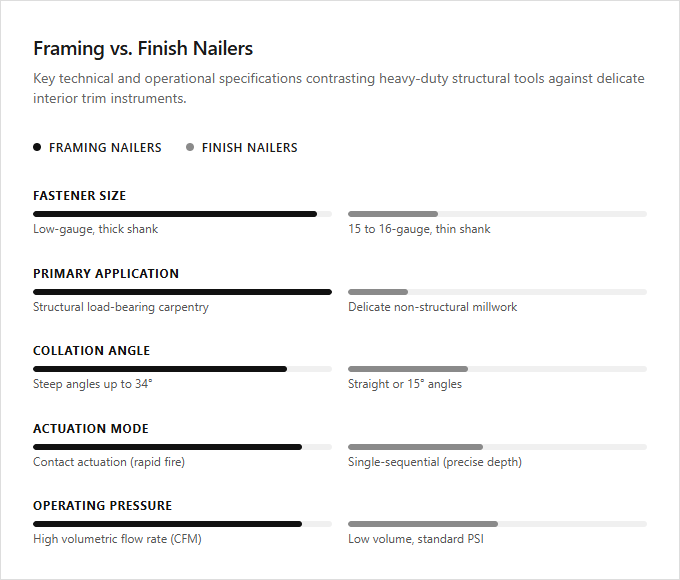
| Factor | Summary |
|---|---|
| Fastener Size | Framing nailers utilize heavy-duty, low-gauge fasteners with thick shank diameters, whereas finish nailers drive thinner 15-to-16-gauge nails designed for seamless concealment. |
| Primary Application | Framing nailers are engineered for heavy-duty structural load-bearing carpentry, while finish nailers are reserved for delicate, non-structural interior millwork and trim installation. |
| Collation Angle | Framing nailers feature steep magazine angles up to 34 degrees with paper or wire collation, whereas finish nailers typically use straight or 15-degree adhesive-collated strips for tight corner access. |
| Actuation Mode | Framing tools frequently utilize contact actuation for rapid-fire production, whereas finish tools rely on single-sequential firing mechanisms to ensure precise depth-of-drive control. |
| Operating Pressure | Framing nailers require a much higher volumetric flow rate (CFM) and pneumatic operating pressure to drive large nails into engineered lumber, while finish nailers operate efficiently at lower PSI. |
Fastener Gauges: From Framing to Finish
Framing and finish nailers serve distinct structural and aesthetic purposes, primarily defined by their fastener gauges. Framing nailers utilize heavy-gauge fasteners, typically measured by shank diameters ranging from 0.113 to 0.162 inches. These thick, robust nails provide the necessary shear strength and holding power required to secure heavy dimensional lumber in load-bearing structures.
In contrast, finish nailers deploy much thinner fasteners, typically ranging from 15-gauge down to delicate 18-gauge brads. These slender pins minimize wood splitting and leave inconspicuous holes, preserving the aesthetic appearance of trim work and detailed molding.
Heavy-duty framing nailers are designed for structural carpenters and home builders executing rough-in work, whereas precision finish nailers are essential tools for cabinetmakers and finish carpenters focused on detailed interior installations.
Angled vs. Straight Finish Nails: 21°/30° Comparison
Framing nailers utilize angled magazines, typically 21-degree plastic-collated or 30-degree paper-collated strips, to provide the necessary clearance for maneuvering into tight joists and wall studs. The steeper 30-degree angle offers superior accessibility in compact structural spaces, while the 21-degree option is widely favored for driving robust, full-round head fasteners.
In contrast, finish nailers employ straight-load magazines designed for thinner 15- or 16-gauge nails. These straight configurations prioritize precise, flush placement in delicate trim, molding, and cabinetry where heavy-duty holding power is not required.
High-angle framing nailers are ideal for structural carpenters and home builders undertaking heavy construction, whereas straight-load finish nailers are best suited for cabinetmakers and detail-oriented woodworkers focused on meticulous, blemish-free trim installation.
Rapid Contact vs. Precise Sequential Trigger Modes
Framing nailers and finish nailers serve distinct structural and aesthetic purposes, primarily differentiated by their trigger firing modes. Framing nailers typically utilize contact actuation, often called bump firing. This mode allows the operator to keep the trigger depressed and drive nails rapidly each time the safety nose contacts the work surface, maximizing speed on large-scale timber construction.
In contrast, finish nailers rely on single sequential actuation to ensure maximum placement control. This precision mechanism requires the operator to depress the safety nose before pulling the trigger for each individual shot, preventing accidental double-firing. This disciplined delivery is essential for delicate trim work where surface damage must be avoided.
High-speed contact framing nailers are ideal for production framing crews prioritizing rapid assembly, while precise sequential finish nailers are best suited for detail-oriented finish carpenters and cabinetmakers requiring flawless accuracy.
Depth-of-Drive Mechanisms: Flush vs. Countersunk Seating
Framing nailers employ robust depth-of-drive adjustments, often utilizing tool-free thumbwheels or detent steps, to handle heavy-gauge nails. This mechanism ensures fasteners seat perfectly flush with structural timber, maintaining the load-bearing integrity of studs and sheathing without over-penetrating and weakening the wood fibers.
Finish nailers feature highly sensitive, precise depth adjustment dials engineered for delicate, visible trim work. This allows the tool to reliably countersink smaller brads slightly below the wood surface, leaving a clean recess for seamless filling and painting. Heavy-duty framing nailers are indispensable for structural carpenters requiring rapid, flush fastening, while precise finish nailers are the ideal tool for cabinet makers and trim installers demanding flawless aesthetics.
Nail Heads: Structural Round vs. Concealable Brads
Framing nailers are engineered for heavy-duty structural applications, utilizing nails with prominent, full round heads. These robust heads provide maximum holding power and shear resistance, ensuring that load-bearing wooden components remain securely anchored under immense stress. Building codes often mandate this specific fastener configuration to guarantee long-term structural integrity in residential and commercial construction.
In contrast, finish nailers employ slender, lost-head brads designed for aesthetic precision. These fasteners feature minimal heads that easily countersink below the wood surface, leaving a tiny footprint that can be seamlessly filled and painted. This design prevents splitting in delicate trim, molding, and cabinetry where a flawless visual appearance is paramount.
Framing nailers are indispensable for professional contractors and builders erecting structural frameworks, while finish nailers are the preferred choice for cabinetmakers and DIY enthusiasts focused on detailed interior trim work.
Nosepiece with Aggressive Teeth and No-Mar Pads
The distinction between framing and finish nailers lies in their nosepiece design, which dictates how the tool interacts with the wood. Framing nailers feature an aggressive nosepiece with sharp metal teeth designed to bite into dimensional lumber. This ensures the tool remains stable and slip-resistant during high-angle toenailing in rough construction environments.
In contrast, finish nailers employ a flat nosepiece equipped with a soft, rubber "no-mar" pad. This protective barrier prevents the tool from denting or scratching delicate trim, molding, and cabinetry during final assembly. Structural framers rely on the aggressive grip of framing nailers, while finish carpenters and cabinetmakers require the surface-protecting precision of finish nailers.
Pneumatic Power: CFM vs. PSI Requirements
Framing nailers require substantial pneumatic power to drive large fasteners into dense engineered lumber. These heavy-duty tools typically operate at pressures between 100 and 120 PSI and demand a high continuous volume of air, often requiring 2.5 to 4 CFM (Cubic Feet per Minute). This substantial CFM requirement means they must be paired with larger air compressors with generous tank capacities to prevent pressure drops during rapid, consecutive firing.
Finish nailers operate efficiently on much lower pneumatic resources. They generally require between 70 and 120 PSI but consume a minimal air volume of only 0.5 to 1.5 CFM, allowing them to run effectively on small, highly portable pancake compressors. Robust framing nailers are ideal for professional framing contractors building structural skeletons, while precise finish nailers are best suited for finish carpenters and cabinetmakers performing detailed trim work.
Leave a comment