
For woodworkers, few frustrations compare to watching hours of meticulous prep work ruin in a split second because a fastener split a delicate piece of trim or failed to secure a structural joint.
While traditional fastening investments-such as standard wood glues, clamps, and manual hammer-and-nail sets-remain baseline essentials in any workshop, they often fall short in speed and precision for complex cabinetry or casing installations.
Upgrading to a dedicated pneumatic or cordless nailer grants you the ability to achieve clean, professional-grade joints with minimal surface damage and unmatched efficiency.
However, we must stipulate that no single tool is a universal solution; success depends entirely on matching the nail gauge to your material density, such as utilizing an 18-gauge brad nailer on delicate MDF trim versus a 16-gauge finish nailer on heavy oak casings.
This guide will analyze the key differences between 16-gauge and 18-gauge nailers, comparing their holding power, aesthetic footprints, and ideal applications to help you make the right choice for your next project.
| Factor | Summary |
|---|---|
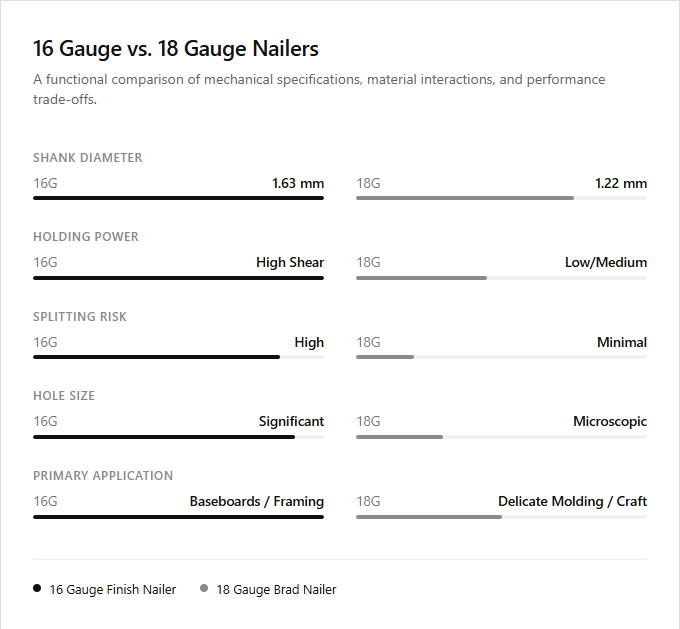
| Shank Diameter | The 16-gauge finish nail features a thicker shank diameter of approximately 1.63 mm, whereas the thinner 18-gauge brad nail measures only 1.22 mm. |
| Holding Power | Due to their larger cross-sectional area, 16-gauge fasteners provide significantly higher shear strength and mechanical holding power than 18-gauge brad nails. |
| Splitting Risk | The thin profile of an 18-gauge brad nailer minimizes the risk of splitting delicate, narrow-profile wood moldings, which can easily fracture under the driving force of a larger 16-gauge nail. |
| Hole Size and Aesthetics | An 18-gauge brad leaves a microscopic entry wound that requires minimal wood putty, while a 16-gauge nail leaves a prominent indentation that requires extensive countersinking and wood filler before painting. |
| Primary Applications | The 16-gauge nailer is designed for heavy-duty trim installations like baseboards and door jambs, whereas the 18-gauge nailer is specialized for delicate cabinetry, crown molding, and intricate craft assembly. |
16-Gauge vs. 18-Gauge Nail Diameter Comparison
When selecting a finish nailer, understanding the physical distinctions between gauge sizes is essential for ensuring structural integrity. The primary difference lies in the thickness of the fasteners. Specifically, 16-gauge nails feature a 0.0625-inch wire diameter for high shear strength, making them highly resistant to bending under stress. In contrast, 18-gauge brad nails utilize a slimmer 0.0475-inch wire diameter, which leaves a significantly smaller footprint and reduces the risk of splitting delicate wood species.
The choice between these two power tools depends entirely on the mechanical demands of the project. Heavy-duty carpenters installing thick door jambs, baseboards, and exterior trim will benefit most from the robust holding power of the 16-gauge model, whereas furniture makers and DIY hobbyists focused on delicate trim work and fine detailing will find the precision of the 18-gauge nailer more suitable.
Why 18-Gauge Brad Nailers Prevent Thin Wood Splitting
When selecting between a 16-gauge finish nailer and an 18-gauge brad nailer, material thickness is the primary deciding factor. The thinner profile of an 18-gauge brad nail allows it to penetrate delicate wood workpieces with minimal displacement. This characteristic offers superior splitting resistance in thin or fragile wood trims, where the thicker 16-gauge finish nail would likely fracture the wood fibers.
While the 18-gauge excels in delicate tasks, the 16-gauge finish nailer provides significantly stronger holding power. The thicker shank of the 16-gauge nail is essential for securing heavier trim, door casings, and baseboards to structural framing. Cabinetmakers and detail installers benefit most from the precision of the 18-gauge nailer, whereas general carpenters and remodelers requiring structural hold will find the 16-gauge model indispensable.
16-Gauge vs. 18-Gauge: Holding Power vs. Positioning
Selecting the correct pneumatic nailer depends on the structural demands of your woodworking project. A 16-gauge finish nailer utilizes thicker fasteners that provide maximum holding power, making them indispensable for securing heavy interior trim, door casings, and baseboards where mechanical strength is paramount.
In contrast, an 18-gauge brad nailer fires thinner wire fasteners designed for delicate applications. These smaller nails leave virtually invisible entry holes and act primarily as temporary positioning pins to hold joint components securely in place while the primary wood adhesive cures.
Professional trim carpenters and structural installers require the robust holding power of the 16-gauge system, whereas fine woodworkers and cabinet makers will find the precision of the 18-gauge tool indispensable for detail work.
Why 16-Gauge Nails Leave Larger Holes Than Brads
When selecting between a 16-gauge finish nailer and an 18-gauge brad nailer, the primary technical distinction lies in the fastener head profile and its impact on the wood surface. The T-shaped fastener head profile of 16-gauge nails requires deep countersinking, leaving a larger hole than the rectangular head of 18-gauge brads. This difference in penetration profile directly influences the amount of post-installation wood filling and sanding required for a pristine finish.
The structural holding power also varies significantly between these two gauges. Professional carpenters undertaking heavy trim installations require the robust holding power of the 16-gauge, whereas furniture makers and hobbyists working with delicate, detailed trim are better served by the clean, low-impact finish of the 18-gauge.
Angled 16-Gauge Nailers Offer Superior Corner Clearance
When selecting between 16-gauge and 18-gauge nailers, understanding their design differences is essential for precise execution. A key distinction lies in maneuverability; 16-gauge angled finish nailers utilize angled collation to improve tight-corner clearance, which is uncommon in straight-collation 18-gauge brad nailers. This physical configuration allows the 16-gauge tool to access recessed joints and crown molding corners with greater ease than its straight-collated counterpart.
While the thicker 16-gauge nails provide robust holding power for heavy trim, the thinner 18-gauge brads prevent splitting in delicate wood surfaces. Professional contractors installing heavy casing and baseboards will find the 16-gauge indispensable, whereas finish woodworkers and DIYers focusing on intricate cabinetry are ideally suited for the 18-gauge.
16-Gauge vs. 18-Gauge Nailer Blade Footprints
Choosing between a 16-gauge and an 18-gauge pneumatic nailer often depends on the visible impact left on the material. Because the 16-gauge nailer utilizes a thicker fastener, it requires a wider driver blade to strike and countersink the nail. This wider driver blade creates a larger footprint on the wood surface than an 18-gauge driver blade, leaving a noticeable indentation that requires extra filling and sanding before finishing.
The 18-gauge nailer features a much narrower driver blade, resulting in a smaller entry hole and minimal surface disruption. Professional carpenters installing heavy baseboards and door jambs benefit most from the robust holding power of the 16-gauge model, while detailed finish carpenters and hobbyists working on delicate cabinetry will find the precise, low-impact 18-gauge more appropriate.
Structural 16-Gauge Nails vs. Delicate 18-Gauge Brads
Choosing between a 16-gauge and an 18-gauge nailer depends on the structural demands of the project. The 16-gauge nailer utilizes thicker fasteners that provide substantial holding power. These robust nails penetrate thick structural substrates securely, ensuring long-term stability in framing, heavy casing, and exterior trim installations.
The 18-gauge brad nailer is engineered for precision and minimal wood splitting. These thinner 18-gauge brads are limited to low-density, delicate trim profiles, leaving virtually invisible holes. They excel in detailed woodwork, cabinetry, and thin paneling where preserving the material is paramount.
Heavy-duty contractors and framing professionals will benefit most from the robust holding power of the 16-gauge model, while finish carpenters and hobbyists focusing on intricate detail work will find the 18-gauge nailer indispensable.
Leave a comment