
Selecting the ideal impact wrench often leads to costly trial and error, as professionals frequently battle either snapped fasteners or insufficient joint tightness on the job. Traditionally, buyers rely on standard baseline investments-such as battery voltage or maximum advertised static torque-to justify their equipment budgets.
However, understanding the synergy between RPM (Rotations Per Minute) and IPM (Impacts Per Minute) grants operators the critical insight needed to optimize fastening torque without risking material fatigue. It is important to stipulate, though, that high raw motor speed does not directly translate to high-impact force once fastener resistance begins.
For instance, in heavy-duty automotive chassis work or structural steel construction, balancing these two distinct metrics is what prevents stripped threads. This guide will break down the mechanical differences between IPM and RPM, clarify how they dictate real-world fastening torque, and help you select the optimal power tool for your specific trade requirements.
| Factor | Summary |
|---|---|
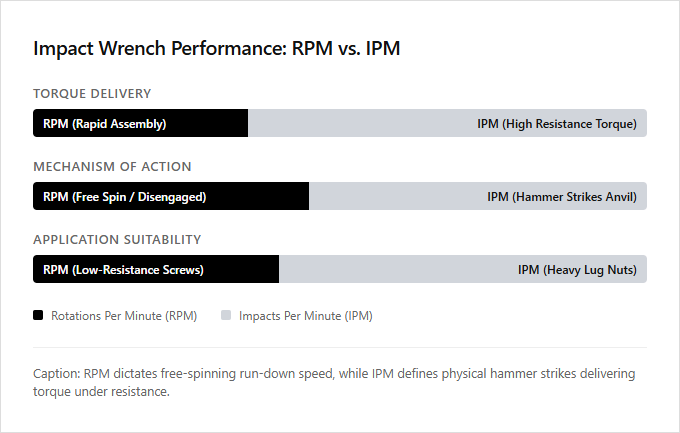
| Rotations Per Minute (RPM) | RPM measures the rotational speed of the anvil under no-load conditions, determining how quickly a fastener can be run down before resistance is met. |
| Impacts Per Minute (IPM) | IPM represents the frequency at which the internal hammer strikes the anvil, delivering the kinetic energy required to break loose stubborn bolts. |
| Torque Delivery | While high RPM facilitates rapid initial assembly, IPM is the critical driver of rotational torque output when the tool encounters high resistance. |
| Mechanism of Action | The internal spring-loaded hammer mechanism disengages to spin freely at high RPM, then re-engages to strike the anvil and generate high IPM under load. |
| Application Suitability | High RPM is ideal for fastening long, low-resistance lag screws, whereas high IPM is essential for heavy-duty fastening and lug nut removal. |
RPM Governs Free-Speed Rundown
When evaluating impact wrenches, understanding the distinction between Rotations Per Minute (RPM) and Impacts Per Minute (IPM) is critical for optimal tool selection. RPM governs the free-speed rundown velocity, determining how quickly a fastener spins before the anvil encounters resistance. High RPM values minimize the time spent on the initial, non-resistance phase of threading a bolt.
Once the fastener tightens, the mechanism engages the anvil, transitioning the tool's performance to IPM, which measures the frequency of concussive force applications. This impact action generates the high torque required to break loose or fully secure stubborn fasteners. High-RPM tools are best suited for high-volume assembly workers prioritizing speed, whereas high-IPM models are essential for heavy-duty mechanics requiring maximum fastening and loosening power.
IPM Defines Hammer Frequency for Peak Breakaway Torque
When evaluating impact wrenches, understanding the distinction between Rotations Per Minute (RPM) and Impacts Per Minute (IPM) is essential for selecting the correct tool. While RPM measures the rotational speed of the anvil under no load, IPM defines the hammering mechanism frequency responsible for generating peak breakaway torque. This concussive force deliverable by high IPM ratings is what allows the tool to break loose stubborn, rusted, or over-tightened fasteners that rotational speed alone cannot budge.
Once the initial resistance is overcome, RPM determines how quickly the fastener is spun run in or out. Balancing these two specifications ensures efficiency and prevents fastener damage during fastening or removal. High-RPM tools are best suited for high-volume assembly technicians prioritizing speed, while high-IPM models are critical for heavy-equipment mechanics and industrial millwrights dealing with seized, high-torque bolts.
High RPM Speeds Up Initial Thread Engagement
When selecting an impact wrench, understanding the distinction between Rotations Per Minute (RPM) and Impacts Per Minute (IPM) is essential for operational efficiency. RPM measures the free-spinning speed of the tool's anvil before resistance is met. High RPM minimizes cycle time during the initial thread engagement phase, allowing fasteners to run down rapidly before the hammer mechanism engages.
Once resistance is encountered, the tool transitions to its impacting phase, measured in IPM, which defines how many times the internal hammer strikes the anvil to deliver torque. High-RPM models suit assembly technicians prioritizing high-volume speed, while high-IPM models are ideal for heavy-duty mechanics requiring the raw power necessary to break stubborn, rusted bolts.
How Twin-Hammer Clutches Maximize Impact Energy
When selecting an impact wrench, understanding the distinction between Rotational Speed (RPM) and Impacts Per Minute (IPM) is critical. While RPM dictates the free-spin speed of the anvil for rapid threading, IPM measures the frequency of the internal hammer strikes under load. Twin-hammer clutches specifically leverage high IPM to maximize kinetic energy transfer per blow. By delivering two balanced, rapid impacts per rotation, this mechanism delivers exceptional torque output and superior power-to-weight ratios.
High-RPM models prioritize rapid fastening, whereas high-IPM twin-hammer configurations focus on breaking loose stubborn joints. High-RPM wrenches are ideal for assembly line operators requiring rapid cycle times on clean threads, while high-IPM twin-hammer tools are best suited for heavy-duty automotive mechanics and industrial technicians tackling seized fasteners.
Excessive IPM to RPM Ratio Causes Fastener Fatigue
When operating an impact wrench, understanding the relationship between Rotations Per Minute (RPM) and Impacts Per Minute (IPM) is critical for joint integrity. RPM dictates the rotational speed of the anvil under no load, while IPM measures the frequency of the concussive blows delivered by the internal hammer mechanism. An imbalance where there is excessive IPM relative to a lower RPM can be highly destructive to the fastening assembly. This rapid, repetitive hammering without sufficient rotational progression induces severe fastener fatigue and can quickly exceed the material's yield strength, resulting in plastic deformation or immediate shear failure.
Engineers and technicians must carefully calibrate these specifications to the specific tensile limits of their hardware. High-RPM models are best suited for assembly line operators requiring rapid thread engagement, while high-IPM units are ideal for heavy-duty mechanics who need maximum concussive force to break loose seized or rusted fasteners.
Brushless Motors Adjust RPM to Prevent Thread Stripping
In impact wrenches, Rotations Per Minute (RPM) measures the rotational speed of the anvil, while Impacts Per Minute (IPM) defines the frequency of the internal hammer striking the anvil to deliver torque. Modern impact wrenches leverage brushless DC motors to manage these forces intelligently. These motors utilize electronic feedback loops to dynamically adjust the RPM under load, throttling down rotation as resistance increases to prevent over-torqueing and thread stripping.
This closed-loop regulation ensures that high-impact force is applied only when necessary, preserving fastener integrity during delicate fastening tasks. Precision-oriented assembly technicians benefit most from electronically regulated RPM control, while heavy-duty fleet mechanics require maximum IPM thresholds for high-torque applications.
Anvil Torsional Deflection Reduces Clamping Force
An impact wrench relies on Rotations Per Minute (RPM) to drive fasteners quickly, and Impacts Per Minute (IPM) to deliver the necessary torque through rapid hammer strikes. When using anvil extensions, torsional deflection occurs within the extended metal shaft. The steel twists slightly with each impact, absorbing and dissipating the vital IPM energy before it reaches the fastener, which significantly reduces the final clamping force.
Choosing the correct tool configuration depends entirely on the operational requirements of the project. High-RPM setups are ideal for high-speed assembly technicians prioritizing rapid rundown, whereas high-IPM direct-drive configurations are suited for heavy industrial millwrights requiring maximum torque delivery without energy loss.
Leave a comment