
Every assembly technician and DIY enthusiast has faced the frustration of stripped screw heads, cracked workpieces, or loose fasteners caused by inconsistent driver force. To solve this, professionals historically relied on standard utility drills or manual hand-tightening to gauge tension by feel.
However, modern precision demands specialized power screwdrivers, which grant operators exact control over fastening forces to eliminate human error. Importantly, achieving this level of accuracy requires the stipulation that torque needs vary wildly depending on the material density and fastener type. For instance, fastening delicate circuit boards in electronics assembly requires a vastly different mechanism than driving heavy-duty screws into hardwood cabinetry.
This article examines the critical differences between adjustable clutch and fixed torque power screwdrivers, helping you select the optimal mechanism for your specific assembly needs.
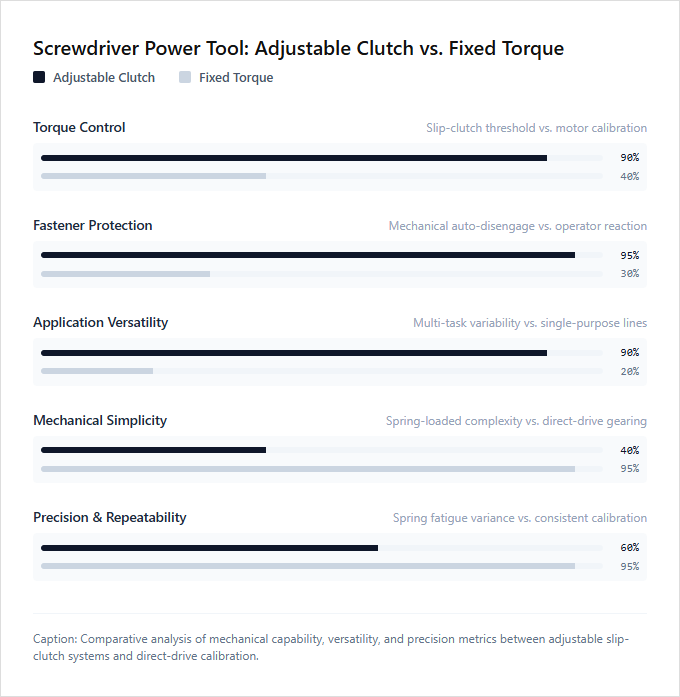
| Factor | Summary |
|---|---|
| Torque Control | Adjustable clutch systems allow operators to pre-set threshold limits using a slip-clutch mechanism, whereas fixed torque tools deliver a constant output determined solely by motor calibration. |
| Fastener Protection | An adjustable clutch disengages the drive shaft to prevent thread stripping, while fixed torque drivers rely on operator reaction to prevent over-tightening. |
| Application Versatility | Tools with adjustable clutches accommodate a wide range of fastening tasks requiring variable torque ratings, whereas fixed torque screwdrivers are dedicated to highly specific assembly line applications. |
| Mechanical Complexity | Adjustable clutches utilize a spring-loaded ball-detent system to regulate power transmission, while fixed torque tools feature simplified direct-drive gearing. |
| Precision and Repeatability | Fixed torque drivers offer superior repeatability by eliminating the mechanical drift associated with spring fatigue in adjustable clutch mechanisms. |
Slip clutch mechanism versatility for varying torque repeatability demands
In precision assembly, selecting between an adjustable clutch and a fixed torque power screwdriver depends on your specific repeatability requirements. Screwdrivers featuring an adjustable slip clutch offer exceptional application versatility. The internal slip clutch mechanism mechanically disengages the motor drive once the tool reaches a pre-set limit, preventing over-tightening and material damage across varying joint types. Fixed torque tools deliver a single, locked-in torque value, ensuring absolute consistency and eliminating the risk of unauthorized operator tampering during standardized production.
Adjustable clutch models are ideal for versatile technicians and field service engineers handling diverse, multi-material fastening tasks, while fixed torque tools are best suited for high-volume assembly line operators performing highly repetitive, single-specification installations.
Tamper-proof preset torque values preventing unauthorized calibration shifts
Industrial assembly environments require a careful choice between adjustable clutch and fixed torque power screwdrivers. Adjustable clutch tools offer external versatility, allowing operators to manually select various torque levels for diverse fastening tasks. In contrast, fixed torque screwdrivers utilize internal, tamper-proof preset torque values designed to prevent unauthorized calibration shifts, ensuring strict adherence to engineering specifications and eliminating operator tampering on the production floor.
By restricting access to torque adjustments, fixed torque models maintain critical quality standards across high-volume production runs. Adjustable clutch screwdrivers are ideal for maintenance technicians and field service engineers requiring multi-application versatility, while fixed torque tools are best suited for dedicated assembly line operators performing highly repetitive, standardized fastening tasks.
Multi-stage torque resolution adjustments for diverse joint specifications
In precision manufacturing, selecting between adjustable clutch and fixed torque power screwdrivers depends on the specific joint requirements. Adjustable clutch tools feature multi-stage torque resolution, allowing operators to fine-tune torque limits across a broad spectrum of fastening profiles. This precise incremental adjustment prevents stripping, over-tightening, and material deformation when dealing with diverse joint specifications and varying material densities.
In contrast, fixed torque screwdrivers deliver a pre-set, unyielding torque level to ensure absolute repeatability in uniform applications. While adjustable clutch screwdrivers are highly suited for service technicians and R&D personnel working with diverse, fragile materials, fixed torque models are best utilized by high-volume assembly line operators performing repetitive, single-specification fastening tasks.
Automatic shut-off clutch integration to eliminate inertia-induced over-tightening
Fixed torque screwdrivers deliver a continuous stream of rotational force, which often results in inertia-induced over-tightening and stripped threads once a fastener bottoms out. To mitigate this risk, adjustable clutch systems allow operators to pre-determine specific torque thresholds. Precision-engineered tools integrate an automatic shut-off clutch mechanism that instantly disengages the motor drive the millisecond the target torque is reached, completely neutralizing kinetic inertia.
This immediate mechanical decoupling ensures absolute joint integrity and prevents damage to sensitive materials. While rugged fixed torque models are best suited for construction workers handling heavy-duty framing applications, adjustable shut-off clutch drivers are essential for electronics technicians requiring extreme precision and damage prevention.
Calibration drift mitigation in mechanical spring-loaded adjustment systems
In precision assembly, selecting between adjustable clutch and fixed torque screwdrivers depends on how each system mitigates calibration drift. Adjustable systems rely on mechanical spring-loaded clutches, where repeated compression can cause spring fatigue and shift the torque threshold. To counteract this drift, premium adjustable tools incorporate positive-lock rings and pre-stressed alloy springs to maintain tension integrity over extensive cycles.
Fixed torque tools mitigate drift by eliminating the adjustment mechanism entirely, utilizing a sealed internal spring preset to a specific value. This configuration minimizes vibrational wear and prevents unauthorized tampering, securing superior long-term repeatability. Adjustable clutch models are ideal for versatile field technicians managing varied fastening specifications, whereas fixed torque tools best serve high-volume assembly line operators requiring foolproof, single-specification consistency.
Transducer-controlled feedback compatibility for high-precision assembly lines
In high-precision assembly lines, the choice between adjustable clutch and fixed torque fastening systems hinges on calibration stability and sensor integration. Fixed torque tools offer seamless compatibility with transducer-controlled feedback systems. Because they lack mechanical slip components, the transducer directly and accurately measures the reaction torque, delivering precise, real-time data for quality tracking. Conversely, mechanical adjustable clutches rely on spring-tension disengagement, which introduces physical variance that can distort high-frequency transducer readings.
Transducerized fixed torque tools ensure superior digital traceability and torque-angle monitoring for safety-critical joints. Fixed torque systems are ideal for aerospace and automotive engineers requiring strict, data-logged quality control, whereas adjustable clutch tools are best suited for general assembly technicians prioritizing rapid, mechanical torque repeatability without data integration.
Joint Rate Dynamics: Hard vs. Soft Configurations
In fastening technology, the choice between adjustable clutch and fixed torque power screwdrivers depends heavily on joint rate dynamics. Hard joints, which experience an abrupt torque spike upon seating, demand the rapid mechanical disengagement provided by an adjustable clutch to prevent component damage. In contrast, soft joints build torque gradually over multiple rotations. Fixed torque tools, often utilizing electronic current monitoring, excel in these soft configurations by delivering consistent energy transfer without the mechanical wear associated with a slipping clutch.
Adjustable clutch models are suited for manual assembly operators requiring versatile torque control across diverse materials, while fixed torque systems are ideal for automated integration specialists seeking high-repeatability in standardized production lines.
Leave a comment