
Few things derail a project faster than a screwdriver bit slipping under load, stripping the fastener and stalling your momentum. For trade professionals and serious DIYers alike, achieving slip-free, efficient torque transfer is a constant job-site challenge.
While standard multi-purpose drill/drivers and traditional keyed chucks have long been the default solutions for general fastening, maximizing your tool's efficiency requires a more tailored approach. Selecting the optimal bit-to-tool interface grants you seamless power transfer and significantly reduces wear on your expensive driver bits.
However, it is important to stipulate that no single holder is universally superior; your choice must align with your specific application. For instance, driving heavy-duty structural lag screws demands a vastly different gripping mechanism than drilling clean pilot holes with smooth-shank bits.
Below, we will demystify the mechanical differences between hex collets and keyless chucks, analyze their torque-handling capabilities, and guide you toward the right bit holder for your power screwdriver needs.
| Factor | Summary |
|---|---|
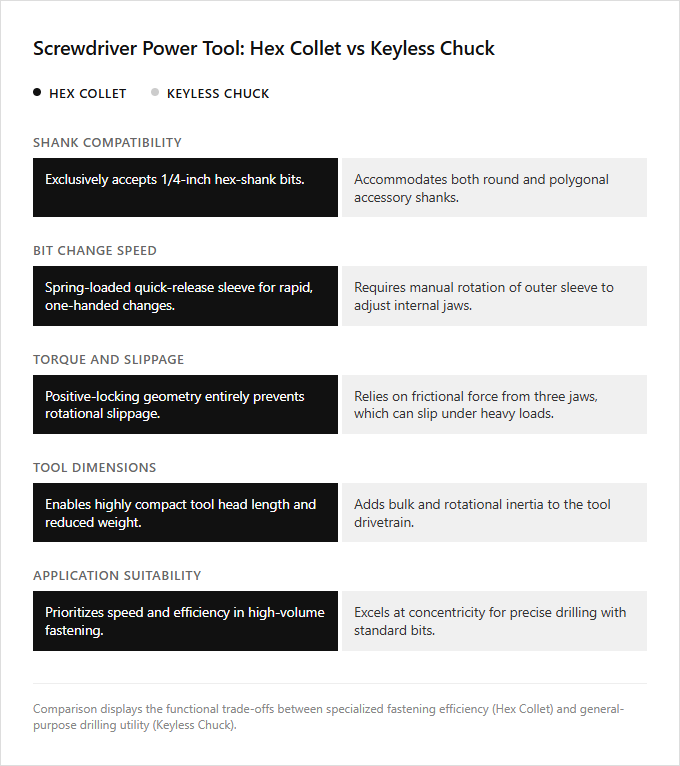
| Shank Compatibility | While a hex collet exclusively accepts 1/4-inch hex-shank bits, a keyless chuck offers greater versatility by accommodating both round and polygonal accessory shanks. |
| Bit Change Speed | Hex collets utilize a spring-loaded quick-release sleeve for rapid, one-handed accessory changes, whereas keyless chucks require manual rotation of the outer sleeve to contract or expand the internal jaws. |
| Torque and Slippage | The positive-locking geometry of a hex collet entirely prevents rotational slippage under high torque, whereas keyless chucks rely on frictional force from a three-jaw mechanism which can slip under heavy loads. |
| Tool Dimensions | Hex collets enable a highly compact tool head length and reduced front-end weight, while keyless chucks add bulk and rotational inertia to the tool's drivetrain. |
| Application Suitability | Keyless chucks excel at concentricity for precise drilling with standard bits, whereas hex collets prioritize speed and efficiency in high-volume fastening applications. |
Hex Collets: Preventing High-Torque Rotational Slip
When selecting a power screwdriver, understanding the mechanism of the tool holder is critical for operational efficiency. Hex collets utilize a mechanical interlock to prevent rotational slip under high torque loads. This design locks the six-sided shank of the bit directly into the receiver, ensuring positive engagement that cannot slip under extreme resistance, making it highly efficient for heavy-duty driving tasks.
In contrast, keyless chucks rely on frictional force applied by adjustable jaws to grip various shank shapes. While this offers versatility for different bit types, it remains more susceptible to slippage under high-demand applications. Hex collets are ideal for high-volume trade professionals requiring rapid bit changes and maximum torque, whereas keyless chucks are best suited for general contractors and DIY enthusiasts who value versatility across diverse drilling and driving tasks.
Frictional Slip in Keyless Chucks
When selecting a power screwdriver, the spindle mechanism significantly influences performance. Keyless chucks utilize adjustable jaws that rely entirely on radial clamping force to grip smooth, round bits. Under high torque, this frictional hold can fail, resulting in rotational slip and reduced efficiency. Conversely, hex collets physically lock onto the flat sides of a hex shank, entirely eliminating slippage under load.
The choice between these mechanisms depends on your specific application requirements. High-torque fastening professionals requiring maximum security and rapid bit changes benefit most from hex collets, whereas general maintenance workers who need a single tool to accept various round drill and driver bits are better suited for keyless chucks.
Hex collets are restricted to standard quarter-inch hex shank geometry.
When selecting a power screwdriver, the choice between a hex collet and a keyless chuck determines accessory compatibility. A hex collet is engineered for rapid bit changes, but it is strictly restricted to standard quarter-inch hex shank geometry. This specialized design cannot accommodate round-shank drill bits, limiting the tool to driving tasks that utilize compatible hex-shank accessories.
A keyless chuck offers greater versatility by utilizing adjustable jaws that grip various shank sizes and shapes. While bit changes take slightly longer, this system supports a broader range of drilling and driving applications. High-volume assembly technicians requiring rapid, repetitive fastening benefit most from the streamlined hex collet, whereas general renovators who frequently switch between drilling and driving prefer the adaptable keyless chuck.
Three-jaw keyless chucks provide superior concentricity and minimize axial runout.
When selecting a power screwdriver, the choice between a hex collet and a keyless chuck significantly impacts tool performance. Three-jaw keyless chucks excel in precision applications. By gripping the accessory continuously along three distinct points, these chucks provide superior concentricity and minimize axial runout, ensuring the bit rotates on a true axis with minimal wobble.
Conversely, hex collets utilize a quick-release mechanism designed exclusively for standard quarter-inch hex-shank bits. While hex collets offer rapid, one-handed bit changes, they inherently allow more physical play. Professionals requiring high-precision drilling and versatile accessory compatibility benefit most from keyless chucks, whereas high-volume assembly technicians prioritizing speed and repetitive driving are ideal candidates for hex collets.
Quick-Release Hex Collets for Rapid Bit Changes
When selecting a screwdriver power tool, the choice between a hex collet and a keyless chuck significantly impacts operational efficiency. Hex collets are engineered specifically for high-speed driving tasks, featuring a quick-release sleeve mechanism that enables rapid, one-handed bit changeover. By simply pulling the sleeve forward, users can insert or eject standard 1/4-inch hex bits instantly, minimizing downtime during repetitive fastening applications.
Keyless chucks offer broader versatility by accepting various shank shapes, including round and hex bits, which are secured by manually rotating the outer collar. While this design accommodates a wider range of drilling and driving accessories, it lacks the specialized speed of the collet system. Production-line installers and cabinet makers prioritize the fast-paced hex collet, while general maintenance technicians and hobbyists favor the versatile keyless chuck for multi-material projects.
The flat-to-flat contact in hex collets maximizes torque transfer efficiency.
When selecting a power screwdriver, understanding the mechanism of bit engagement is crucial for optimal tool performance. Hex collets utilize a precise flat-to-flat contact system that perfectly matches the six-sided shank of standard screwdriver bits. This design eliminates slippage under high loads, maximizing torque transfer efficiency from the motor directly to the fastener and preventing damage to the bit.
In contrast, keyless chucks rely on three compressing jaws to grip various shank shapes. While versatile, they are more prone to slipping under heavy rotational resistance. Professionals requiring rapid bit changes and high-torque driving benefit most from hex collets, whereas general contractors and DIY enthusiasts who need to switch between drilling and driving tasks are better suited for keyless chucks.
Keyless Chuck Damage Under High Resistance
When selecting a screwdriver power tool, the choice between a hex collet and a keyless chuck directly impacts tool durability. Keyless chucks offer versatility for various shank shapes but are highly susceptible to jaw deformation and scoring under high-resistance applications. When a bit encounters heavy torque, slippage within the keyless mechanism can gall the clamp jaws, permanently compromising their gripping strength and alignment.
The hex collet utilizes a locked, six-sided mechanism that prevents rotational slippage, distributing torque evenly without wearing down the tool components. Hex collets are ideal for high-torque assembly specialists requiring speed and repeatability, whereas keyless chucks are best for general maintenance operators who frequently switch between different bit types.
Leave a comment