
Repetitive fastening tasks often lead to chronic wrist fatigue and musculoskeletal strain, a costly issue that plagues assembly line managers and manual technicians alike. Selecting the wrong tool geometry can quietly drain factory floor productivity and increase medical leave.
When upgrading assembly lines, procurement teams typically look to standard funding sources, such as capital equipment budgets or operational efficiency grants, to cover the upfront costs of new tooling. However, choosing the correct form factor grants operators immediate physical relief and unprecedented control, transforming a basic tool upgrade into a high-ROI ergonomic intervention.
As a stipulation, this comparison assumes both configurations are calibrated to equivalent torque specifications. For example, tier-one automotive manufacturers rely on specialized inline drivers on vertical assembly lines to minimize operator joint stress. Below, we will analyze the biomechanics of pistol grip versus inline screwdrivers, evaluate their ideal application environments, and outline key factors to help you choose the optimal tool for your workspace.
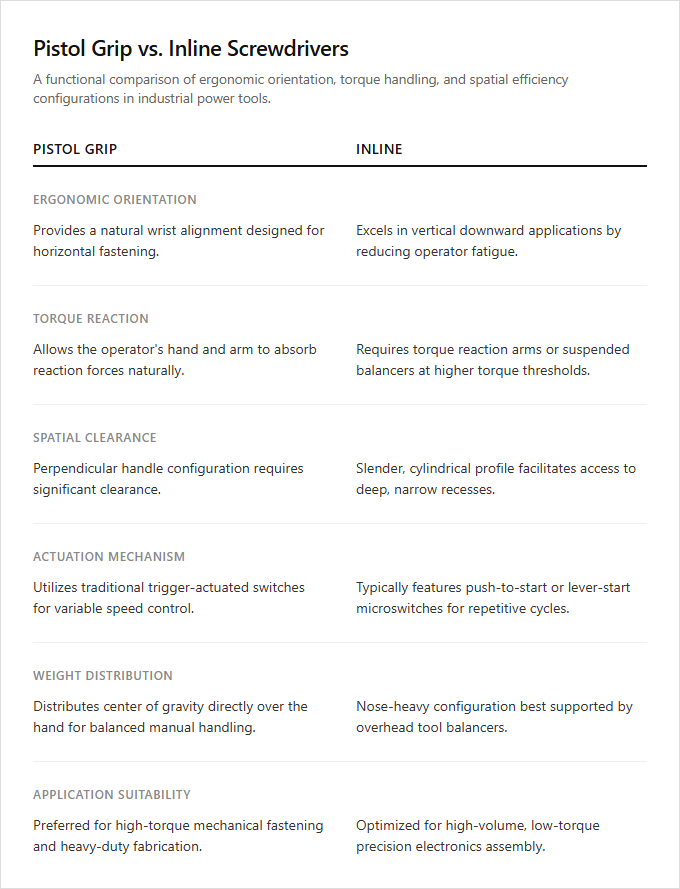
| Factor | Summary |
|---|---|
| Ergonomic Orientation | Pistol grip screwdrivers provide a natural wrist alignment for horizontal fastening, whereas inline configurations excel in vertical downward applications by reducing operator fatigue. |
| Torque Reaction | Inline tools require torque reaction arms or suspended balancers at higher torque thresholds, while the physical design of a pistol grip allows the operator's hand and arm to absorb reaction forces more naturally. |
| Spatial Clearance | The slender, cylindrical profile of inline screwdrivers facilitates access to deep, narrow recesses, whereas the perpendicular handle of pistol grip models requires significant clearance. |
| Actuation Mechanism | Inline drivers typically utilize push-to-start or lever-start microswitches to speed up repetitive cycles, whereas pistol grip models rely on traditional trigger-actuated switches for variable speed control. |
| Weight Distribution | Pistol grip tools distribute their center of gravity directly over the operator's hand for balanced handling, while inline tools are nose-heavy and best supported by overhead tool balancers. |
| Application Suitability | Inline models are optimized for high-volume, low-torque precision electronics assembly, whereas pistol grips are preferred for high-torque mechanical fastening and heavy-duty fabrication. |
Torque reaction management relative to the operator's forearm axis
When selecting industrial power screwdrivers, understanding torque reaction relative to the operator's forearm axis is critical for ergonomics. In a pistol grip configuration, the torque reaction acts perpendicular to the operator's forearm, creating a bending moment at the wrist. Inline screwdrivers align the reaction torque directly along the forearm's axis during vertical operations, converting the rotational force into a straight axial push that is easier to stabilize.
Proper tool selection depends entirely on the orientation of the fastening task. High-volume bench assembly workers performing vertical operations benefit most from inline tools, whereas technicians executing horizontal, chest-height installations are better suited to pistol grip models.
Mitigation of ulnar deviation during vertical fastening applications
Vertical fastening applications present distinct ergonomic challenges, particularly regarding wrist posture. When driving fasteners vertically downward, mitigating ulnar deviation-the harmful outward bending of the wrist toward the pinky finger-is critical for preventing long-term repetitive strain injuries and maintaining operator productivity.
Utilizing an inline screwdriver for downward vertical work allows the operator to maintain a neutral, straight wrist alignment while safely applying axial force. Conversely, a pistol-grip tool in this same downward orientation forces the wrist into significant ulnar deviation, though it remains the ergonomically superior choice for horizontal or overhead vertical-upward fastening.
High-volume electronics assemblers working on flat, low-level benches require inline tools to protect their joints, while HVAC technicians and drywall installers performing overhead work are best suited for pistol-grip models.
Axial force transmission efficiency during push-to-start actuation
The mechanical efficiency of axial force transmission during push-to-start actuation depends heavily on tool geometry. Inline screwdrivers align the operator's hand, wrist, and forearm directly with the drive axis. This coaxial configuration delivers maximum force transmission efficiency, converting the user's linear push directly into tool actuation with minimal energy loss or joint strain during downward assembly.
Conversely, pistol grip screwdrivers feature a grip perpendicular to the drive shaft, creating an offset that reduces direct axial force efficiency. However, this design offers superior leverage and ergonomic alignment when pushing forward horizontally. Inline models are highly suited for electronics assemblers working on flat workbenches, whereas pistol grip tools are ideal for maintenance technicians performing horizontal fastening on vertical panels.
Integration of torque reaction arms for high-capacity inline tools
Pistol grip and inline power screwdrivers serve distinct ergonomic and operational needs in industrial assembly. While pistol grip tools are ideal for horizontal fastening where the operator's arm naturally absorbs thrust, inline tools excel in vertical down-force applications. However, high-capacity inline tools generate significant torque reaction that can strain the operator's wrist. To mitigate this hazard, integrating torque reaction arms is essential for high-torque inline models, as these mechanical supports absorb the rotational force and ensure operator safety during high-capacity fastening.
This integration transforms inline tools into highly stable systems suitable for precise vertical assembly lines. Pistol grip models are best suited for operators performing rapid, lower-torque horizontal tasks, whereas inline tools equipped with reaction arms are ideal for industrial assembly workers managing heavy-duty, repetitive vertical fastening.
Center of gravity alignment and tool-suspension balancers
Choosing between pistol grip and inline power screwdrivers depends heavily on center of gravity alignment. Pistol grip designs position the center of gravity directly under the hand, stabilizing horizontal fastening and reducing wrist strain. Conversely, inline tools align gravity directly along the spindle axis, which optimizes axial force during vertical, downward driving applications.
Integrating tool-suspension balancers further enhances these ergonomic profiles. Overhead balancers perfectly support vertical inline drivers, neutralizing tool weight to prevent operator fatigue in high-volume environments, while pistol grips rely more on manual control for varied angles. Inline models are best suited for stationary assembly operators performing repetitive downward tasks, whereas pistol grip models are ideal for maintenance technicians requiring multi-directional portability.
Perpendicular joint orientation suitability for pistol grip configurations
Pistol grip and inline power screwdrivers are engineered for distinct ergonomic advantages based on the direction of joint application. In applications featuring a perpendicular joint orientation-where the fastening axis is perpendicular to a vertical work surface-the pistol grip configuration is highly superior. This design allows operators to apply axial force directly behind the tool spindle, minimizing wrist strain and maximizing thrust efficiency during horizontal driving tasks.
Inline screwdrivers, by contrast, are optimized for vertical downward fastening on horizontal surfaces, where the operator's arm aligns straight with the tool axis. Operators requiring high-torque horizontal fastenings on vertical planes are ideal candidates for pistol grip tools, while technicians performing high-repetition downward assembly tasks benefit most from the inline configuration.
Musculoskeletal load distribution during repetitive duty cycles
The ergonomic selection between pistol grip and inline power screwdrivers depends heavily on the orientation of the work surface to minimize musculoskeletal load during repetitive duty cycles. Pistol grip screwdrivers are engineered for vertical surfaces, aligning the reaction torque with the operator's forearm to reduce wrist deviation and upper extremity strain. Conversely, inline screwdrivers are optimized for downward, horizontal tasks, allowing axial force to be driven through the shoulder and arm without inducing harmful wrist flexion.
Repetitive duty cycles with incorrect tool geometry accelerate musculoskeletal fatigue and elevate the risk of tendonitis. Sustained exposure to reaction torque requires precise posture matching to distribute mechanical stress across larger muscle groups rather than isolating it in the carpal tunnel. Pistol grip models are ideal for assembly line workers performing chest-height vertical fastening, whereas inline configurations best serve technicians engaged in benchtop, downward vertical assembly.
Leave a comment