
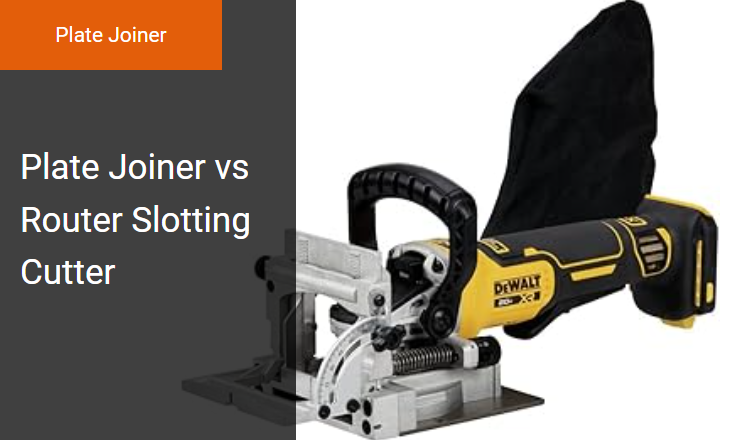
Achieving flush, perfectly aligned wood joints during glue-ups remains a frustrating hurdle for many woodworkers, where even a fraction of a millimeter of misalignment translates to hours of arduous sanding. While standard shop investments-such as traditional doweling jigs or pocket-hole systems-serve as reliable baseline resources for joinery, they often lack the lateral adaptability required for flawless, stress-free assemblies.
Investing in a dedicated plate joiner grants craftsmen the unique advantage of rapid cutting combined with lateral alignment flexibility. However, achieving professional results stipulates that users understand the distinct mechanical differences between dedicated machinery and makeshift alternatives. For example, when edge-gluing expansive dining tabletops or constructing cabinet face frames, the plate joiner offers a level of forgiving adjustment that rigid methods simply cannot replicate.
Below, we provide a comprehensive comparison between the specialized plate joiner and the router slotting cutter, evaluating setup efficiency, cut precision, and workflow integration to help you choose the optimal tool for your workshop.
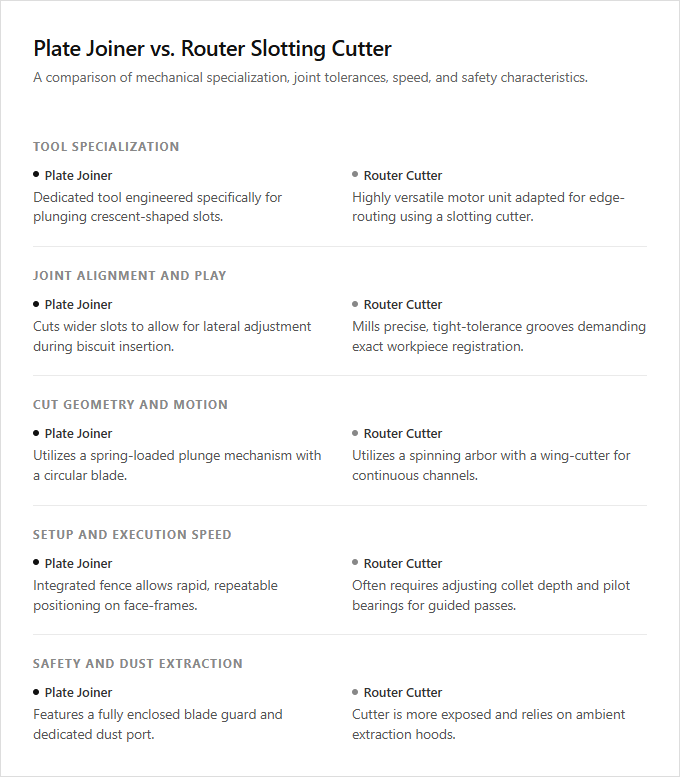
| Factor | Summary |
|---|---|
| Tool Specialization | The plate joiner is a dedicated tool engineered specifically for plunging crescent-shaped slots, whereas a router is a highly versatile motor unit adapted for edge-routing using a slotting cutter. |
| Joint Alignment and Play | Plate joiners cut slightly wider slots to allow for lateral adjustment during biscuit insertion, while router slotting cutters mill precise, tight-tolerance grooves that demand exact workpiece registration. |
| Cut Geometry and Motion | A plate joiner utilizes a spring-loaded plunge mechanism with a circular blade to make plunge cuts, whereas a router utilizes a spinning arbor with a wing-cutter to mill continuous horizontal channels. |
| Setup and Execution Speed | The integrated fence on a plate joiner allows for rapid, repeatable positioning on face-frames, while a router setup often requires adjusting collet depth and pilot bearings for guided passes. |
| Safety and Dust Extraction | Plate joiners feature a fully enclosed blade guard and dedicated dust port to contain waste, whereas a spinning router slotting cutter is more exposed and relies on ambient extraction hoods. |
Crescent-shaped pocket cutting vs flat-bottomed slotting
A plate joiner utilizes a plunge-cutting circular blade to create a precise, crescent-shaped pocket. This curved slot is engineered specifically to accommodate compressed wooden biscuits, allowing for slight lateral play during assembly to facilitate easier alignment. The plunging action ensures a localized, hidden cut that maintains the structural integrity of the surrounding wood.
In comparison, a router equipped with a slotting cutter produces a continuous, flat-bottomed slot along the edge of the workpiece. This method provides a uniform depth and consistent profile, making it highly effective for receiving splines, tongue-and-groove joints, or decorative T-molding. The resulting flat channel offers robust surface-to-surface contact for long-grain glue joints.
The plate joiner is best suited for cabinetmakers seeking rapid, forgiving alignment during panel glue-ups, while the router slotting cutter is ideal for precision woodworkers requiring continuous structural grooves and custom profile integration.
Spring-loaded plunge mechanism vs fixed-depth router collet routing
A plate joiner utilizes a spring-loaded plunge mechanism that exposes the blade only when pressed against the workpiece. This specialized design ensures rapid, precise alignment and consistent depth for biscuit slotting, as the integrated fence and plunge action work in tandem to prevent tool drift.
A router slotting cutter relies on a fixed-depth collet setup. While this configuration offers exceptional versatility for various edge profiles, it requires manual height adjustments and steady handling to maintain stability without the dedicated guidance of a plunging joiner.
Dedicated plate joiners are ideal for production cabinetmakers requiring rapid, repetitive alignment, while router slotting cutters suit general woodworkers seeking a multi-purpose tool for occasional joinery.
Rotational speed variance in spindle RPM
When comparing a plate joiner to a router slotting cutter, the variance in spindle RPM is a critical distinction. Dedicated plate joiners typically operate at a fixed speed of approximately 10,000 RPM, engineered specifically for plunging safely into timber without burning the fibers. In contrast, wood routers run at much higher speeds, often adjustable from 10,000 to 25,000 RPM, requiring precise modulation to manage peripheral cutter speed and prevent heat build-up on the slotting bit.
This rotational variance dictates cutting control and finish quality. The slower, stable RPM of the plate joiner offers safer plunge-cutting mechanics, while the high-speed router achieves exceptionally clean cuts at the cost of increased feed-rate sensitivity. Plate joiners suit high-volume cabinetmakers prioritizing rapid, standardized assembly, whereas router slotting cutters are ideal for precision craftspeople requiring adaptable tooling for custom joinery.
Fence registration accuracy vs shank-mounted pilot bearing tracking
Plate joiners rely on a dedicated, adjustable fence to reference the workpiece face. This engineering ensures precise, repeatable vertical alignment across multiple joints, mitigating cumulative errors during assembly. The fence-based registration provides exceptional stability, allowing users to quickly index cuts at specific angles and heights with mechanical consistency.
A router slotting cutter utilizes a shank-mounted pilot bearing that tracks the workpiece edge directly. This method ensures a highly consistent slot depth by following the physical profile of the wood, bypassing any face-surface imperfections. While this approach offers excellent edge-following accuracy, it lacks the rapid vertical adjustment and face-referencing speed of a dedicated joiner fence.
Dedicated plate joiners are ideal for production cabinetmakers prioritizing rapid, repeatable panel alignment, while router slotting setups best suit versatile woodworkers seeking to maximize the utility of their existing machinery.
Four-inch diameter carbide-tipped blade kerf vs router bit wing diameter
A dedicated plate joiner utilizes a four-inch diameter carbide-tipped blade to plunge straight into wood. This large diameter creates a precise, shallow crescent-shaped kerf that perfectly accommodates standard biscuit sizes. The design of the machine stabilizes the blade, ensuring consistent depth and vertical alignment across multiple joints.
In contrast, a router slotting cutter relies on a much smaller wing diameter, typically under two inches. While highly precise, this smaller rotational radius requires higher spindle speeds and careful manual control to prevent wood burning or depth variance. The cutting path is guided by a pilot bearing rather than a fixed plunge mechanism.
Professional cabinetmakers requiring rapid, repeatable alignment during high-volume assembly will benefit most from the plate joiner, while furniture makers seeking occasional jointing versatility with existing workshop machinery will find the router slotting cutter more suitable.
Lateral tolerance adjustment for compressed beechwood biscuit expansion
A dedicated plate joiner creates an oversized, crescent-shaped slot that naturally allows for lateral tolerance. This side-to-side play is crucial when aligning workpieces, as compressed beechwood biscuits expand upon contact with water-based glue to lock the joint in place. A router equipped with a slotting cutter produces a highly precise, straight channel with minimal lateral play, demanding exact alignment during the initial cut.
While the router offers exceptional depth control, the plate joiner's inherent lateral tolerance simplifies the assembly of complex panels by permitting micro-adjustments before the adhesive cures. Dedicated plate joiners suit production-oriented woodworkers prioritizing rapid assembly alignment, while router slotting setups favor hobbyists or specialists seeking multi-functional utility from a single tool.
Integrated dust extraction port efficiency vs exposed cutter debris scatter
When cutting biscuit slots, dust management differs significantly between tools. A dedicated plate joiner features an enclosed blade housing integrated with a highly efficient dust extraction port. This enclosed design ensures that high-velocity wood chips are immediately funneled into a vacuum system or collection bag, maintaining a clean workspace and clear line of sight.
In contrast, a router utilizing a slotting cutter operates with an exposed bit, leading to widespread debris scatter. Without a sealed shroud to contain the waste, wood dust is flung tangentially across the workshop, which increases cleanup time and requires robust ambient air filtration. The plate joiner is highly suited for production cabinetmakers prioritizing speed and workshop cleanliness, whereas the router slotting cutter is ideal for versatile craftspeople who prefer utilizing a single multi-purpose tool for occasional joinery tasks.
Leave a comment