
Achieving flawless edge profiles and tear-out-free dados is a constant struggle for woodworkers, who frequently battle hand fatigue and workpiece drift during critical passes. Before investing in new hardware, craftsmen typically look to standard workshop funding sources-balancing their tool acquisition budgets against multi-purpose machinery.
However, selecting the correct handle configuration is the pivotal decision that grants operators the exact control and stability needed to eliminate chatter. As an educational stipulation, it is important to note that neither design is a universal solution; performance is highly dependent on your specific application and workflow.
Industry-standard benchmarks, such as the Bosch 1617 and DeWalt DW618 series, illustrate how ergonomics directly dictate cutting accuracy. Below, we provide an executive summary of what this guide will cover: a direct comparison of D-Handle and Twin-Handle routers, analyzing their ergonomic control, precision depth adjustment mechanisms, and which design best suits your routing needs.
| Factor | Summary |
|---|---|
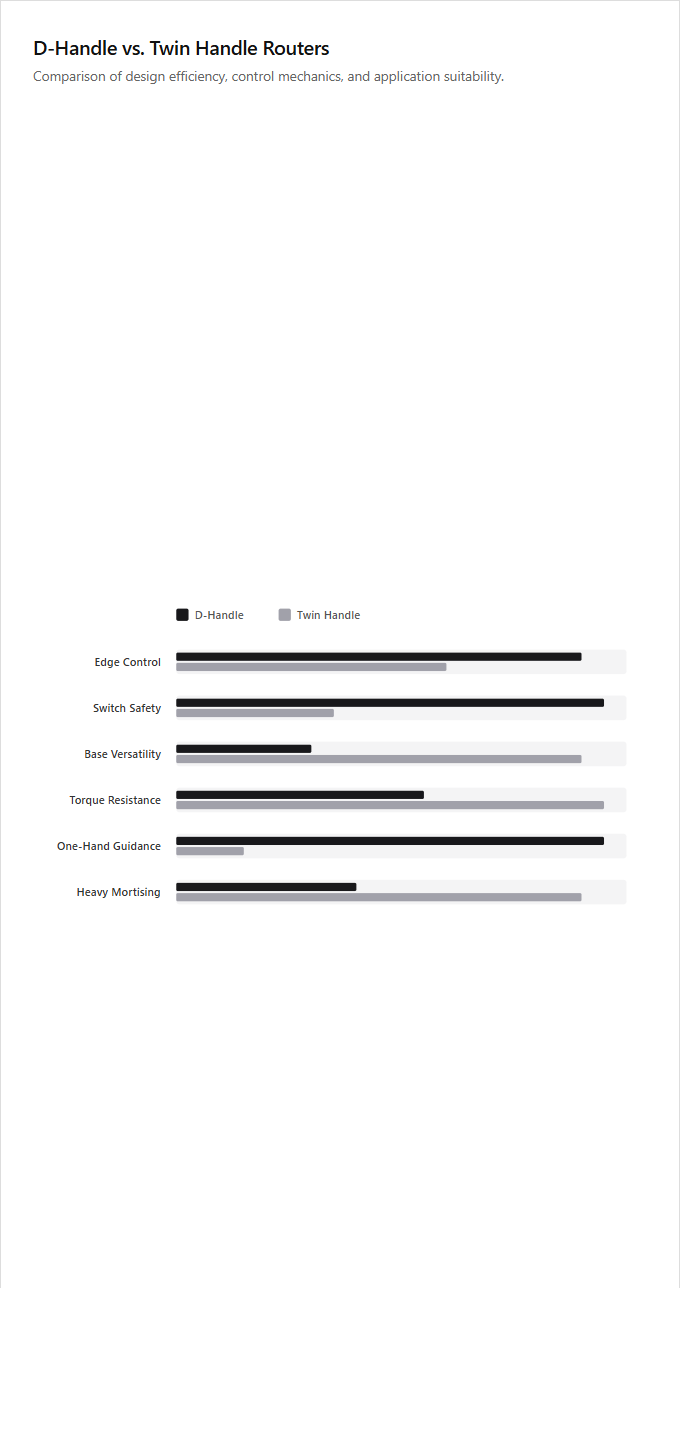
| Ergonomic Configuration | The D-Handle router utilizes a pistol-grip design for one-handed guidance, whereas the Twin Handle router distributes force evenly through dual knob grips to optimize lateral stability. |
| Power Switch Integration | D-Handle models feature an integrated trigger switch on the handle for immediate power termination, while Twin Handle models typically rely on a motor-mounted toggle switch. |
| Base Compatibility | D-Handle routers are primarily restricted to fixed-base operations, whereas Twin Handle routers are frequently paired with plunge bases utilizing a spring-loaded column mechanism. |
| Directional Maneuverability | The off-center grip of a D-handle allows for precise edge-routing guidance, while twin handles provide the symmetrical leverage needed to counteract rotational torque reaction. |
| Operational Safety | D-handle routers offer enhanced operator safety via a built-in dead-man's switch trigger, whereas twin-handle models often require the operator to release one hand to actuate a standard rocker switch. |
| Application Suitability | Twin handle configurations excel at heavy-duty template routing and mortising, while D-handle configurations are preferred for continuous, high-precision edge-profiling tasks. |
Integrated handle trigger switch versus motor housing toggle switch
When selecting a woodworking router, the switch configuration significantly impacts both safety and control. D-handle routers feature an integrated trigger switch directly on the handle, allowing operators to power the tool on and off without releasing their grip. This design provides superior control and immediate shut-off capability during continuous, hand-guided routing tasks.
In contrast, twin-handle routers traditionally position a toggle switch on the motor housing, requiring the operator to momentarily release one hand to activate the tool. This setup is highly efficient for stationary applications where the router remains mounted under a table or when performing deep plunge cuts that require a symmetrical grip.
D-handle routers are ideal for carpenters prioritizing maximum hand-held control during edge profiling, while twin-handle models best serve versatile woodworkers who frequently transition between plunge routing and dedicated router table installations.
Micro-fine rack-and-pinion depth adjustment versus plunge base turret stop limits
D-handle routers excel in stability and control, often utilizing a micro-fine rack-and-pinion depth adjustment system. This mechanism allows operators to make precise, incremental vertical adjustments for highly consistent edge routing and template work. The integrated trigger switch on the D-handle ensures the user maintains a secure, two-handed grip during startup and operation, enhancing overall safety and control on flat surfaces.
In contrast, twin-handle routers are typically associated with plunge bases, featuring adjustable turret stop limits for multi-pass routing. This setup enables quick, repeatable depth transitions for complex tasks like mortising and stopped grooves without requiring manual recalibration between cuts. Precision-focused production woodworkers benefit most from the D-handle's steady, single-pass accuracy, while furniture makers requiring versatile, stepped-depth cuts are ideal candidates for the twin-handle plunge router.
Asymmetric directional control versus bilateral symmetrical knob steering
The choice between a D-handle and a twin-handle router depends heavily on the steering mechanism. A D-handle router utilizes asymmetric directional control, placing one hand on a low-profile pistol grip with an integrated trigger, which provides excellent forward feeding power. Conversely, a twin-handle router employs bilateral symmetrical knob steering, distributing hand placement evenly on both sides of the motor to ensure balanced downward pressure and consistent lateral guidance.
While the asymmetric grip excels at maintaining steady contact during edge-routing, bilateral steering offers superior stability during plunge operations and template routing. The D-handle configuration suits production carpenters prioritizing single-finger power control on edge profiles, whereas the twin-handle design is ideal for precision woodworkers requiring maximum stability for intricate plunge cuts.
Center of gravity height variance and rotational torque stability
D-handle routers position the operator's primary control hand lower and closer to the workpiece, significantly reducing the center of gravity height variance during operation. This low-profile grip configuration offers superior stability against rotational torque, minimizing the risk of the tool tilting or gouging the material during heavy cuts.
Twin-handle routers feature dual grips positioned higher on the motor housing. This elevated center of gravity introduces greater variance during lateral movement, though the symmetric, dual-hand design allows operators to distribute downward force evenly to counteract rotational torque.
D-handle models are ideal for production woodworkers requiring precise, single-handed edge routing, whereas twin-handle designs suit artisans needing maximum stability and control for plunge cuts and heavy-duty profiling.
One-handed power-cut safety versus dual-hand grip maintenance requirements
The D-handle router offers a distinct safety advantage through its integrated pistol-grip trigger switch. This design allows operators to maintain secure control with one hand while keeping a finger on the power trigger, enabling an instant power-cut if control is compromised during operation.
In contrast, twin handle routers require consistent dual-hand grip maintenance to ensure stability and precise guiding along the workpiece. Because the power switch is typically located on the motor housing rather than the handles, operators must momentarily release one hand from the grip to shut down the tool, requiring careful physical coordination.
D-handle models are ideal for mobile carpenters prioritizing rapid-response safety during edge-profiling, while twin-handle units best suit workshop artisans executing heavy, controlled plunge cuts that demand constant dual-hand stabilization.
Fixed-base casting compatibility versus spring-loaded plunge column guidance
The D-handle router utilizes a robust fixed-base casting compatibility, prioritizing rigid depth stability and highly repeatable edge-routing operations. By locking the motor unit securely into a solid, stationary casting, this configuration eliminates physical deflection during heavy passes. The integrated D-handle trigger offers superior single-handed control, making it highly effective for continuous perimeter profiling.
Twin-handle routers employ spring-loaded plunge column guidance to steer the motor vertically into the workpiece. This dual-column architecture allows for controlled, stepped descents, which are essential for internal cuts, template routing, and mortising. Cabinetmakers requiring versatile, vertical depth penetration on varied workpieces prefer the twin-handle design, while production carpenters specializing in repetitive, heavy-duty edge-shaping achieve greater consistency with the D-handle model.
Gyroscopic force control during high-RPM edge routing profile cuts
High-RPM edge routing profile cuts generate significant gyroscopic forces that can cause a router to deflect from the intended cut line. Twin handle routers distribute these torsional forces evenly across both hands, providing balanced lateral control. This dual-point grip allows operators to stabilize the tool's natural tendency to pivot during heavy profiling, ensuring consistent edge alignment along the workpiece.
D-handle routers position the primary trigger hand lower and closer to the router base, lowering the center of gravity while the auxiliary hand guides the knob. This asymmetrical configuration offers superior leverage to counteract gyroscopic tilting along vertical axes, maintaining precise perpendicularity on narrow edge profiles. Production woodworkers requiring continuous, single-switch control on dedicated edge-shaping lines favor the D-handle, while general craftsmen performing varied routing operations benefit more from the balanced, two-handed control of the twin handle design.
Leave a comment