

Achieving flawlessly repeatable curves or dead-straight profiles with a handheld router often feels like an exercise in frustration, where a single hand slip can instantly ruin expensive hardwood. Before upgrading to dedicated stationary machinery, woodworkers typically evaluate standard shop funding allocations, debating whether to invest capital in costly spindle shapers or CNC tables.
However, optimizing your current handheld setup with the right guiding accessory grants your router the precision of industrial-grade machinery at a fraction of the investment. Under the stipulation that no single accessory serves as a universal solution, craftsmen must align their tooling with specific project geometries. For instance, template guides are indispensable for replicating intricate, curved cabinet parts, whereas a robust router fence remains the gold standard for edge-profiling straight shelving.
This article compares template guides and router fences, analyzing their mechanical setups, accuracy thresholds, and ideal applications to help you select the ultimate guiding accessory for your workshop.
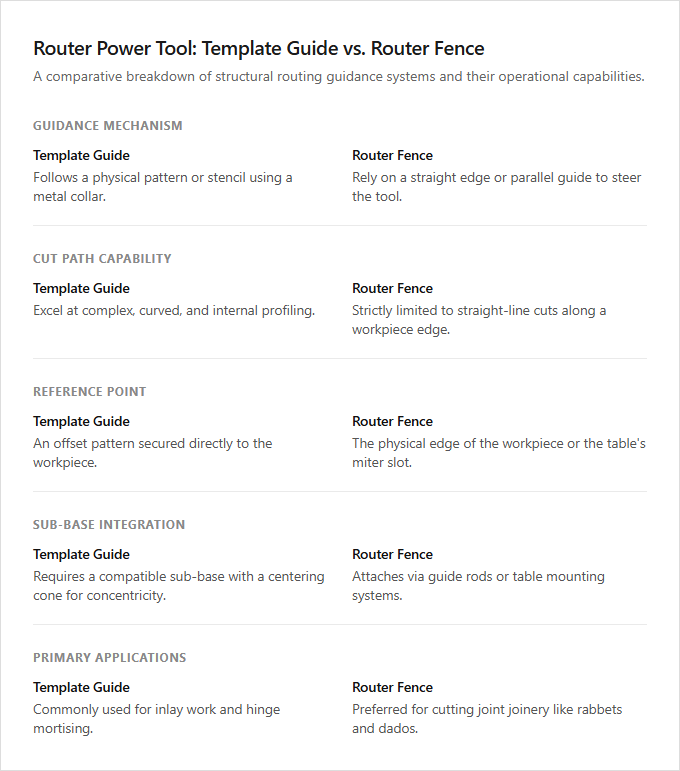
| Factor | Summary |
|---|---|
| Guidance Mechanism | A template guide follows a physical pattern or stencil using a metal collar, whereas a router fence relies on a straight edge or parallel guide to steer the tool. |
| Cut Path Capability | Template guides excel at complex, curved, and internal profiling, while router fences are strictly limited to straight-line cuts along a workpiece edge. |
| Reference Point | A template guide references an offset pattern secured directly to the workpiece, while a router fence references the physical edge of the workpiece or the table's miter slot. |
| Sub-base Integration | Template guides require a compatible sub-base with a centering cone to ensure concentricity with the collet, whereas router fences attach via guide rods or table mounting systems. |
| Primary Applications | Template guides are commonly used for inlay work and hinge mortising, whereas router fences are preferred for cutting joint joinery like rabbets and dados. |
Guide Bushing Offset Calculation for Template Routing
When choosing between template guides and router fences, the control mechanism dictates the workflow. Template routing relies on a guide bushing, where precise offset calculation is critical. To achieve exact final cut dimensions, woodworkers must calculate the difference between the outer diameter of the guide bushing and the diameter of the router bit. This mathematical offset determines how far the template must be offset from the actual cut line to ensure accuracy.
In contrast, a router fence provides a straight, physical reference barrier parallel to the cutter, eliminating the need for offset calculations. Adjustments on a fence rely on direct alignment relative to the bit for edge profiling or grooving. Template guides suit woodworkers replicating complex, curved shapes, while router fences are perfect for craftsmen executing straight, linear joinery.
Split router fence micro-adjustment allows for precise edge-jointing operations.
When utilizing a woodworking router, choosing between a template guide and a router fence depends on the required cut geometry. A router fence excels in straight-line operations along a board's edge. Specifically, a split router fence with micro-adjustment capabilities allows woodworkers to offset the outfeed face, enabling precise edge-jointing operations directly on the router table without a dedicated jointer.
Template guides steer the router along a physical pattern to replicate complex, curved profiles with high fidelity. Template guides are ideal for production woodworkers duplicating identical curved parts, whereas adjustable fences are best suited for craftspeople performing straight profiling and edge-jointing.
Aligning Router Sub-Base for Template Guide Accuracy
Router fences and template guides offer two distinct methods for controlling woodworking cuts. When utilizing a template guide, achieving precise concentricity alignment of the router sub-base is absolutely critical. If the sub-base is not perfectly centered around the collet, the distance between the cutter and the guide bushing varies as the router rotates against the template, resulting in inconsistent and inaccurate cuts.
A router fence bypasses this concentricity requirement by referencing a straight physical edge, making it highly forgiving of minor base misalignments during linear operations. Detail-oriented craftsmen replicating intricate, curved patterns benefit most from template guides, whereas production woodworkers focusing on straight-line joinery and edge profiling are better suited to a router fence.
Omnidirectional Guide Bushings vs. Linear Router Fences
In precision woodworking, selecting the appropriate guiding method determines the complexity of your cuts. Template guides, or guide bushings, offer omnidirectional pathing capability, allowing the router to follow intricate, curved, and non-linear patterns. By tracing a template, the tool moves freely in any direction, making it indispensable for sign-making, inlay work, and replicating complex shapes.
Conversely, a router fence restricts movement to rigid linear travel along a straight edge. This setup secures the workpiece against a parallel guide, ensuring absolute straightness for edge-shaping, dados, and jointing. Template guides are ideal for creative craftsmen requiring free-form versatility, whereas router fences are best suited for traditional joiners prioritizing repetitive, straight-line precision.
Router Fence Featherboards for Consistent Pressure
When choosing between a template guide and a router fence, understanding their distinct guiding mechanisms is essential for precision woodworking. A router fence excels in straight-line operations, providing a continuous reference surface. Integrating featherboards onto the fence system ensures consistent workpiece pressure during straight-edge profiling, which eliminates vibration and guarantees uniform cuts. This setup stabilizes the stock securely against both the table and the fence throughout the pass.
Template guides mount to the router base, allowing the tool to follow complex, curved patterns. This method bypasses the fence entirely, relying on a physical template to dictate the cut path. Template guides are ideal for artisans replicating intricate, curved furniture parts, whereas router fences equipped with featherboards are best suited for woodworkers executing highly repetitive, straight-line joinery and profiling.
Chip Extraction: Fence Ports vs. Template Guide Obstruction
When routing, debris management directly impacts both cut visibility and tool longevity. A router fence equipped with an integrated dust port offers superior chip extraction efficiency. By capturing waste immediately at the point of cut along a straight path, the airflow remains unobstructed, which maintains a clean workspace and prevents heat buildup around the bit.
Conversely, utilizing a template guide creates a physical barrier beneath the sub-base. This ring-like obstruction restricts the natural path of suction, often trapping chips within the template cavity and requiring manual clearing. While integrated fence systems suit production-oriented woodworkers prioritizing dust-free straight profiling, template guides remain the choice for artisans performing intricate, repetitive pattern routing where precise mechanical guidance is paramount.
Template Guides vs. Router Fences: Internal vs. Edge Routing
When performing precision woodworking with a router, selecting the right guidance system determines the scope of your cut. A router fence restricts operations to the periphery of a workpiece, guiding the tool along straight, external edges for profile routing and edge shaping. While highly effective for border details, fences cannot access the interior field of a workpiece, limiting their utility to external perimeters.
Template guides, or bushing guides, offer unmatched versatility by enabling intricate internal cutout routing. Mounted directly to the router base, these guides follow the inner contours of a custom template, allowing the bit to plunge and carve complex interior shapes, pocket cuts, and cutouts anywhere on the wood's surface.
Template guides are essential for artisans crafting complex joinery and internal recesses, whereas router fences are ideal for production woodworkers focusing on consistent edge profiles and straight-line cabinetry.
Leave a comment