
In high-precision manufacturing, engineers and machinists constantly struggle with ram deflection and rotational play during heavy press-fit operations. Achieving exact alignment under high-force torsional loads often leads to costly part spoilage and premature tool wear.
Before upgrading, facilities typically look to traditional capital equipment budgets and standard machinery procurement pipelines to source massive, expensive hydraulic systems. However, selecting the right manual arbor press grants operators remarkable torsional stability and micro-precision control without inflating operational overhead.
Of course, achieving this efficiency is contingent on one major stipulation: the ram's mechanical interface must be perfectly matched to the application's directional forces. For example, high-precision aerospace shops utilize the industry-standard Dake JT-2 square-ram series to eliminate rotational deviation under load.
In this guide, we will analyze the structural differences between square ram and round ram designs, evaluate their respective resistance to torsional stress, and outline key criteria to help you select the ideal press for your high-precision workflow.
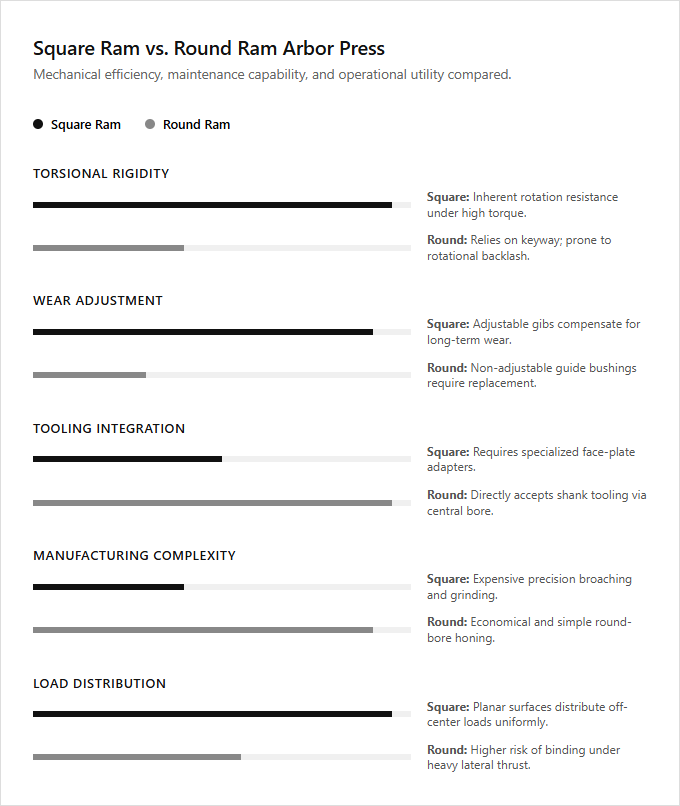
| Factor | Summary |
|---|---|
| Torsional Rigidity | The square ram inherently resists rotational torque during high-pressure operations, whereas the round ram requires a keyway system to prevent rotation, which can introduce mechanical backlash. |
| Wear Adjustment | Square ram presses feature adjustable gibs to compensate for sliding wear over time, while round ram designs rely on guide bushings that cannot be easily adjusted for tolerance loss. |
| Tooling Integration | Round rams readily accept cylindrical shank tooling via a central bore and set-screw, whereas square rams often require specialized face-plate adapters for secure tool mounting. |
| Manufacturing Complexity | Producing a square ram press involves high-precision broaching and grinding of the frame guide, making it more expensive than the round-bore honing processes used for round ram models. |
| Load Distribution | The flat, planar surfaces of a square ram distribute off-center thrust loads more uniformly, significantly reducing the risk of binding under heavy compressive forces. |
Torsional rigidity and resistance to angular deflection under eccentric loading
When selecting an arbor press, understanding the mechanical behavior of the ram geometry under load is critical. Square ram arbor presses offer superior torsional rigidity due to their flat-sided design, which naturally prevents rotation. When subjected to eccentric loading-where the force is applied off-center-the square ram inherently resists angular deflection, maintaining precise tool alignment and preventing structural binding under heavy, asymmetric stresses.
Round ram arbor presses exhibit less resistance to torsional forces, making them more susceptible to twisting under off-center loads unless they are equipped with an external guide key. While round rams are highly effective for straightforward, centered operations, they allow for slight rotational play. High-precision machinists requiring tight tolerances under complex, uneven loads benefit most from square ram presses, whereas maintenance technicians performing standardized, linear press-fit operations are better suited to round ram models.
Implementation of adjustable gibs for wear compensation and clearance elimination
Square ram arbor presses inherently accommodate the integration of adjustable gibs. These gibs are essential for wear compensation and clearance elimination, as operators can tighten them over time to counteract lateral play and maintain precise tool alignment. Conversely, round ram presses lack adjustable gibs, relying instead on the tight machining tolerances of the frame bore, which makes compensating for eventual wear much more difficult.
This structural difference directly influences long-term accuracy and maintenance. Square ram presses are suited for high-precision fabricators requiring long-term alignment control and repeatability, whereas round ram presses are ideal for light-duty operators performing straightforward, general assembly tasks.
Prevention of rotational backlash without relying on keyway tolerances
Round ram arbor presses rely on a key and keyway system to prevent ram rotation. Over time, wear on these components introduces rotational backlash, compromising precision. In contrast, square ram arbor presses inherently prevent rotation through their geometry. The flat sides of the square ram mate directly with the machined press frame, eliminating the need for keyways and the tolerances associated with them.
By distributing rotational forces across broad, flat surfaces rather than a narrow key, square rams maintain strict alignment even under heavy load. This design ensures consistent, repeatable accuracy throughout the tool's lifespan. Toolmakers requiring high-precision alignment and repetitive stamping benefit from the rigid square ram, while general maintenance technicians performing basic pressing and bushing installations find the round ram press sufficient.
Surface contact area distribution across flat guideways versus line contact
The choice between square and round ram arbor presses depends significantly on force distribution. A square ram arbor press utilizes flat guideways, which provide a broad surface contact area. This design distributes the applied load evenly across the mating surfaces, which minimizes lateral play and maintains precise tool alignment under heavy pressure.
In contrast, a round ram relies on line contact within its cylindrical bore. While this configuration allows for easier rotational adjustment, it offers less resistance to torsional forces and can experience accelerated wear during high-torque applications. Industrial machinists requiring high-precision alignment and heavy-duty stamping benefit most from the robust square ram design, whereas hobbyists and light-duty assembly technicians find the versatile round ram ideal for their tasks.
Precise geometric perpendicularity maintenance during high-force press strokes
During high-force press strokes, maintaining precise geometric perpendicularity is critical to prevent tool deflection and workpiece damage. Square ram arbor presses excel in these demanding applications. The flat, machined surfaces of a square ram provide superior resistance to torsional forces, ensuring the ram does not rotate during downward travel and consistently delivers force perpendicular to the base.
Round ram arbor presses, while highly effective for general-purpose tasks, rely on external keys and keyways to prevent rotation. Under extreme loads, these alignment components can experience wear, which slightly compromises perpendicularity over time. Precision toolmakers and heavy-duty fabricators require the unyielding alignment of the square ram, whereas general maintenance technicians and hobbyists benefit from the versatility and cost-efficiency of the round ram design.
Easy Centerless Grinding for Superior Ram Concentricity
In precision manufacturing, the choice between square and round ram arbor presses often depends on guidance accuracy. Round ram presses offer a distinct advantage due to the ease of centerless grinding. This machining process allows cylindrical rams to achieve superior dimensional concentricity and exceptionally tight tolerances, which minimizes lateral play and ensures highly consistent, axial force delivery along the press stroke.
Square ram presses naturally resist rotational forces without auxiliary keys, but they require complex, multi-surface machining to match the guidance precision of their round counterparts. Industrial fabricators requiring high torsional resistance for heavy broaching operations typically choose square ram presses, while instrument makers and electronics technicians requiring extreme concentric alignment favor the precision of round ram designs.
Stress concentration zones at sharp corner geometries under high tonnage
In high-tonnage applications, the geometry of an arbor press ram significantly influences its structural integrity and longevity. Square ram designs feature sharp internal corner geometries that naturally act as stress concentration zones under heavy loads. These angular transitions create localized areas of high tensile stress, increasing the susceptibility to micro-cracking and eventual structural fatigue over extended operation.
In contrast, round rams distribute applied forces uniformly across their circular cross-section, eliminating the localized stress risers associated with sharp corners. This cylindrical geometry ensures superior resistance to deformation during heavy-duty pressing cycles. Precision machinists requiring long-term durability under extreme loads benefit most from the robust round ram, while operators performing lighter, alignment-sensitive assembly tasks find the non-rotational guidance of the square ram ideal.
Leave a comment