
Maintaining sensitive electronics requires precision, yet technicians and IT professionals constantly struggle with the rapid thermal drops, chemical residues, and quick depletion associated with traditional aerosol dusters. While standard office supply budgets and IT procurement channels have historically allocated continuous funding for these disposable cans, this recurring operational expenditure is increasingly difficult to justify.
Transitioning to a dedicated electric air cleaner grants users unlimited, consistent pressure and substantial long-term savings. However, an important technical stipulation remains: to effectively replace compressed gas, an electric blower must meet specific thresholds for static pressure and cubic feet per minute (CFM). For instance, clearing microscopic debris from dense server racks or intricate gaming motherboards demands a precise balance of velocity and electrostatic safety.
This article evaluates cordless air dusters against compressed gas cans, analyzing raw performance metrics, return on investment, and safety profiles to help you select the ultimate electronics cleaning tool for your workflow.
| Factor | Summary |
|---|---|
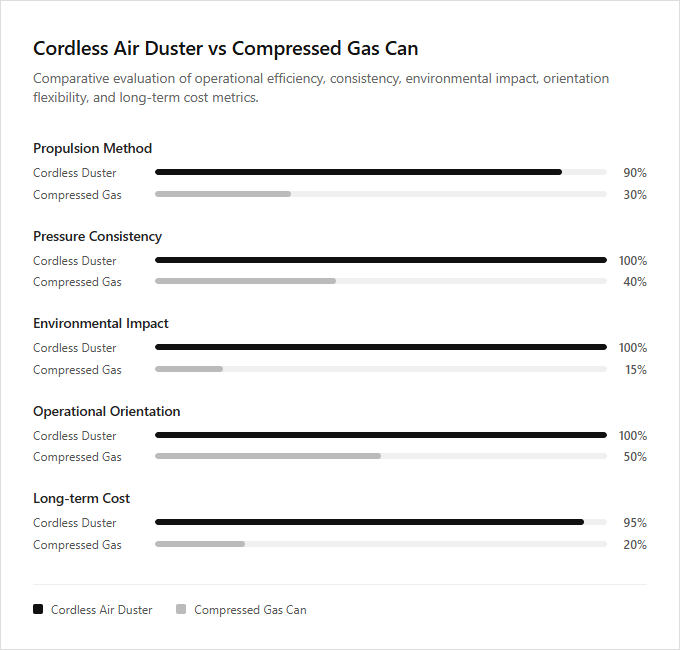
| Propulsion Method | Cordless air dusters utilize an electric motor powered by a lithium-ion battery to generate airflow, whereas compressed gas cans rely on pressurized chemical propellants like difluoroethane. |
| Pressure Consistency | Cordless dusters maintain a constant volumetric flow rate, while gas cans suffer from pressure drops due to adiabatic cooling during extended discharge. |
| Environmental Impact | Electric dusters produce no volatile organic compounds, unlike compressed cans which release greenhouse gases and require hazardous waste disposal. |
| Operational Orientation | Cordless units can be operated at a 360-degree orientation without issue, whereas inverting a compressed gas can results in the liquid phase propellant spraying out. |
| Long-term Cost | The cordless option represents a one-time capital expenditure with a low total cost of ownership, while gas cans are recurring consumables. |
The Technology Behind Cordless Air Dusters
When selecting an air cleaning tool for sensitive electronics and workshop maintenance, professionals weigh the benefits of cordless air dusters against traditional compressed gas cans. Modern cordless air dusters utilize rechargeable lithium-ion batteries to power high-velocity brushless motors, delivering a continuous, chemical-free airflow. This advanced motor technology ensures consistent pressure without the risk of liquid freezing or releasing harmful fluorocarbon propellants into the environment.
Compressed gas cans provide a high-pressure blast but suffer from rapid pressure drops during prolonged use and require ongoing replacement costs. Cordless dusters are ideal for IT professionals and workshop technicians requiring frequent, high-volume cleaning, whereas compressed gas cans are best suited for occasional home users seeking an immediate, low-frequency maintenance solution.
Environmental Hazards of Compressed Gas Propellants
When selecting precision cleaning tools for electronics, the choice typically falls between cordless air dusters and traditional compressed gas cans. Traditional compressed gas cans rely on chemical fluorocarbon propellants, such as difluoroethane, to generate the necessary pressure. These chemical agents pose significant environmental hazards, contributing to greenhouse gas emissions and atmospheric degradation with every use.
Cordless air dusters utilize electric motors to draw in and compress ambient air, offering a sustainable, chemical-free alternative. This rechargeable technology eliminates chemical waste and removes the risk of inhaling harmful propellants. Technicians seeking an eco-friendly, high-frequency cleaning solution for busy workshops benefit most from cordless dusters, whereas field service professionals needing maximum portability and instant high-pressure bursts for occasional remote tasks are best suited for compressed gas cans.
Why Spray Cans Get Cold: The Joule-Thomson Effect
When selecting a precision cleaning tool, understanding the thermodynamic differences between cordless air dusters and compressed gas cans is essential. Disposable gas cans rely on liquefied propellants that expand during deployment. Under continuous operation, this expansion triggers the Joule-Thomson effect, causing the canister temperature to plummet. This rapid cooling induces a significant drop in internal pressure, resulting in a weakening airflow that limits cleaning efficiency over extended periods.
Electric cordless air dusters bypass this limitation by utilizing battery-powered motors to maintain a constant, high-velocity airflow without thermal degradation. Disposable compressed gas cans remain practical for general consumers needing quick, occasional dust removal, while rechargeable cordless dusters are best suited for technicians and workshops requiring sustained, high-frequency maintenance of sensitive electronics.
Consistent CFM Performance of Cordless Electric Blowers
When selecting a precision cleaning tool for electronics, the choice between cordless electric air dusters and traditional compressed gas cans involves performance consistency. Cordless electric blowers excel by delivering a continuous, high-volume airflow measured in Cubic Feet per Minute (CFM). Unlike gas canisters that suffer from rapid pressure drops and freezing during extended use, electric dusters maintain a stable CFM output throughout the battery cycle, ensuring thorough debris removal without interruption.
While compressed gas cans provide strong initial pressure, their chemical propellants degrade quickly and pose environmental challenges. Cordless electric dusters are ideal for IT professionals and technicians requiring frequent, sustained device maintenance, whereas compressed gas cans remain suitable for occasional home users needing immediate, low-cost spot cleaning.
Electric dusters offer safe, unrestricted 360-degree cleaning.
When selecting precision cleaning tools for sensitive electronics, understanding the operational mechanics of the equipment is essential. Traditional compressed gas cans rely on chemical propellants that pose a significant risk of freezing and spraying liquid when tilted or inverted. Cordless electric air dusters utilize motor-driven fans to generate high-velocity airflow, allowing for unrestricted 360-degree orientation during operation without any risk of moisture discharge.
This physical difference directly impacts safety and efficiency when clearing debris from complex, hard-to-reach angles. Disposable gas cans remain a practical choice for occasional home users requiring quick, upright cleaning on flat surfaces, while cordless air dusters are ideal for IT professionals and technicians who require continuous, multi-angle precision maintenance on high-value hardware.
Electric Blowers with Anti-Static Nozzles Protect Circuitry
When clearing dust from sensitive electronics, choosing between cordless air dusters and compressed gas cans involves critical safety considerations. Standard compressed gas cans can generate static electricity and discharge cold liquid, posing risks to delicate circuitry. In contrast, many modern cordless electric blowers feature specialized anti-static nozzles designed specifically to mitigate the risk of electrostatic discharge (ESD), ensuring safer maintenance of computer components.
While cordless models require recharging, they provide a continuous, cost-effective airflow without chemical propellants. Technicians working regularly with sensitive circuitry benefit most from the ESD-safe cordless dusters, whereas general consumers needing a quick, maintenance-free solution for basic household dusting will find compressed gas cans highly suitable.
Electric Dusters: Lower TCO Despite Higher Upfront Cost
When selecting maintenance tools, the choice between cordless electric air dusters and compressed gas cans involves a trade-off between upfront cost and long-term value. While compressed gas cans have a low initial purchase price, their recurring replacement costs accumulate rapidly. Cordless electric dusters require a higher initial capital expenditure, yet they offer a significantly lower Total Cost of Ownership (TCO) because they can be recharged and reused indefinitely, eliminating ongoing procurement expenses.
These electric alternatives also provide consistent airflow without the risk of chemical residue or freezing liquid. Compressed gas cans remain suitable for occasional, off-site users needing quick, infrequent cleanups, while cordless electric dusters are ideal for IT professionals and lab technicians performing high-frequency, systematic equipment maintenance.
Leave a comment