
Contractors and fabricators frequently struggle with the hazardous, airborne dust generated by cutting fiber cement siding, as well as the warped, jagged edges that result from using incorrect metal-cutting methods. While many professionals rely on standard tool budgets to acquire multi-purpose saws, these generic options often compromise both job site safety and workpiece precision.
Investing in application-specific power shears grants operators clean, virtually dust-free siding installations and distortion-free, double-cut metal fabrication. However, the vital stipulation is that fiber cement and metal shears are engineered with entirely different mechanical actions and blade configurations. For example, utilizing specialized tools like PacTool Snapper Shears for HardiePlank or double-cut shears for 18-gauge sheet metal is essential for maintaining warranty-compliant material integrity.
This article compares fiber cement shears against metal shears, detailing their unique mechanics, dust-mitigation advantages, and how to select the right power tool for your specific trade applications.
| Factor | Summary |
|---|---|
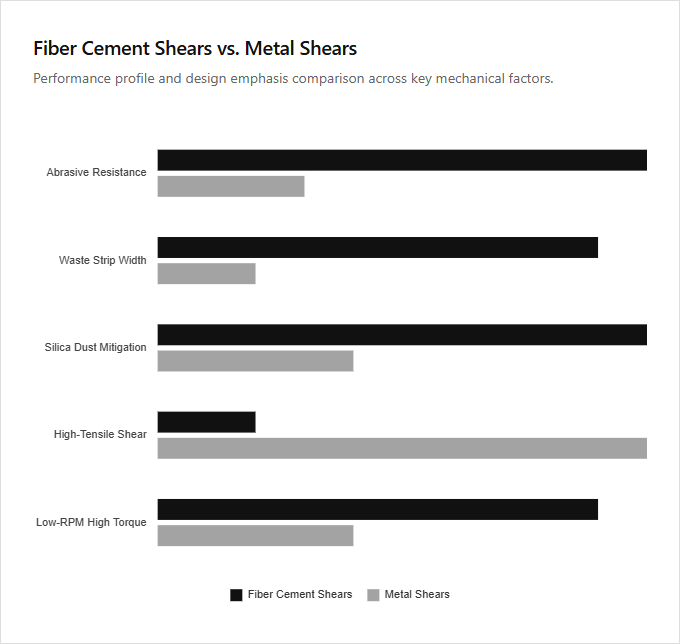
| Blade Design | Fiber cement shears utilize a wider, specialized middle blade to handle abrasive materials, whereas metal shears employ a tighter bypass blade clearance to cleanly slice through sheet metal. |
| Cutting Mechanism | Fiber cement shears remove a continuous waste strip to prevent delamination of composite materials, while metal shears use a scissor-like deformation action to shear ductile metals. |
| Material Compatibility | Fiber cement shears are engineered specifically for abrasive Portland cement composites, whereas metal shears are optimized for high-tensile alloys like steel and aluminum. |
| Dust and Debris Generation | Fiber cement shears are designed to minimize the release of hazardous respirable crystalline silica, while metal shears produce sharp swarf or metal shavings instead of airborne particulates. |
| Tool Speed and Torque | Fiber cement shears typically operate at a lower RPM with high torque, while metal shears utilize high strokes-per-minute (SPM) to quickly guide through various sheet metal gauges. |
Dust-Free Carbide Blade for Fiber Cement Shearing
While metal shears and fiber cement shears utilize similar mechanical power delivery, their blade designs serve vastly different material requirements. Fiber cement shears feature specialized carbide-tipped blade geometry engineered specifically to handle dense, abrasive siding. This unique blade configuration mechanically shears the material without sawing, which virtually eliminates harmful crystalline silica dust and ensures a safer, OSHA-compliant job site.
In contrast, metal shears utilize hardened steel bypass blades designed to slice through sheet metal cleanly without material deformation. Professional siding contractors require the dust-free, specialized fiber cement shears for safe residential installations, whereas HVAC technicians, roofers, and drywall installers rely on metal shears for rapid, spark-free sheet metal fabrication.
Double-Cut Blade for Deformation-Free Metal Swarf
Fiber cement shears and metal shears serve distinct roles in construction and fabrication, distinguished primarily by their blade design and material compatibility. Fiber cement shears are engineered to slice through abrasive, dense cementitious siding without generating harmful silica dust. Conversely, specialized metal shears utilize a double-cut blade configuration engineered to produce a continuous, deformation-free metal swarf. This double-cut mechanism removes a thin strip of waste material, preventing distortion along the workpiece edges to ensure a clean, precise finish.
Choosing the correct tool depends entirely on the material demands of the project. Contractors specializing in exterior residential siding require the dust-free, rapid cutting of fiber cement shears, while HVAC technicians and precision metal fabricators rely on the distortion-free capability of double-cut metal shears.
Gauge Limits: Metal Thickness vs. Composite Siding Density
Sheet metal shears are engineered to overcome the high tensile strength of ductile metals, with their capacities strictly governed by material gauge. A tool rated for 18-gauge mild steel, for example, cannot safely cut thicker sheets without overloading the motor and damaging the precision-ground blades. The cutting mechanism relies on tight blade clearances to shear steel cleanly without deformation.
Fiber cement shears are designed to handle the abrasive, brittle density of composite siding rather than ductile metallic thickness. These tools utilize wider, specialized blades that crack the composite material along a scored line, prioritizing dust suppression and clean edges on cementitious matrices. Using metal shears on fiber cement will quickly ruin the blades due to the material's extreme abrasiveness.
Metal shears are essential for HVAC technicians and metal fabricators requiring precise, distortion-free cuts in sheet steel, while fiber cement shears are the standard choice for siding contractors and residential builders installing heavy composite panels.
Kerf Width Profiles: Optimizing Waste and Edge Quality
Fiber cement shears utilize a wider, specialized kerf profile designed to shear through dense, abrasive composites without generating harmful silica dust. This blade configuration removes a distinct waste ribbon, preventing edge delamination and leaving a smooth, paint-ready finish on siding panels during fabrication.
Metal shears employ much narrower, highly precise kerf profiles to maintain material integrity. Double-cut metal shears remove a thin curl of waste to deliver flat, distortion-free edges, while single-cut models produce zero material waste but can slightly deform the cut line. Siding contractors prioritizing clean, dust-free installations will benefit most from fiber cement shears, whereas HVAC technicians and sheet metal fabricators require the clean, deformation-free precision of metal shears.
Optimizing SPM via Workpiece Strength and Ductility
In shear power tools, optimizing the strokes-per-minute (SPM) is critical to match the unique material properties of the workpiece. Metal shears require precise variable speed control because metals possess high tensile strength and high ductility. Lowering the SPM prevents excessive heat buildup and blade wear when cutting tougher alloys, while higher speeds suit softer metals. Conversely, fiber cement is a highly abrasive, non-ductile material with low tensile strength. Fiber cement shears operate at lower, consistent speeds to minimize dust generation and prolong blade life against abrasive silica.
Matching the correct shear and SPM to the material ensures cleaner cuts and tool longevity. Metal shears are ideal for HVAC technicians and metal fabricators needing high-speed precision across varying metal gauges, while fiber cement shears are best suited for siding installers and residential contractors prioritizing dust control and durable cutting performance on composite materials.
Micro-Adjustable Blades Prevent Cement Delamination and Metal Burring
Selecting between fiber cement and metal shears requires an understanding of micro-adjustable blade clearances. Fiber cement shears utilize a specific gap tolerance to shear dense silica-based composites cleanly; improper clearance leads to interlaminar shearing stresses that cause edge delamination and crumbling. In contrast, metal shears demand extremely tight, micro-adjusted tolerances to cleanly slice through steel, as even a minor deviation results in unsightly edge burring and material distortion.
Adjusting these tools precisely preserves blade life and ensures clean, paint-ready edges on both substrates. Siding installers and residential contractors benefit most from the dust-reducing, delamination-preventing fiber cement shears, while HVAC technicians and roofers require the precision of metal shears to ensure seamless, burr-free joint fits.
High-Torque Motors Engineered for Cement Dust Resistance
Selecting the appropriate shear power tool requires an understanding of the engineered differences between fiber cement and metal cutting applications. Fiber cement shears integrate high-torque, low-speed motors and specialized, abrasive-resistant metallurgy to combat the highly destructive nature of silica and cementitious dust. These hardened blade alloys prevent premature dulling, while sealed internal components shield the motor from microscopic debris that would otherwise cause electrical failure.
In contrast, metal shears are engineered to overcome the high tensile strength and physical resistance of various sheet metals. Rather than focusing on dust mitigation, their motor and jaw configurations prioritize continuous mechanical force to execute clean, distortion-free cuts through steel or aluminum. Exterior siding contractors require the dust-resistant resilience of fiber cement shears, whereas HVAC technicians and precision metal fabricators are best served by the high-tensile cutting dynamics of metal shears.
Leave a comment