
Selecting the wrong pneumatic stapler can instantly ruin expensive upholstery fabric or compromise structural framing integrity-a frustrating setback common to both workshop craftsmen and jobsite contractors. While standard equipment funding sources and procurement budgets often prioritize generic, all-purpose tools to save upfront costs, this compromise frequently leads to costly project failures.
Investing in application-specific fastening grants your operation flawless material finish and long-term joint durability. However, a key educational stipulation remains: optimal tool performance is strictly dependent on matching the wire gauge to your specific compressor PSI limits. For example, deploying a 22-gauge fine wire stapler is essential for securing delicate velvet without tearing, whereas a 16-gauge heavy-duty stapler is required to provide the holding power needed for subflooring.
This article analyzes the critical differences between fine wire and heavy-duty pneumatic staplers, detailing their specifications, ideal applications, and how to choose the right tool for your trade.
| Factor | Summary |
|---|---|
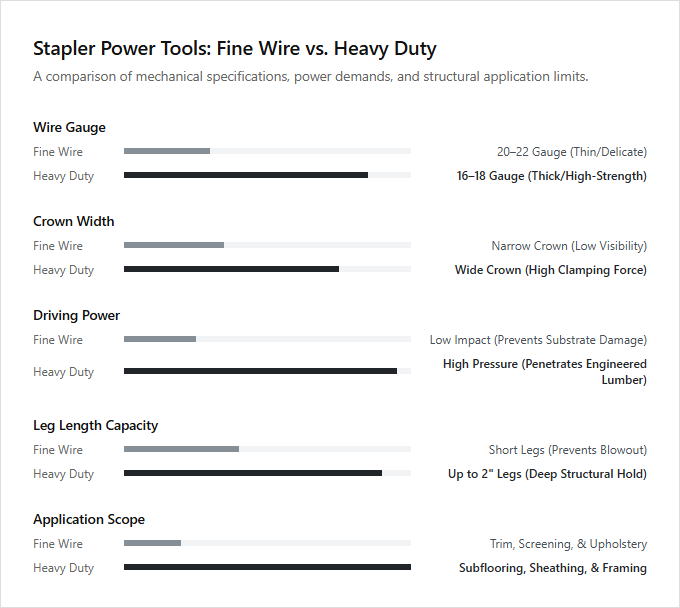
| Wire Gauge | Fine wire staplers typically utilize high-gauge wire, such as 20 to 22-gauge, for delicate tasks, while heavy-duty staplers require thicker 16 to 18-gauge wire to ensure high tensile strength and structural integrity. |
| Crown Width | Fine wire staplers feature narrow crowns to minimize visual impact on upholstery, whereas heavy-duty staplers employ wide crowns to distribute clamping force over a larger surface area during construction. |
| Driving Power | Heavy-duty staplers require higher pneumatic pressure or mechanical force to penetrate dense engineered lumber, while fine wire staplers operate with lower impact energy to avoid tearing fragile substrates. |
| Leg Length Capacity | Fine wire tools are restricted to shorter fastener leg lengths to prevent blowout in thin materials, whereas heavy-duty staplers accommodate longer fasteners up to two inches for deep structural holding power. |
| Application Scope | Fine wire staplers are the industry standard for trim work, screening, and upholstery, while heavy-duty models are engineered for demanding tasks like subflooring, roof sheathing, and framing. |
22-Gauge Fine vs. 16-Gauge Heavy-Duty Fasteners
Fine wire staplers utilize thin 22-gauge fasteners, which have a wire diameter of approximately 0.030 inches. These lightweight staples leave minimal footprints, making them ideal for delicate materials where aesthetics are paramount. They securely attach fabrics, thin trim, and upholstery without splitting the wood or leaving large, visible holes.
In contrast, heavy-duty staplers fire robust 16-gauge fasteners, measuring about 0.062 inches in thickness. These thick, sturdy staples provide exceptional holding power and shear resistance, which is necessary for structural integrity. They easily penetrate denser materials like subflooring, pallets, and heavy framing.
Fine wire models are ideal for furniture upholsterers and finish carpenters seeking discrete fastening, whereas heavy-duty staplers are designed for construction contractors and industrial packagers requiring maximum holding strength.
Crown width variations optimizing structural holding power versus fabric concealment
Fine wire staplers utilize narrow crown widths and thin gauge wire to secure delicate materials without tearing fibers. This design minimizes the visible footprint of the fastener, allowing the wire to sink flush into the material for seamless fabric concealment. The reduced crown width ensures the textile remains unmarred, preserving aesthetic integrity in detailed finish work.
Heavy-duty staplers employ wide crowns and thicker gauge wire to maximize structural holding power across a larger surface area. This broader distribution of tension prevents heavy materials from pulling through or tearing under load. Fine wire models are ideal for upholstery artisans seeking discreet fabric fastening, whereas heavy-duty systems best serve construction contractors requiring robust load-bearing hold.
PSI for Dense Lumber vs. Delicate Frames
Pneumatic heavy-duty staplers require substantial operating pressure, typically ranging from 70 to 120 PSI, to drive thick-gauge fasteners into dense construction lumber. This elevated pressure ensures clean, flush countersinking in tough materials like oak, Douglas fir, and engineered wood without bending the staple crown.
Fine wire staplers operate efficiently at lower pressures, generally between 60 to 90 PSI. This controlled output prevents delicate wood frames from splitting and protects thin fabrics or trim from damage during fastening.
Heavy-duty models are ideal for framing contractors and industrial builders requiring maximum holding power, while fine wire staplers are best suited for furniture upholsterers, cabinet makers, and detailed artisans.
Substrate material density compatibility separating textile upholstery from engineered sheathing
Fine wire staplers are engineered for low-density substrates where material preservation is critical. Utilizing thin-gauge wire, these tools secure textiles, delicate fabrics, and vinyl to wood frames without tearing the fibers. This minimal puncture footprint prevents damage to delicate aesthetic surfaces.
Heavy-duty staplers leverage thick-gauge wire to penetrate high-density materials like plywood, OSB, and engineered sheathing. These tools deliver the driving force necessary to secure structural panels against shear forces, preventing material pull-through under load.
Fine wire models are suited for furniture upholsterers and finish carpenters requiring precision, whereas heavy-duty models are indispensable for framing contractors and roofers managing structural installations.
Shear strength capacities defining load-bearing construction applications versus non-structural fastening
Heavy duty staplers are engineered for load-bearing construction applications, utilizing thick-gauge wire that delivers exceptional shear strength. This robust mechanical fastening resists lateral forces, making it essential for securing structural sheathing, subfloors, and heavy framing materials where joint integrity is critical.
In contrast, fine wire staplers deploy thin-gauge fasteners designed specifically for non-structural fastening. These tools minimize material splitting and leave inconspicuous holes, which is ideal for securing delicate fabrics, vapor barriers, and thin trim work that do not bear structural loads.
Contractors and framers require the high shear capacity of heavy duty models for rigorous structural integrity, while finish carpenters, upholsterers, and craftspeople rely on fine wire staplers for detailed, non-damaging precision work.
CFM: Upholstery Tools vs. Heavy-Duty Cylinders
Pneumatic staplers vary significantly in their air consumption patterns. Fine wire upholstery staplers operate at high frequencies, requiring rapid, low-volume bursts of air. While their individual cycle CFM (cubic feet per minute) demand is minimal, continuous high-speed cycling requires a compressor capable of maintaining consistent pressure. In contrast, heavy-duty pneumatic staplers utilize much larger cylinders to drive thick fasteners into dense materials. These robust tools demand a significantly higher volume of air per stroke, requiring larger compressor tanks to prevent pressure drops.
Selecting the appropriate tool depends on the specific operational environment and material requirements. Fine wire staplers are ideal for production-line upholsterers and furniture makers needing rapid, repetitive fastening, whereas heavy-duty models suit construction contractors and timber framers who require maximum driving power for structural applications.
Optimizing Shank Length to Prevent Substrate Splitting
Fine wire power staplers utilize thin-gauge wire to secure delicate materials without causing aesthetic damage or structural compromise. Their shorter shank lengths and minimal profiles prevent substrate splitting in fragile woods, thin plastics, and fabrics, making them ideal for tasks requiring shallow penetration depth. In contrast, heavy-duty staplers accommodate thicker gauge wires and longer shank lengths, delivering the high drive power necessary for deep penetration into dense hardwoods, engineered lumber, and thick sheathings where robust holding power is essential.
Fine wire tools are best suited for upholstery specialists and finish carpenters requiring precise, split-free fastening on delicate surfaces, whereas heavy-duty models are essential for roofers, insulation installers, and framers demanding maximum structural retention in rugged construction environments.
Leave a comment