
Selecting the appropriate high-torque tooling often presents a frustrating compromise between raw power and physical strain. While standard equipment procurement typically defaults to legacy pneumatic shop standards or generic fleet-wide impact systems, these traditional choices frequently overlook the specific biomechanical demands of sustained, heavy-duty fastening.
Matching the tool's physical architecture to the specific job site environment grants operators the precise leverage needed to mitigate fatigue while optimizing torque transmission. However, we must stipulate that peak torque ratings are practically irrelevant if the tool's form factor prevents proper stabilization. In demanding sectors like heavy equipment maintenance and structural steel assembly, the physical interface of the tool directly dictates safety and throughput.
To assist in your procurement decision, this article provides a comparative analysis of Pistol Grip versus D-Handle impact wrenches. We will examine their ergonomics, torque capabilities, and spatial limitations to help you select the optimal configuration for your high-torque operations.
| Factor | Summary |
|---|---|
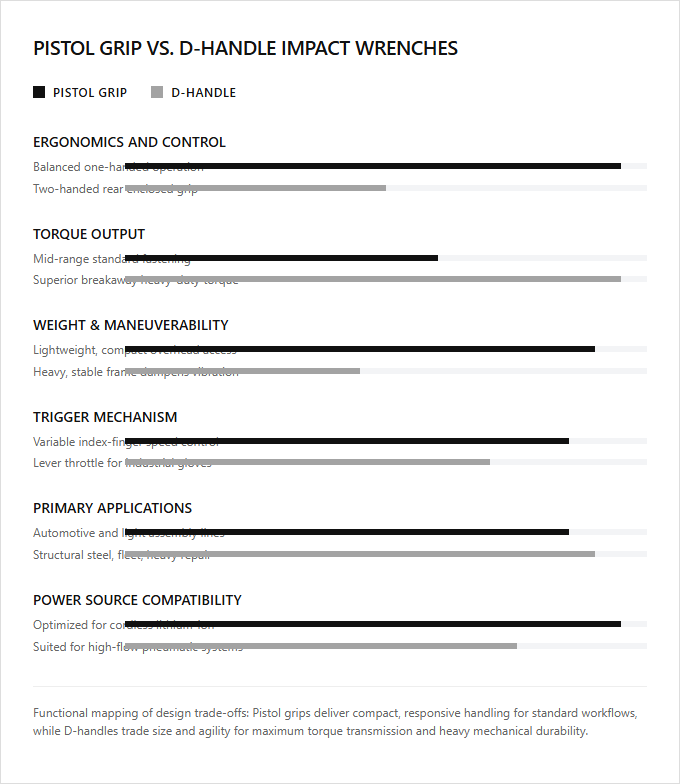
| Ergonomics and Control | Pistol grip designs feature a trigger-style handle located directly underneath the motor housing for balanced one-handed operation, whereas D-handle models utilize a rear enclosed grip that requires two-handed stability to manage high reactive torque. |
| Torque Output | D-handle impact wrenches are engineered with larger pneumatic cylinders or high-voltage brushless motors to deliver superior breakaway torque, while pistol grip variants prioritize mid-range torque output for standard fastening tasks. |
| Weight and Maneuverability | Pistol grip tools offer a lightweight, compact footprint that enhances overhead maneuverability in tight spaces, whereas the heavier, elongated frame of D-handle tools helps stabilize the tool during high-vibration heavy-duty operations. |
| Trigger Mechanism | Pistol grip models utilize an index-finger variable-speed trigger for precise speed modulation, while D-handle tools often employ an inside or outside lever throttle to facilitate safe operation with thick industrial gloves. |
| Primary Applications | Pistol grips dominate automotive workshops and light assembly lines due to their speed, while D-handles are the industry standard for structural steel erection, heavy equipment repair, and fleet tire service. |
| Power Source Compatibility | Pistol grip configurations are highly prevalent in cordless lithium-ion battery platforms for maximum portability, whereas D-handle configurations are most common in high-flow pneumatic systems to maintain sustained high-torque outputs. |
Reactionary torque transfer and ergonomic axial alignment
Pistol grip impact wrenches position the handle beneath the motor, aligning the hand perpendicularly to the tool's drive axis. While this design provides superior maneuverability in confined spaces, it forces the operator's wrist to absorb sudden reactionary torque. In contrast, D-handle models position the primary grip directly behind the motor along the centerline. This configuration optimizes ergonomic axial alignment, allowing the operator to push directly behind the anvil and transfer reactionary forces more safely through the arm and shoulder.
The choice between these designs depends on the specific operational environment. Compact pistol grips are preferred by automotive mechanics needing speed and agility in tight engine bays, whereas high-capacity D-handle units are ideal for industrial pipefitters and heavy equipment technicians performing high-torque, repetitive bolting.
Power-to-weight ratio and maximum breakaway torque output
Pistol grip impact wrenches offer an exceptional power-to-weight ratio, packing significant torque into a compact, lightweight frame. This design allows operators to maneuver easily in tight spaces without experiencing rapid fatigue. In contrast, D-handle models prioritize raw maximum breakaway torque, utilizing a larger, heavier housing to generate the immense force required for heavy-duty industrial fasteners. While D-handles are heavier, their inline design helps manage high reaction torque.
The choice between these configurations depends on the specific application requirements. Pistol grip tools are ideal for automotive technicians and assembly workers needing speed and agility, whereas D-handle models are best suited for heavy equipment mechanics and industrial operators tackling massive structural bolts.
Drive anvil size and heavy-duty socket retention systems
Pistol grip impact wrenches typically feature smaller drive anvils, ranging from 3/8-inch to 1/2-inch, making them highly maneuverable in confined spatial configurations. Conversely, D-handle models are engineered for high-torque applications, commonly utilizing larger 3/4-inch to 1-inch drive anvils to withstand extreme torsional stress during heavy-duty fastening tasks.
The socket retention systems also differ significantly to match these performance levels. Pistol grips often employ friction rings or detent pins for rapid socket changes. In contrast, D-handle wrenches utilize robust through-hole retention systems with steel pins and O-rings to prevent heavy sockets from detaching under severe vibration. Automotive technicians favor the agile pistol grip for quick assembly work, whereas industrial mechanics and heavy equipment operators rely on the secure, high-capacity D-handle for heavy infrastructure and fleet maintenance.
Clearance profile and accessibility within restricted spatial envelopes
Pistol grip impact wrenches feature a compact, vertical design that positions the motor directly above the trigger. This configuration minimizes the tool's overall length and clearance profile, making it highly effective for accessing confined spaces such as tight engine bays. The balanced center of gravity allows operators to maneuver easily within restricted spatial envelopes.
D-handle models utilize a rear-mounted grip that increases the tool's axial length, requiring a larger clearance envelope. While less maneuverable in perpendicular angles, this extended body allows stable, straight-on access to deeply recessed fasteners where lateral space is open.
Pistol grip models suit automotive technicians needing agility in cramped engine quarters, whereas D-handle units are ideal for industrial diesel mechanics performing high-torque, heavy-duty fastening.
Inside throttle lever vs variable-speed finger trigger mechanisms
Pistol grip impact wrenches typically feature variable-speed finger triggers, offering precise speed modulation and excellent maneuverability in tight automotive compartments. In contrast, heavy-duty D-handle impact wrenches utilize inside throttle levers, which prioritize robust, full-on power delivery and a secure grip during high-torque industrial applications.
The variable-speed finger trigger allows operators to feather the throttle for delicate fastening, preventing thread damage. The inside throttle lever of the D-handle design provides safety against accidental activation and ensures maximum control during heavy-duty, repetitive operations. Automotive technicians and light assembly workers benefit most from the precision of pistol grips, while heavy machinery mechanics and structural steelworkers require the rugged control of D-handle models.
Auxiliary dead handle integration for vibration attenuation
Pistol grip impact wrenches offer excellent maneuverability, but their compact design transfers significant reaction torque directly to the operator's wrist. To mitigate this, advanced pistol models incorporate a detachable auxiliary dead handle. This secondary attachment provides a dual-axis grip that effectively dampens high-frequency vibrations and enhances tool stability during sudden torque spikes.
Conversely, D-handle impact wrenches feature a built-in auxiliary dead handle as a core structural element. This configuration positions the operator's supporting hand perpendicular to the anvil, optimizing leverage and isolating the user from harmful, long-term mechanical oscillations. Pistol grip units with modular dead handles suit automotive technicians needing versatility in confined spaces, while robust D-handle tools are designed for industrial millwrights executing heavy-duty, continuous fleet maintenance.
Twin-hammer versus pinless clutch impact mechanisms
Pistol grip impact wrenches are compact, highly maneuverable tools that frequently utilize twin-hammer mechanisms. This design employs two balanced hammers to deliver rapid, simultaneous blows per rotation, ensuring fast torque delivery and reduced user fatigue. It is an efficient, high-performance configuration designed for rapid-fire fastening in tight spaces.
In contrast, D-handle models are engineered for heavy-duty applications, often incorporating a robust pinless clutch mechanism. By eliminating high-wear internal pins, the pinless clutch design provides superior durability and sustained torque output under continuous loads. This simplified, heavy-impact mechanism ensures reliable performance in harsh, demanding industrial environments.
Automotive technicians requiring speed and agility in tight bays benefit most from the twin-hammer pistol grip, whereas heavy industrial operators and diesel mechanics find the high-torque, pinless clutch D-handle essential for servicing large machinery and structural components.
Leave a comment