
Selecting the incorrect grinder for demanding industrial applications frequently results in premature motor burnout, ruined workpieces, and costly downtime. While procurement teams often rely on standard equipment funding sources and capital budgets to simply replace failed assets, this reactive cycle fails to address the underlying mechanical mismatch between tool capability and task requirements.
Crucially, aligning the right power characteristics with the job grants operators unprecedented material removal efficiency and significantly extended tool lifespans. To manage expectations, however, we must stipulate that high RPM does not automatically translate to faster output under heavy load. For instance, in heavy-duty structural steel beveling or cast iron fabrication, high-torque tools consistently outperform high-speed alternatives that stall under pressure.
In this article, we will analyze the critical engineering trade-offs between high torque and high speed, evaluate optimal RPM efficiencies, and provide a decision-making framework to help you select the ideal grinder for your production environment.
| Factor | Summary |
|---|---|
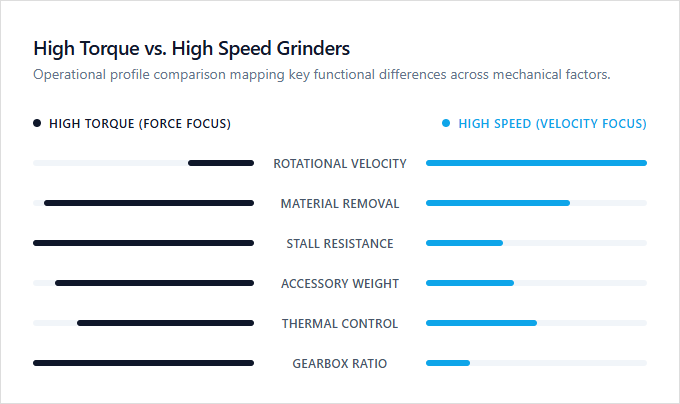
| Rotational Velocity | High-speed grinders operate at maximum revolutions per minute (RPM) to optimize abrasive cutting efficiency, whereas high-torque grinders maintain a lower, controlled angular velocity. |
| Material Removal Rate | High-torque grinders rely on sheer mechanical force to plunge through thick structural steel, while high-speed grinders leverage rapid superficial contact for swift finishing and deburring. |
| Stall Resistance | High-torque units leverage robust gear reduction systems to prevent motor stalling under heavy mechanical load, whereas high-speed units can easily bog down when excessive pressure is applied. |
| Accessory Compatibility | High-speed grinders are paired with small-diameter carbide burrs or flap discs, while high-torque models are engineered to drive heavy wire cup brushes and thick grinding wheels. |
| Thermal Dynamics | High-speed operation generates rapid friction-induced heat on the workpiece surface, whereas high-torque grinding distributes energy deeper with less localized thermal stress. |
| Gearbox Configuration | High-torque grinders utilize planetary or heavy bevel gear reduction to multiply rotational force, while high-speed grinders employ direct-drive or minimal reduction gearing to maximize shaft rotation. |
High-Torque Grinders Maximize Material Removal
High torque grinders are engineered to maintain strong rotational force under heavy loads. By sustaining power when pressing hard against tough substrates, these tools maximize the Material Removal Rate (MRR) during heavy stock removal, deep cutting, and thick weld blending. This consistent power prevents motor stalling and ensures high efficiency during demanding resurfacing tasks.
Conversely, high speed grinders utilize rapid rotations per minute to achieve exceptionally smooth finishes and precise cuts with lighter abrasives. They excel in detail work, polishing, and light deburring where surface quality is the primary objective. Industrial fabricators tackling heavy-duty steel preparation are best suited for high torque models, whereas detail-oriented metalworkers and precision finishers require the control of high-speed units.
Optimizing SFPM for Efficient High-Speed Grinding
When selecting a grinder, understanding the distinction between high torque and high speed models is essential for task efficiency. High-speed grinders are engineered to optimize Surface Feet Per Minute (SFPM), which maximizes the peripheral speed of the abrasive wheel. This rapid rotation facilitates clean, rapid cutting operations, allowing the abrasive material to shear through metal swiftly with minimal operator pressure.
High-torque grinders operate at lower rotational speeds but deliver substantial rotational force. This mechanical advantage prevents the tool from stalling under heavy loads, making them highly effective for aggressive material removal and weld blending. High-speed units are ideal for fabricators requiring precise, rapid slicing, while high-torque models suit heavy industrial welders and masonry workers performing deep stock removal.
Stall Torque Prevents RPM Drops Under Load
When selecting an industrial grinder, understanding the engineering distinction between high torque and high speed is essential for optimal performance. High-torque grinders are specifically designed to maintain consistent rotational speed under heavy resistance. By delivering high stall torque, these power tools effectively prevent RPM drops when pressing into dense materials, ensuring continuous and efficient material removal without overloading the motor.
Conversely, high-speed grinders operate at maximum revolutions per minute to deliver swift, clean cuts through thinner materials where resistance is minimal. While they excel in rapid surface finishing and light cutting, they lack the sustained driving force of their high-torque counterparts under heavy loads. High-torque models are ideal for heavy-duty fabricators and masonry professionals requiring sustained power, whereas high-speed units best serve light-metal workers and finishers focused on rapid, precise cuts.
High speed grinding minimizes thermal stress within the Heat-Affected Zone
When selecting between high torque and high speed grinders, the mechanical demands of the project dictate the optimal choice. High speed grinders excel at minimizing thermal stress within the Heat-Affected Zone (HAZ). By operating at elevated revolutions per minute, these tools reduce contact time between the abrasive and the workpiece, dispersing heat rapidly and preventing metallurgical degradation in sensitive metals.
In contrast, high torque grinders provide the sustained rotational force necessary for deep cutting and heavy stock removal without stalling under load. High torque models are best suited for structural welders and heavy fabricators managing thick-gauge steel, whereas high speed units are ideal for precision machinists and finish-craftsmen working with thin-gauge alloys.
Gear Reduction Multiplies Tool Torque
Industrial grinders are optimized for specific mechanical advantages, primarily categorized by high torque or high speed configurations. High torque tools utilize integrated gear reduction to multiply spindle output, transferring motor power into sheer rotational force rather than velocity. This gearing mechanism prevents the tool from stalling under heavy pressure, maintaining consistent performance during intense grinding operations.
High speed grinders maximize revolutions per minute to facilitate rapid, clean cuts with minimal surface friction. Heavy-duty fabricators and masonry professionals requiring aggressive material removal benefit most from high torque grinders, while metal finishers and detail-oriented tradespeople prefer high speed models for precise cutting and polishing.
High speed grinders prevent Wheel Loading when using bonded abrasives
In industrial metalworking, choosing between a high-torque and a high-speed grinder depends on the specific application and abrasive media. High-speed grinders are particularly effective when utilizing bonded abrasives, as the elevated revolutions per minute allow the abrasive grains to fracture and self-sharpen before metal debris can clog the face. This rapid cutting action successfully prevents wheel loading, which maintains consistent material removal rates and reduces thermal discoloration on the workpiece.
While high-speed models excel at preventing wheel loading, high-torque grinders provide the necessary rotational force to maintain speed under heavy downward pressure. High-torque models are best suited for structural welders and heavy fabricators requiring deep gouging and weld blending, whereas high-speed units are ideal for precision finishers and maintenance technicians who require clean, rapid cuts and delicate surface preparation.
High-Speed Configurations Reduce Finishing Surface Roughness
When selecting a professional grinder, the operational trade-off between high torque and high speed determines the quality of the final workpiece. High-torque grinders excel in rapid material removal, maintaining consistent rotational force under heavy loads. High-speed configurations, on the other hand, are engineered specifically for precision finishing. The elevated rotational speed reduces the chip thickness cut by each abrasive grain, which significantly lowers the Surface Roughness (Ra) values and produces a superior, highly polished surface.
Operating at higher velocities minimizes micro-cracking and thermal damage on the workpiece. High-torque units are ideal for heavy fabrication and demolition workers requiring aggressive stock removal, while high-speed models are best suited for precision machinists and detail-oriented toolmakers aiming for flawless, low-roughness aesthetics.
Leave a comment