
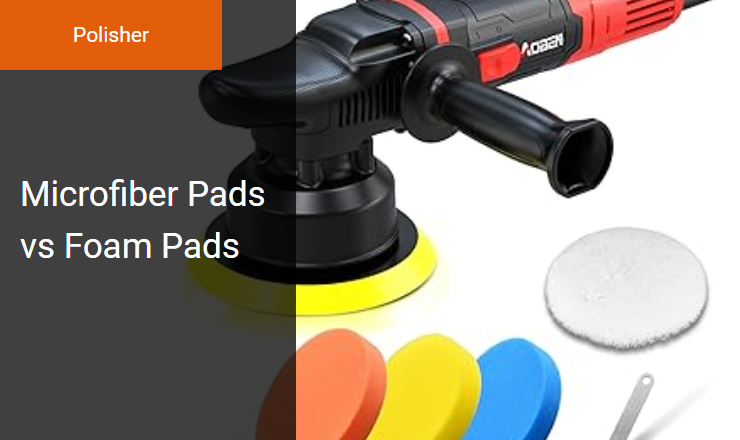
Achieving a flawless, swirl-free finish with a dual-action (DA) polisher often feels like an exercise in frustration, leaving detailers battling persistent micro-marring or stubborn scratches. Traditionally, professionals turned to aggressive wool pads and rotary machines to level defects, which frequently introduced severe hologramming. Selecting the optimal pad-to-machine synergy, however, grants detailers the power to achieve unparalleled paint clarity while reducing labor times by half.
To manage expectations, it is crucial to note that pad performance is highly contingent on clear coat hardness and your machine's specific throw. For instance, pairing a Meguiar's microfiber cutting pad with a Rupes LHR15 MarkIII requires vastly different pressure and speed settings than using a Lake Country HDO foam polishing pad.
Below, we break down the engineering behind microfiber versus foam, compare their heat dissipation properties, and provide a definitive roadmap for selecting the perfect pad for your next paint correction project.
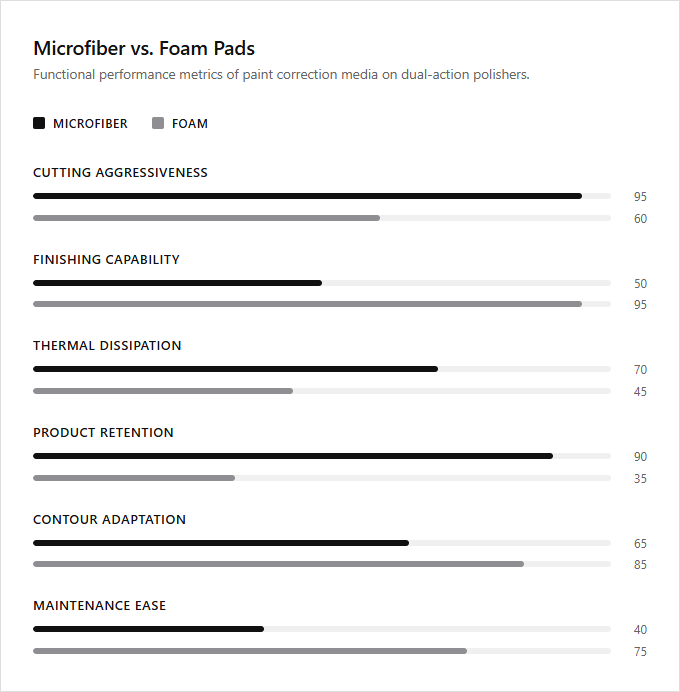
| Factor | Summary |
|---|---|
| Cutting Aggressiveness | Microfiber pads offer superior abrasive correction due to their high fiber surface area, while foam pads rely on specific cell density configurations for varying levels of defect removal. |
| Finishing Capability | Foam pads excel at the final jeweling stage to eliminate compounding haze, whereas microfiber pads are more prone to leaving minor micro-marring on soft clear coats. |
| Thermal Dissipation | Closed-cell foam pads tend to retain heat near the backing plate, while microfiber pads require frequent rotational cleaning to mitigate friction-induced thermal paint damage. |
| Product Absorption | Foam pads exhibit high capillary action that draws liquid polish deep into the cell matrix, whereas microfiber keeps the active abrasive slurry on the outer working surface. |
| Pad Construction | Microfiber pads utilize a laminated polyurethane interface layer for contour adaptation, while foam pads rely entirely on the mechanical properties of their polymer foam structure. |
| Maintenance Requirements | Microfiber fibers require frequent decompression using compressed air to prevent matting, whereas foam pads are typically cleared of spent residue using a pad conditioning spur. |
Microfiber Pads Level Paint Faster Than Foam Pads
Microfiber polishing pads offer superior mechanical abrasion compared to traditional foam pads. The dense network of microfibers increases the contact surface area, allowing the pad to cut through deep paint defects and level clear coats rapidly. This high-cutting efficiency makes microfiber the preferred choice for heavy correction work on hard paint systems.
Foam pads disperse product differently, absorbing compound into their cellular structure to provide a gentler, more predictable finishing action. While foam pads excel at removing fine haze and restoring high-gloss clarity, they lack the aggressive leveling speed of microfiber. Professional detailers tackling severe defects benefit most from microfiber pads, while enthusiasts seeking a mirror-like finish on delicate finishes should opt for foam.
Foam Pads Minimize Haze During Final Finishing
When selecting polishing pads for dual-action (DA) polishers, understanding the structural differences between microfiber and foam is essential for achieving a flawless finish. Microfiber pads feature dense, aggressive fibers that maximize paint contact, making them highly effective for rapid defect correction and heavy cutting on hard clear coats.
Foam pads utilize a pliable, structured cell design that distributes pressure evenly and reduces heat buildup. This characteristic makes foam pads superior for the final finishing phase, as they minimize DA haze and micro-marring to deliver a jewel-like clarity on delicate paint surfaces.
Microfiber pads are best utilized by high-volume detailers requiring fast scratch removal, whereas foam pads are ideal for precision refinishers and hobbyists seeking a flawless, swirl-free final gloss.
Open-Cell Foam Pads Prevent Paint Burning
When selecting polishing pads, understanding the thermal dynamics of microfiber versus foam is essential for safe paint correction. Microfiber pads excel at rapid defect removal due to their dense, abrasive fibers, yet they tend to retain heat during extended use. Conversely, foam pads provide superior temperature control; open-cell foam pads feature a porous, interconnected structure that facilitates continuous airflow, offering superior thermal dissipation to prevent paint burning under high rotation speeds.
This thermal efficiency ensures a safer polishing cycle on delicate clear coats. Microfiber pads are best suited for experienced technicians performing heavy compounding on hard, severely damaged paints, while foam pads are ideal for both beginners and professionals seeking precise finishing and reliable heat management on sensitive surfaces.
Compression-Damping Foam Pads for Vehicle Contours
When selecting polishing pads for automotive detailing, the choice between microfiber and foam significantly impacts the final finish. Microfiber pads feature dense, aggressive fibers designed for rapid paint correction and heavy defect removal. In contrast, foam pads utilize compression damping, allowing the material to compress and rebound dynamically. This physical characteristic enables foam to conform precisely to complex vehicle contours, body lines, and curves, distributing polishing pressure evenly across irregular surfaces.
While microfiber maximizes cutting efficiency on flat panels, foam provides superior finishing capabilities and control on intricate designs. Microfiber pads are ideal for high-volume collision centers and professional detailers focused on rapid defect removal, whereas foam pads are best suited for precision refinishers and enthusiasts working on complex bodywork that requires a flawless, hologram-free finish.
Preventing Microfiber Pad Matting with Frequent Spurring
Microfiber pads offer exceptional cutting capacity due to the high surface area of their individual fibers. However, during operation, these fibers suffer from rapid matting as they accumulate spent compound and clear coat residue. To maintain cutting efficiency and prevent paint marring, operators must perform frequent pad spurring or use compressed air to fluff the fibers between passes.
Foam pads present a different set of performance characteristics, relying on cell structure to manage heat and residue. They resist matting and generally require less active maintenance during the polishing cycle, though they offer less aggressive defect removal. Microfiber pads are ideal for high-volume detailers requiring rapid heavy correction, while foam pads are best suited for refinement specialists and enthusiasts aiming for a flawless, high-gloss finish.
Foam Pad Capillary Action Controls Product Distribution
When selecting polishing pads for paint correction, understanding the material science is crucial for optimal results. Foam pads utilize a specialized cell structure to manage liquid compounds. This cell network controls product distribution through capillary action, drawing the polish into the pores and releasing it evenly under working pressure to ensure a consistent, predictable finish.
Microfiber pads feature thousands of individual fibers that provide a higher surface area, maximizing cutting efficiency for rapid defect removal. While foam pads excel at fine finishing due to their controlled absorption, microfiber pads offer superior leveling capability. Microfiber pads are ideal for technicians performing heavy correction on hard clear coats, while foam pads are best suited for operators seeking a flawless, high-gloss final finish.
Closed-Cell Foam Pads for Ultimate Paint Jeweling
In the realm of automotive paint correction, selecting the appropriate pad media is crucial for achieving a flawless finish. Microfiber pads excel at rapid defect removal due to their dense, abrasive fibers, which maximize surface contact. In contrast, foam pads offer superior control for finishing phases. Specifically, closed-cell foam pads are optimal for paint jeweling, as their dense structure prevents polish absorption and keeps the abrasive particles active on the surface to achieve maximum depth and gloss reflection.
The cellular construction of foam allows for uniform pressure distribution, which is essential for removing microscopic hazing. High-volume collision centers and restoration technicians utilize microfiber pads for rapid correction of severe defects, whereas precision detailers and concours enthusiasts prefer ultra-fine foam pads for delicate, high-gloss jeweling.
Leave a comment