
Achieving a flawless, swirl-free finish is a notoriously frustrating challenge for detailers, who must constantly balance aggressive defect removal with the risk of burning through delicate clear coats. Before allocating standard equipment funding sources to a new machine, professionals must logically bridge the gap between entry-level hand polishing and high-risk rotary correction.
Selecting the correct mechanical motion is key; a properly matched polisher grants operators the ability to safely eliminate deep holograms without the paint-burn hazards of older technologies. However, this transition comes with the educational stipulation that even the best tool must be aligned with proper pad chemistry and paint depth analysis.
Trusted industry benchmarks like the Rupes LHR15 and the Griot's Garage G9 demonstrate how the right mechanism elevates shop efficiency. Below, we provide an executive breakdown of the mechanical differences, safety profiles, and correction speeds of Dual Action versus Random Orbital polishers to guide your next investment.
| Factor | Summary |
|---|---|
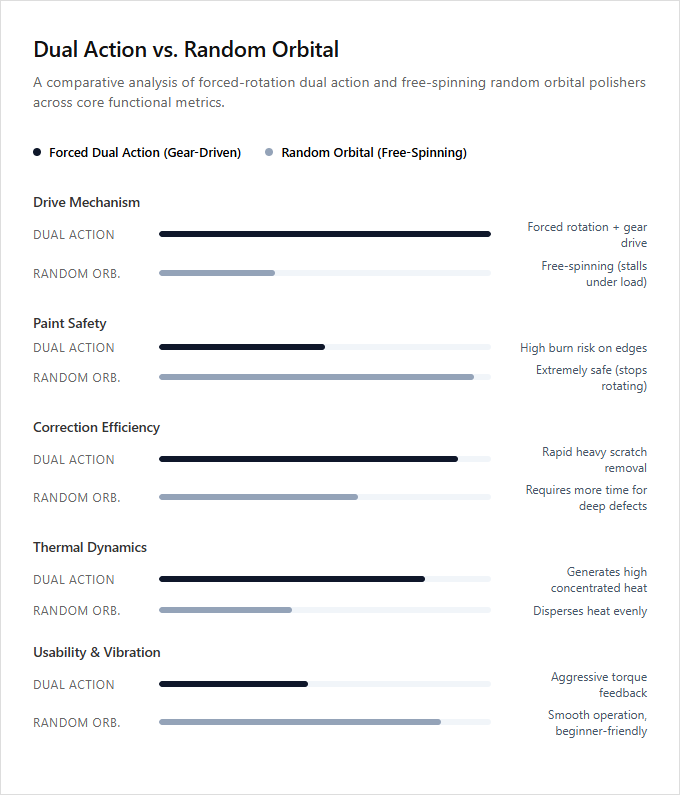
| Drive Mechanism | Dual Action polishers utilize a gear-driven forced rotation alongside oscillation, whereas Random Orbital polishers rely on a free-spinning spindle that can stall under heavy load. |
| Paint Safety | Random Orbital polishers offer a safer operation with a lower risk of paint burn-through because the pad stops rotating when excess pressure is applied, unlike forced Dual Action tools. |
| Correction Efficiency | Dual Action polishers provide superior defect correction and scratch removal due to constant torque, while Random Orbital units require more time to correct deep paint imperfections. |
| Thermal Dynamics | Forced Dual Action machines generate higher friction and surface heat, whereas Random Orbital polishers distribute thermal energy more evenly due to their random oscillation path. |
| Usability and Vibration | Random Orbital polishers generally produce less counter-vibration, making them more ergonomic for beginners compared to the aggressive feedback of gear-driven Dual Action models. |
Random Orbital vs. Forced-Rotation Polishers
Selecting the right polishing tool requires understanding how each mechanism behaves under load. Random orbital polishers utilize a free-spinning spindle design. When excessive pressure is applied, the rotation stops while the orbital motion continues, a safety feature that effectively prevents paint burn-through. In contrast, forced-rotation dual action polishers employ a gear-driven system that maintains constant pad rotation and oscillation, ensuring consistent cutting power even under heavy downward force.
This mechanical difference dictates the speed of defect removal and the safety margin during operation. Random orbital units provide a gentler, heat-reducing action ideal for finishing, whereas forced-rotation models deliver the high-torque correction needed for severe scratches. Beginners and hobbyists seeking a risk-free paint correction process benefit most from random orbital polishers, while experienced detailing professionals tackling heavy defects prefer the relentless power of forced-rotation dual action machines.
How Orbit Size Determines Paint Correction Performance
In paint correction, the distinction between dual action and random orbital polishers lies in their orbit size, measured in millimeters. This throw size determines both the correction speed and the finishing capabilities of the machine. A larger throw increases the surface area covered, accelerating defect removal, whereas a smaller throw concentrates the polishing action for superior finishing and clarity.
The oscillation diameter also dictates the tool's behavior on complex body panels. Larger orbits excel at rapid leveling on flat surfaces, while smaller orbits offer greater stability and safety on tight curves, minimizing localized heat buildup.
High-throw random orbital polishers are ideal for high-volume professional detailers requiring rapid paint correction, whereas standard dual action polishers are better suited for hobbyists and beginners seeking a safer, highly versatile tool for intricate finishing.
Avoiding Polisher Pad Stall on Curved Panels
Dual action and random orbital polishers serve distinct roles in paint correction, primarily differing in their drive mechanisms and behavior under load. Random orbital polishers rely on a free-spinning backing plate driven by centrifugal force rather than direct gears. Because of this design, random orbital polishers are highly susceptible to pad stall on curved panels when excessive downward pressure is applied to the backing plate, which stops the rotation and limits the tool's correction efficiency.
In contrast, gear-driven dual action polishers maintain forced rotation regardless of surface contours or operator pressure. Random orbital polishers are ideal for beginners and enthusiasts seeking a safe, forgiving tool for flat panels, while gear-driven dual action units are best suited for professional detailers requiring consistent cutting power across complex vehicle body lines.
How Dual Action Polishers Prevent Paint Strike-Through
When selecting a mechanical polisher, understanding the thermal dynamics of paint correction is essential. Dual action polishers utilize a unique motion that combines spindle rotation with a secondary orbital path. This constant oscillation prevents the buffing pad from concentrating energy on a single point, which significantly reduces localized friction heat on the clear coat and minimizes the risk of accidental paint strike-through.
In contrast, standard random orbital polishers rely on a free-spinning pad design that delivers excellent finishing capabilities but behaves differently under downward pressure. Dual action models are ideal for beginners and safety-conscious enthusiasts seeking a forgiving tool that prevents paint damage, while high-torque random orbital machines are favored by experienced refinishing technicians who require rapid, heavy defect removal.
Preventing Holograms with Random Orbital Movement
When selecting a paint correction power tool, understanding the mechanical differences between Dual Action and Random Orbital units is essential. The random orbital movement uniquely combines free-spinning spindle rotation with orbital oscillation. This dual-motion technology prevents excessive heat buildup and eliminates the risk of hologramming and unsightly buffer trails, ensuring a safer application on delicate clear coats.
Forced-rotation dual-action polishers maintain consistent pad rotation even under heavy pressure to deliver more aggressive cutting power. Random orbital polishers are ideal for detailing enthusiasts and beginners seeking a foolproof, swirl-free finish, whereas gear-driven dual-action machines are best suited for experienced professionals requiring rapid correction of severe paint defects.
OPM, Not RPM, Governs Orbital Defect Removal
When selecting a polishing power tool, understanding the mechanical distinction between Dual Action and Random Orbital machines is essential for achieving optimal paint correction. In random orbital polishers, defect removal speed is governed by orbits per minute (OPM) rather than traditional revolutions per minute (RPM). This OPM metric measures how rapidly the pad oscillates in an eccentric pattern, which effectively minimizes heat buildup and prevents paint burn-through.
Dual action polishers combine this orbital motion with forced rotation to ensure the pad continues spinning even under heavy pressure. This dual motion provides more consistent cutting power on deep scratches, whereas a standard random orbital relies primarily on free-spinning oscillation. Dual action units are ideal for professional detailers requiring high efficiency, while standard random orbital machines are best suited for beginners and enthusiasts seeking maximum safety against paint damage.
High-Torque Gear-Driven Polishers for Heavy Defect Removal
Selecting the appropriate paint correction machinery requires an understanding of drive mechanisms. Gear-driven dual action polishers utilize a direct drive mechanism to provide high torque for cutting heavy defects without stalling. This forced-rotation design ensures continuous pad rotation under load, delivering consistent cutting power across flat panels and complex body contours alike.
In contrast, standard random orbital polishers employ a free-spinning pad that halts under excessive pressure, which inherently prevents paint burn-through and minimizes hologramming. Standard random orbital models are ideal for DIY enthusiasts seeking a safe, forgiving tool for light polishing, whereas gear-driven dual action units are best suited for experienced professionals requiring rapid, aggressive defect removal.
Leave a comment