
For professional operators and assembly technicians, struggling with post-squeeze adhesive drool, wasted material, and damaged workpiece surfaces is a costly and persistent frustration. Historically, workshops have relied on standard, open-bore nozzle configurations as their baseline tooling investment, operating under the assumption that manual dexterity alone can compensate for basic hardware limitations.
However, transitioning to specialized anti-drip mechanisms grants users a level of volumetric flow control that standard setups simply cannot match. It is critical to stipulate, however, that while anti-drip technology significantly mitigates passive leakage, chamber temperature and adhesive viscosity still dictate overall performance limits.
In high-precision applications-such as delicate electronics potting or intricate cabinetry joinery-the choice of delivery system directly impacts defect rates. This article provides a comparative analysis of anti-drip versus standard nozzles, evaluating their mechanical flow dynamics, thermal efficiency, and long-term cost-to-value ratio to help you optimize your adhesive workflow.
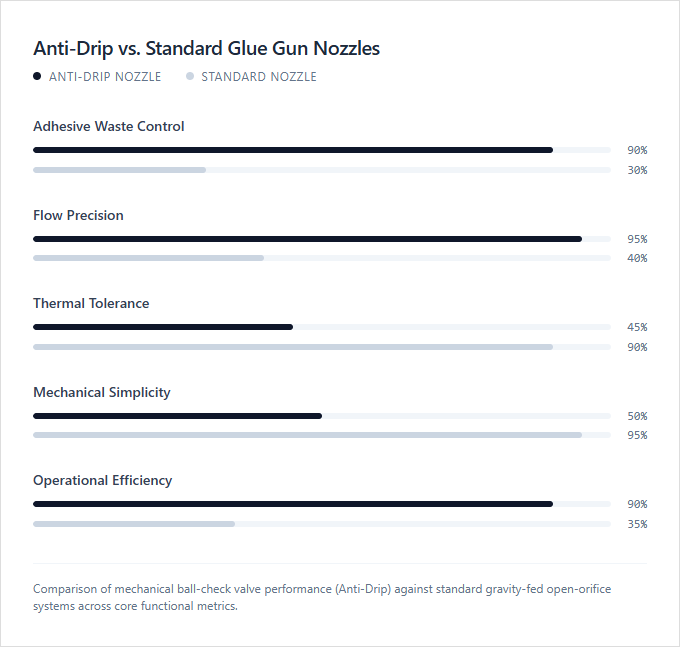
| Factor | Summary |
|---|---|
| Adhesive Waste | The anti-drip nozzle utilizes a mechanical ball-check valve to prevent post-extrusion leakage, whereas a standard nozzle relies solely on gravity and surface tension, leading to significant material loss. |
| Flow Precision | Anti-drip nozzles feature rapid pressure attenuation to eliminate stringing during bonding, while standard nozzles allow continuous molten polymer flow until chamber pressure dissipates. |
| Thermal Regulation | Maintaining optimal viscosity is critical for anti-drip nozzles to prevent premature solidification within the valve, whereas standard nozzles tolerate broader temperature fluctuations due to their open-orifice design. |
| Mechanical Complexity | Standard nozzles offer high reliability through a monolithic construction, while anti-drip mechanisms contain spring-loaded internal components susceptible to clogging under high thermal stress. |
| Operational Efficiency | The clean shut-off behavior of anti-drip nozzles reduces downtime spent on surface cleanup, whereas standard nozzles require frequent manual wiping due to continuous adhesive drool. |
Spring-loaded ball-check valve mechanical shut-off versus open-bore gravity flow
The primary distinction between hot glue gun nozzles lies in their internal flow control mechanisms. A standard nozzle features an open-bore design that relies entirely on gravity flow and thermal expansion, allowing molten adhesive to escape freely whenever the heating chamber is active. In contrast, an anti-drip nozzle integrates a spring-loaded ball-check valve. This mechanical shut-off system uses a small ball held by a spring to seal the orifice, opening only when trigger pressure forces the adhesive forward, effectively preventing unwanted leakage between applications.
Standard nozzles are ideal for high-volume, rapid-assembly industrial workers who require uninterrupted adhesive flow, whereas anti-drip nozzles are best suited for precision crafters and detail-oriented technicians who prioritize a clean, waste-free workspace.
Cavity backpressure regulation during trigger release
In thermal adhesive application, managing the internal cavity backpressure of a glue gun is critical for operational precision. Standard nozzles rely on open-channel flow; when the trigger is released, the residual pressure within the heating chamber slowly dissipates, forcing molten adhesive to ooze out continuously until equilibrium is reached.
In contrast, anti-drip nozzles feature an internal spring-loaded ball check valve designed to regulate this cavity backpressure instantly. Upon trigger release, the valve seals the chamber exit, mechanically neutralizing the remaining pressure and preventing unwanted run-off. Standard nozzles are well-suited for high-volume, continuous industrial bonding where minor dripping is negligible, whereas anti-drip nozzles are ideal for detail-oriented crafters and electronics technicians requiring clean, waste-free precision.
Capillary action minimization at the exit orifice
Standard glue gun nozzles rely on a basic open orifice, which frequently succumbs to capillary action. As the adhesive melts, surface tension and capillary draw pull the liquefied material toward the exit, leading to persistent dripping and material waste when the trigger is released. In contrast, anti-drip nozzles are engineered to minimize this capillary action at the exit orifice. These advanced nozzles incorporate internal check-valves or specialized narrow-taper geometries that break the surface tension and seal the chamber immediately after extrusion stops.
By mitigating gravity and capillary forces, the anti-drip design ensures a cleaner workspace and prevents unwanted adhesive strings. Standard nozzles are suited for high-volume packaging and rapid bonding where continuous flow is preferred, while anti-drip nozzles are ideal for detail-oriented crafters, woodworkers, and electronics technicians requiring precise placement and clean operations.
Viscosity-dependent sealing thresholds under high-temperature operation
In high-temperature glue gun operation, thermal energy significantly lowers adhesive viscosity, testing the containment limits of the dispensing system. Standard nozzles feature an unobstructed orifice that relies solely on capillary action, meaning they frequently fail to prevent gravitational drool when the adhesive liquefies under extreme heat. Anti-drip nozzles address this by integrating internal, spring-loaded ball check valves calibrated to specific viscosity-dependent sealing thresholds, effectively blocking flow until manual trigger pressure overcomes the spring tension.
Standard nozzles suit industrial high-volume operators who require rapid, uninterrupted adhesive delivery, whereas anti-drip models are designed for precision technicians and artisans who perform detailed, intermittent bonding and require a clean work environment.
Non-Newtonian fluid rheology control during adhesive shear thinning
Hot melt adhesive operates as a non-Newtonian fluid, exhibiting shear-thinning behavior where viscosity decreases significantly under applied mechanical shear. Standard nozzles rely entirely on this pressure-induced flow transition; however, once trigger force is removed, the residual low-viscosity polymer continues to weep under gravity and thermal expansion, leading to post-extrusion dripping and material waste.
Anti-drip nozzles mitigate this rheological challenge by incorporating internal spring-loaded ball check valves. This mechanism requires the user to exceed a specific yield stress threshold to initiate flow, while instantly sealing the orifice when trigger pressure ceases to counteract gravity. Standard nozzles are preferred by high-volume industrial operators requiring continuous, uninterrupted extrusion, whereas anti-drip nozzles are ideal for precision assembly technicians demanding clean, highly intermittent adhesive placement.
Thermal expansion tolerance of the internal seating material
The performance divergence between anti-drip and standard glue gun nozzles lies primarily in the thermal expansion tolerance of their internal seating materials. Standard nozzles typically employ basic metal-to-metal joints or rigid seals that can deform under repeated thermal cycling, leading to adhesive leakage as the components expand at different rates. In contrast, premium anti-drip nozzles utilize high-tolerance, fluoropolymer or elastomeric ball-check valves. These advanced materials maintain their sealing integrity and elastomeric memory at peak operating temperatures, effectively countering the volumetric expansion of the molten adhesive.
Choosing the correct nozzle design depends directly on your specific operational workflow. Standard nozzles suit high-production packagers and general crafters who require continuous adhesive flow, while anti-drip models are ideal for detailed model makers, delicate fabricators, and precision woodworkers who require spotless, intermittent application.
Orifice diameter optimization for precise dispensing and stringing reduction
Standard glue gun nozzles feature a consistent, wider orifice diameter optimized for maximum adhesive volume rather than flow control. While this design supports rapid material delivery, the lack of an internal shut-off mechanism often leads to post-dispense drooling and excessive stringing as the molten polymer cools.
In contrast, anti-drip nozzles employ an optimized, restricted orifice diameter integrated with an internal ball-check valve to actively prevent adhesive weep. This structural optimization ensures precise dispensing by instantly cutting off the adhesive flow when trigger pressure is released, significantly reducing clean-up time and material waste. Standard nozzles are ideal for high-volume packaging and construction workers needing rapid bonding, while anti-drip variants are best suited for detailed crafters and electronics technicians requiring meticulous accuracy.
Leave a comment