
In high-volume manufacturing, assembly technicians frequently battle physical fatigue and inconsistent bead profiles when relying on standard adhesive tools. While operations managers typically look to standard capital funding sources to patch these productivity gaps with basic, budget-friendly upgrades, securing approval for specialized machinery can be challenging.
However, choosing the correct extrusion method grants production lines a major leap in efficiency, directly reducing material waste and downtime. Under the stipulation that raw throughput must always be balanced against the specific viscosity of your adhesive and your operators' cycle times, tool selection is highly application-dependent. For instance, in demanding environments like rapid packaging assembly or automotive trim bonding, the wrong feed system can lead to joint failures or costly rework.
This article evaluates the critical differences between pneumatic and manual feed hot melt glue guns, analyzing how each mechanism impacts labor fatigue, bead precision, and overall operational ROI.
| Factor | Summary |
|---|---|
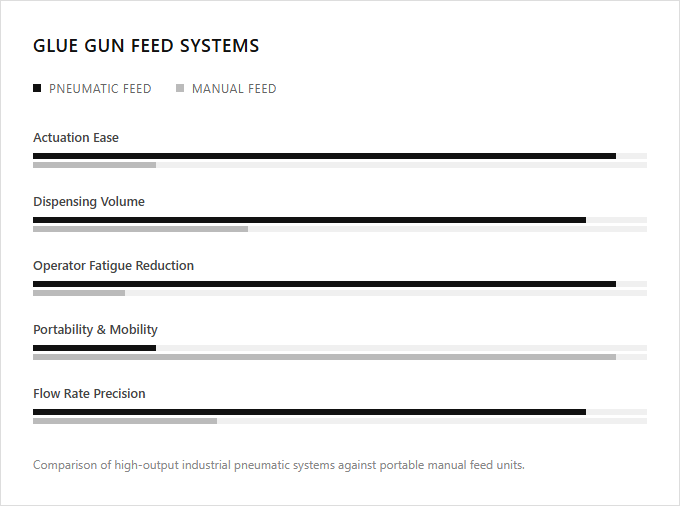
| Actuation Mechanism | Pneumatic feed guns utilize compressed air to drive the adhesive, whereas manual feed guns rely on physical trigger force exerted by the operator's hand. |
| Dispensing Volume | Pneumatic systems excel in industrial manufacturing by delivering continuous adhesive output, while manual systems are better suited for low-volume, intermittent bonding tasks. |
| Operator Fatigue | The pneumatic automatic extrusion mechanism significantly reduces the risk of repetitive strain injury compared to manual models that require constant hand gripping. |
| Portability and Setup | Manual glue guns offer superior mobility requiring only an electrical source, whereas pneumatic systems require a dedicated connection to an air compressor line. |
| Flow Rate Precision | Pneumatic guns provide highly consistent bead dispensation via regulated pressure control, whereas manual feed relies entirely on tactile feedback and variable physical pressure. |
Pneumatic Regulators Outperform Manual Extrusion Control
When selecting industrial hot melt systems, the choice between pneumatic and manual feed glue guns directly impacts assembly precision. Manual feed models rely entirely on hand-squeeze pressure, which introduces natural variance in adhesive delivery. Conversely, pneumatic feed systems utilize regulated compressed air to drive the adhesive, bypassing the ergonomic limitations of physical force.
Pneumatic pressure regulators optimize the process by maintaining a highly consistent extrusion flow rate. By delivering a constant, adjustable pressure to the adhesive chamber, these tools ensure uniform bead width and precise volume control, eliminating the pulsing flow common in manual operations.
Manual feed glue guns are highly suitable for maintenance technicians and low-volume artisans requiring tool portability, whereas pneumatic systems are designed for high-throughput assembly line operators who demand fatigue-free, repetitive precision.
Pneumatic Feed Prevents Fatigue from High-Viscosity Adhesives
Selecting the appropriate feed mechanism for industrial glue guns is critical for operational efficiency. Manual feed glue guns rely entirely on hand-squeeze triggers to advance the adhesive, which is suitable for standard, low-viscosity materials. However, when working with high melt viscosity adhesives, the force required to extrude the material increases significantly, making manual operation impractical for extended periods.
Pneumatic feed systems resolve this issue by utilizing compressed air to drive the adhesive forward. This eliminates physical strain, preventing operator hand fatigue and ensuring a consistent flow rate during high-volume assembly tasks. Manual models are ideal for hobbyists or low-volume packers requiring precision control, while pneumatic feed systems are best suited for industrial assembly line workers handling heavy-duty, high-viscosity bonding.
Pneumatic Pulses Outperform Manual Shot Precision
In industrial adhesive applications, the choice between pneumatic and manual feed glue guns depends heavily on the required precision. Pneumatic feed systems utilize timed compressed air pulses to deliver highly consistent adhesive volumes. This pneumatic control ensures exceptional shot size repeatability, which is critical for standardized assembly lines where product quality must remain uniform.
Manual feed systems rely entirely on operator hand pressure, which inherently lacks the precise shot size repeatability achieved via timed pneumatic pulses. Variations in trigger pull speed and physical fatigue lead to inconsistent adhesive dispensing over extended shifts. Pneumatic models are ideal for high-volume production workers requiring exact tolerances, while manual systems best suit maintenance technicians or hobbyists performing occasional, low-volume bonding tasks.
Pneumatic Feed Maximizes Production Throughput
In industrial adhesive applications, selecting the appropriate feed mechanism for a hot melt glue gun directly impacts operational efficiency. Pneumatic feed systems utilize compressed air to continuously dispense adhesive at a consistent flow rate. This automation maximizes production throughput by significantly reducing manual cycle dwell times, allowing operators to focus on precise placement rather than the physical exertion of manual dispensing.
In contrast, manual feed glue guns rely on a hand-triggered lever mechanism, requiring the operator to physically control the adhesive flow. While this design offers excellent tactile control for intricate bonding, it introduces variable dwell times and potential user fatigue during high-volume runs. Pneumatic systems are ideal for high-output assembly line operators requiring rapid, repetitive bonding, whereas manual feed tools are best suited for craftspeople or technicians performing low-volume, precision-focused assembly tasks.
Pneumatic Solenoids Eliminate Manual Gun Trigger Fatigue
Manual feed glue guns require continuous manual trigger squeezing to advance the adhesive, which often leads to significant operator fatigue during extended production cycles. In contrast, pneumatic feed systems eliminate this physical strain by utilizing compressed air to drive the adhesive forward. A pneumatic solenoid valve control manages the flow with a simple, effortless button press or foot pedal, completely bypassing the mechanical resistance and hand strain associated with manual triggers.
This pneumatic control ensures consistent adhesive volume and maintains high productivity levels throughout long work shifts. Manual systems are ideal for hobbyists or occasional repair technicians needing low-cost portability, while pneumatic models are best suited for high-volume industrial assembly line workers requiring continuous, effortless operation.
Constant Feed Pressure Ensures Uniform Adhesive Beads
When selecting an industrial hot melt glue gun, the feed mechanism directly influences the quality of the adhesive application. Pneumatic feed systems utilize compressed air to deliver constant feed pressure, preventing fluctuations in adhesive bead geometry inherent to manual hand pressure. This consistent output ensures uniform bonding and reduces material waste across high-demand operations.
Manual feed models rely entirely on the physical grip of the operator, which can lead to inconsistent flow rates as hand fatigue sets in over time. High-volume industrial assembly operators requiring precise, repetitive dispensing benefit most from pneumatic feed systems, while field technicians and hobbyists favor manual tools for their portability and simple, electricity-only setup.
Pneumatic Back-Pressure Reduces Nozzle Drool
When selecting industrial adhesive equipment, the feed mechanism significantly impacts operational efficiency and adhesive control. Pneumatic feed glue guns leverage compressed air to drive the adhesive forward, integrating automated back-pressure relief. This system immediately reverses chamber pressure when the trigger is released, minimizing nozzle drool and material waste. In contrast, manual feed models rely on mechanical linkages, which maintain residual force on the adhesive chamber and often lead to post-application dripping.
Beyond precision, pneumatic systems alleviate operator fatigue during high-volume production, whereas manual options offer unmatched portability and simplicity for intermittent tasks. Pneumatic systems are ideal for high-volume assembly technicians requiring clean, precise applications, while manual feed tools are best suited for maintenance personnel performing on-the-go repairs.
Leave a comment