
Every technician has experienced the frustration of a socket slipping off a cordless ratchet in a tight engine bay, or the equally aggravating struggle to pry a stuck socket off an anvil with greasy hands. While professionals typically rely on standard manufacturer tool bundles and default configurations when acquiring new equipment, socket retention is rarely given the strategic consideration it deserves.
Yet, choosing the correct anvil interface grants mechanics immediate gains in both operational speed and workshop safety. To set realistic expectations, we must stipulate that no single retention system is a universal cure-all; for example, heavy-duty diagnostic work utilizing a Milwaukee M12 Fuel ratchet demands a different configuration than high-repetition assembly lines. Below, we break down the mechanics, pros, and cons of friction rings versus pin detents to help you select the ideal socket retention mechanism for your specific workflow.
| Factor | Summary |
|---|---|
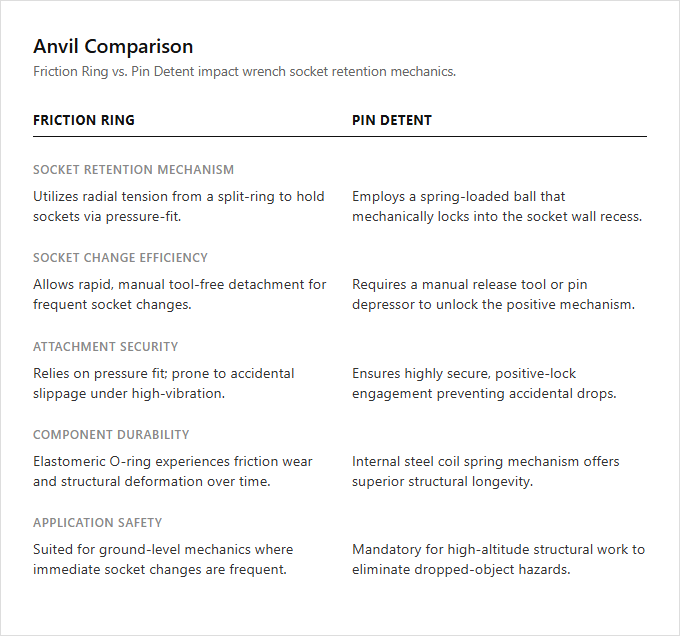
| Socket Retention Mechanism | Friction ring anvils utilize radial tension from a split-ring to hold sockets, whereas pin detents employ a spring-loaded ball that mechanically locks into the socket wall recess. |
| Socket Change Efficiency | Friction rings allow for rapid, manual socket detachment without additional tools, while pin detents require a release tool or pin depressor to unlock the mechanism. |
| Attachment Security | The pin detent provides a highly secure, positive-lock connection that prevents accidental socket detachment during high-vibration applications, unlike the pressure-fit friction ring. |
| Component Durability | The elastomeric O-ring on friction ring anvils experiences rapid wear and deformation over time, whereas the internal coil spring of a pin detent offers superior mechanical longevity. |
| Application Safety | Pin detents are the preferred choice for high-altitude structural bolting to eliminate gravity-induced dropped object hazards, while friction rings are suited for ground-level automotive maintenance. |
Friction Rings for Rapid, Tool-Free Socket Changes
When selecting a power ratchet, the choice of anvil design significantly impacts workflow efficiency. Friction rings utilize radial tension on the anvil for rapid, tool-less socket changes, allowing operators to swap sizes quickly by hand during fast-paced assembly tasks.
Pin detent anvils employ a spring-loaded pin that aligns with a matching hole in the socket to establish a highly secure connection. This mechanism requires a manual tool to depress the pin for socket removal, preventing the socket from slipping off in deep or awkward engine bays.
Friction rings are ideal for automotive mechanics who require frequent, rapid socket changes, while pin detents best suit industrial utility workers who prioritize secure, semi-permanent tool retention during overhead operations.
Pin Detents Prevent Accidental Socket Detachment
When selecting a cordless ratchet wrench, the choice between a friction ring and a pin detent anvil significantly impacts job site productivity and safety. Pin detent mechanisms engage the socket retention hole to prevent accidental detachment during high-vibration operation, keeping the socket securely locked onto the tool. Friction ring anvils instead rely on radial pressure to hold the socket in place, allowing operators to perform rapid, manual socket changes without the need for additional tools to depress a release pin.
The optimal anvil design depends on the specific demands of the work environment. Automotive mechanics performing frequent size changes benefit most from the efficiency of friction rings, whereas industrial technicians working at heights or in high-vibration environments require the uncompromising security of pin detents.
Wear and Retention Loss in Hog and Split Rings
When selecting a power ratchet, the choice between a friction ring and a pin detent anvil significantly impacts long-term socket retention. The friction ring system relies on a split-ring design backed by an elastomer band. Over time, constant socket changes subject these components to frictional wear, resulting in a gradual loss of retention force. This wear eventually requires the replacement of the ring assembly to maintain adequate grip on the sockets.
In contrast, the pin detent mechanism utilizes a spring-loaded pin that mechanically locks into the socket hole, offering secure retention with minimal wear over extended use. Automotive technicians who perform rapid, frequent socket changes benefit most from the quick-release nature of the friction ring, whereas heavy industrial operators working at heights prefer the secure, positive lock of the pin detent.
Pin Detents Increase Socket Transition Time
When selecting a power ratchet wrench, the choice between a friction ring and a pin detent anvil significantly impacts workflow efficiency. Friction ring anvils allow operators to slide sockets on and off quickly, facilitating rapid transitions. In contrast, pin detents require the manual depression of a spring-loaded plunger to release the socket, which increases the cycle time required for socket transitions during multi-size fastening tasks.
While the friction ring excels in speed, the pin detent provides a highly secure connection that prevents sockets from falling off. Friction rings are ideal for automotive mechanics who perform frequent socket changes, whereas pin detents are best suited for heavy industrial workers operating at heights where socket drops pose safety hazards.
Pin Detent Systems for Overhead Tool Safety
When selecting a power ratchet wrench, the choice between a friction ring and a pin detent anvil significantly impacts onsite safety and workflow. Friction rings utilize a retaining ring to hold sockets, allowing for rapid, tool-free swaps. Conversely, pin detent systems employ a spring-loaded pin that locks directly into the socket recess. This positive lock provides crucial security, making pin detents essential for overhead work where dropped tool hazards must be strictly prevented.
While friction rings offer convenience, they can wear down and lose grip over time. Pin detent systems require a tool to depress the pin for socket removal, ensuring the attachment remains secure under heavy vibration. Friction rings are suitable for automotive technicians needing quick socket changes at ground level, whereas pin detent systems are ideal for industrial ironworkers and utility crews performing high-elevation structural tasks.
Friction Ring Anvils Simplify Field Replacement
When selecting a power ratchet wrench, the choice between a friction ring and a pin detent anvil significantly impacts maintenance and productivity. Friction ring anvils hold sockets securely while allowing quick, manual changes without additional tools. A major advantage of this design is serviceability; friction ring anvils allow easier field replacement of the retaining ring and O-ring assembly when they wear out, minimizing tool downtime on the job.
Pin detent anvils utilize a spring-loaded pin that locks the socket firmly in place, requiring a pin tool or small object to release it. This mechanism offers maximum socket retention, preventing accidental drops during high-torque applications or when working in overhead environments. Friction ring models are ideal for automotive technicians requiring rapid socket swaps, whereas pin detent configurations suit industrial operators or structural ironworkers working at heights where absolute socket security is paramount.
Pin Detents vs. Friction Rings: Socket Compatibility
When selecting a power ratchet wrench, the choice of anvil style-friction ring or pin detent-significantly impacts socket compatibility and workflow efficiency. Friction rings utilize friction to hold standard square drive sockets securely in place. This design allows for rapid, tool-free socket changes and is widely compatible with standard off-the-shelf sockets.
In contrast, pin detent anvils employ a spring-loaded pin that locks into a matching hole on the socket. This mechanism requires specialized sockets with aligned thru-holes to establish a secure connection that prevents accidental detachment. Friction rings are ideal for automotive mechanics needing rapid socket changes, while pin detent systems are best suited for heavy-duty industrial operators or overhead workers who require absolute socket retention for safety.
Leave a comment