
Copper Nozzle vs Brass Nozzle: Evaluating Thermal Conductivity for Glue Gun Adhesive Extrusion
Industrial assembly operators and product designers frequently battle inconsistent adhesive flow, nozzle clogging, and thermal lagging-issues that stall production lines and compromise structural bond integrity. While engineering departments typically rely on standard equipment procurement budgets to source generic factory-issued tools, this baseline approach ignores how critical nozzle metallurgy is to heat transfer.
Upgrading to a high-performance alloy grants operators superior thermal responsiveness and flawless, uninterrupted adhesive delivery. However, this upgrade operates under the strict stipulation that the glue gun's heating cartridge can deliver a stable baseline wattage. For instance, in demanding packaging lines or precision automotive trim assembly, the choice of nozzle material directly dictates daily throughput.
This article evaluates the thermal conductivity of copper versus brass nozzles, comparing their melt rates, heat retention, and wear resistance to help you optimize your adhesive extrusion setup.
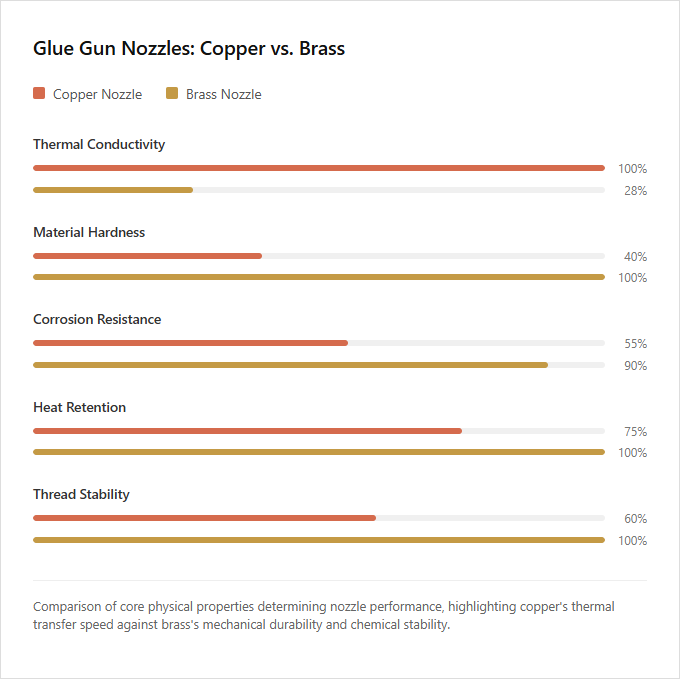
| Factor | Summary |
|---|---|
| Thermal Conductivity | Copper nozzles exhibit superior thermal conductivity compared to brass, allowing for faster heat-up times and more consistent adhesive melting rates. |
| Material Hardness | Brass nozzles possess greater Vickers hardness than pure copper, making them more resistant to physical wear and thread damage during nozzle replacements. |
| Corrosion Resistance | While copper is prone to rapid surface oxidation at high temperatures, brass offers superior chemical stability against reactive compounds found in polyurethane hot melt adhesives. |
| Heat Retention | Brass has a higher volumetric specific heat capacity than copper, which helps maintain a stable operating temperature during intermittent extrusion cycles. |
| Thermal Expansion | The lower coefficient of thermal expansion in brass reduces the risk of thread binding or adhesive leakage at the junction with the heating block. |
Copper vs. Brass: Faster Heat Transfer to Adhesives
In professional glue gun applications, the selection of nozzle material directly dictates thermal efficiency and adhesive flow consistency. Copper features a significantly higher thermal conductivity coefficient (approximately 401 W/m·K) compared to brass (typically around 109 W/m·K). This physical advantage dramatically accelerates the rate of heat transfer into the adhesive, enabling rapid melting, faster startup times, and a continuous delivery of liquefied glue without temperature drops during heavy use.
While brass nozzles heat more slowly, they offer superior mechanical durability and resistance to thread wear over time. High-volume production workers requiring rapid, uninterrupted adhesive output benefit most from copper nozzles, whereas DIY hobbyists and maintenance technicians prioritizing tool longevity and cost-efficiency are better suited to brass.
Copper's Thermal Advantage Minimizes Extrusion Delay
When selecting a professional glue gun, the nozzle material significantly impacts overall thermal performance and operational efficiency. Copper nozzles offer a distinct technical advantage over standard brass alternatives due to their superior thermal diffusivity. This high rate of heat transfer minimizes transient warm-up times and reduces initial extrusion delays, ensuring the adhesive reaches its optimal flow state almost instantly upon tool activation.
While brass nozzles provide excellent wear resistance and cost-effectiveness, they exhibit a slower thermal response during demanding applications. High-volume industrial assembly technicians and rapid-prototyping professionals benefit most from the fast-heating efficiency of copper, whereas occasional DIY hobbyists and school craft educators will find the durable, slow-cooling nature of brass perfectly suited to their intermittent projects.
Copper Thermal Transfer Reduces Hot Melt Extrusion Force
In professional hot melt adhesive applications, the choice of nozzle material directly impacts tool efficiency and operator comfort. Copper nozzles offer exceptional thermal conductivity, transferring heat rapidly to the adhesive. This high thermal transfer optimizes viscosity reduction, allowing the adhesive to flow smoothly and lowering the required extrusion force. Operators experience less hand fatigue and achieve more consistent bead control during prolonged assembly tasks.
Brass nozzles provide a durable, cost-effective alternative with superior resistance to wear and thread damage. Brass retains heat well and withstands physical impact, though it lacks the rapid thermal response of copper. Heavy-duty industrial operators demanding rugged durability benefit most from brass nozzles, whereas high-volume assembly technicians and precision crafters require the effortless, high-flow extrusion of copper nozzles.
How Brass Stabilizes Extrusion Temperatures
When selecting a professional glue gun, nozzle composition significantly impacts thermal performance and adhesive flow. Copper nozzles are highly valued for rapid thermal conductivity, allowing for quick heat-up times and immediate responsiveness to temperature adjustments. Brass nozzles present a distinct thermodynamic advantage for specific operational workflows.
Brass offers greater thermal inertia due to its specific heat capacity, maintaining a more stable temperature during intermittent extrusion cycles. This heat retention prevents the adhesive from cooling prematurely between activations, ensuring consistent viscosity and smooth application. Copper nozzles are ideal for high-speed assembly technicians requiring rapid startup, while brass nozzles are best suited for precision artisans who value stable, intermittent dispensing.
Copper's Thermal Response Maximizes Adhesive Melt Rate
When selecting nozzle components for professional glue guns, the thermal conductivity of the material directly impacts adhesive delivery. Copper nozzles outperform brass equivalents due to their superior heat transfer capabilities. The rapid thermal response of copper prevents localized cooling, maximizing the volumetric melt rate of the adhesive and ensuring a consistent, uninterrupted flow during high-demand applications. Brass, while highly durable and resistant to thread wear, exhibits a slower thermal recovery time under continuous extrusion.
The choice between these two materials depends on the specific operational environment and output requirements. Brass nozzles are highly suited for maintenance technicians needing rugged, long-lasting tools for intermittent repairs, whereas copper nozzles are ideal for high-volume production line operators who require maximum extrusion speeds and precise thermal management.
Copper Heat Risks Polymer Charring During Inactivity
When selecting a professional hot glue gun, the choice of nozzle material significantly impacts thermal management and adhesive integrity. Copper nozzles offer exceptional thermal conductivity, enabling rapid heat-up times and consistent melt rates. However, this intense heat transfer increases the risk of thermal degradation and polymer charring within the chamber during periods of inactivity, which can lead to clogs and degraded bond strength.
In contrast, brass nozzles exhibit a more moderate thermal profile. While they require slightly more time to reach operating temperature, they offer superior resistance to adhesive overheating during workflow pauses. High-volume industrial operators requiring continuous, rapid extrusion benefit most from the efficiency of copper nozzles, whereas intermittent crafters and assembly technicians are better suited to the forgiving thermal stability of brass.
Brass Nozzles Resist Wear from Filled Adhesives
When selecting a professional glue gun, nozzle material significantly impacts tool longevity and thermal efficiency. Copper nozzles offer exceptional thermal conductivity, allowing for rapid heating and precise temperature recovery during high-volume output. While copper excels in heat transfer, brass exhibits superior mechanical strength when processing demanding materials.
Specifically, brass provides superior resistance to abrasive wear at the nozzle orifice when extruding filled or reinforced adhesive formulations. While standard adhesives flow smoothly through copper, specialty glues containing metallic or glass-fiber fillers will quickly erode softer copper orifices, altering the extrusion profile. Brass maintains its dimensional integrity under these abrasive conditions, ensuring a consistent adhesive bead.
Copper nozzles are ideal for high-speed packaging operators requiring rapid thermal response with standard hot melts, whereas brass nozzles are suited for industrial assembly technicians utilizing reinforced, abrasive adhesives for structural bonding.
Leave a comment