
In precision assembly and industrial manufacturing, engineers and technicians frequently battle torque inefficiency-manifesting as stripped fasteners, tool stalling under heavy load, or rapid battery drain. While development teams often rely on standard R&D funding sources to procure higher-voltage brushless motors, simply throwing raw electrical power at the problem ignores the fundamental mechanics of transmission.
Optimizing the internal drivetrain, however, grants maximum torque efficiency and control without increasing energy consumption or tool weight. Of course, achieving this performance is contingent on a critical stipulation: the internal gear configuration must strictly align with the speed and torque requirements of the specific fastening application. For instance, in high-throughput electronics assembly, selecting the correct drive system is the difference between seamless high-volume output and costly line stoppages.
This article compares planetary gearboxes and direct-drive systems in electric screwdrivers. We will evaluate their torque density, mechanical efficiency, and wear characteristics to help you specify the optimal drive configuration for your assembly environment.
| Factor | Summary |
|---|---|
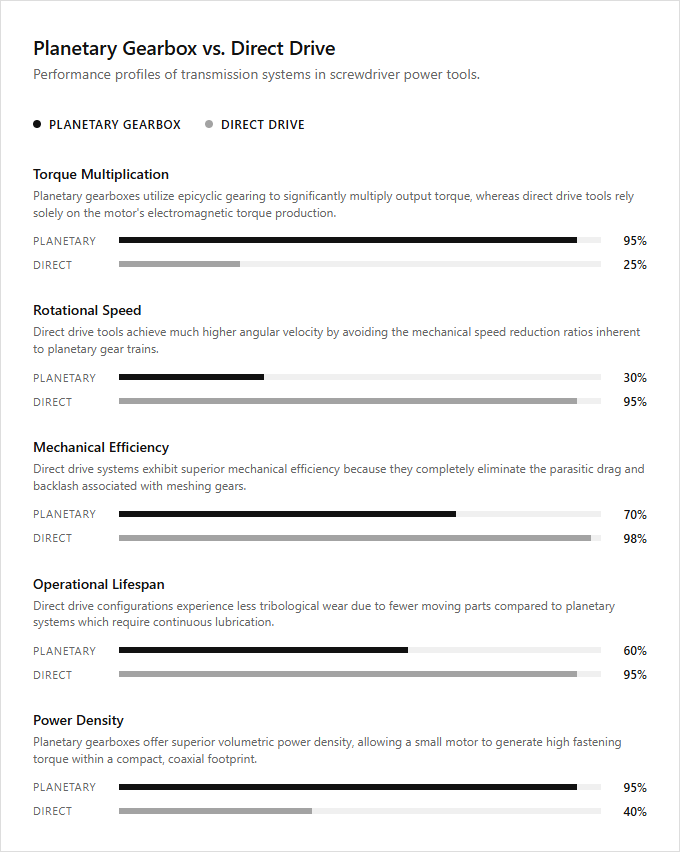
| Torque Multiplication | Planetary gearboxes utilize epicyclic gearing to significantly multiply output torque, whereas direct drive tools rely solely on the motor's electromagnetic torque production. |
| Rotational Speed | Direct drive tools achieve much higher angular velocity by avoiding the mechanical speed reduction ratios inherent to planetary gear trains. |
| Mechanical Efficiency | Direct drive systems exhibit superior mechanical efficiency because they completely eliminate the parasitic drag and backlash associated with meshing gears. |
| Operational Lifespan | Direct drive configurations experience less tribological wear due to fewer moving parts compared to planetary systems which require continuous lubrication. |
| Power Density | Planetary gearboxes offer superior volumetric power density, allowing a small motor to generate high fastening torque within a compact, coaxial footprint. |
Gear reduction ratio amplification of output torque
In electric screwdrivers, the choice between a planetary gearbox and a direct drive system determines how motor power is translated into rotational force. A planetary gearbox utilizes a system of multiple gears to achieve a high gear reduction ratio. This mechanical reduction slows the output speed while significantly amplifying the output torque, allowing small motors to deliver the massive driving force needed for dense materials.
Direct drive systems couple the motor shaft directly to the chuck without intervening gears. This configuration offers high rotational speeds and excellent tactile feedback, though it lacks the torque amplification of geared systems. Planetary gear tools are best suited for carpentry professionals requiring maximum driving power, whereas direct drive tools are ideal for electronics technicians who need precise control and high speed for delicate fasteners.
Rotor inertia limitations on dynamic response and deceleration
In electric screwdrivers, the choice between a planetary gearbox and a direct drive system significantly impacts dynamic response. Direct drive systems couple the motor directly to the spindle, minimizing reflected rotor inertia and allowing for rapid deceleration and precise torque control. In contrast, planetary gearboxes multiply the effective rotor inertia by the square of the gear ratio, which limits the tool's ability to stop instantly and increases the risk of torque overshoot during high-speed fastening.
Direct drive models are ideal for precision electronics assembly technicians requiring instant stopping power and delicate torque control, whereas planetary gearbox screwdrivers suit heavy-duty construction workers needing high torque multiplication over rapid deceleration.
Backlash tolerance affecting torque-holding precision
In power screwdrivers, the choice between a planetary gearbox and a direct drive system hinges on backlash tolerance and its impact on torque-holding precision. Planetary gearboxes utilize multiple gear stages to achieve high torque density. However, the cumulative spacing between these mating gears introduces mechanical backlash. This play can cause minute delays in feedback loops, which can slightly compromise the tool's ability to hold exact torque limits during high-precision fastening tasks.
Direct drive configurations eliminate the gear train entirely by linking the motor shaft directly to the output. This design removes gear-related backlash, delivering immediate rotational feedback and exceptional torque-holding precision. Assembly professionals requiring microscopic accuracy in electronics assembly should select direct drive tools, whereas heavy industrial operators demanding high torque output for robust fasteners will benefit more from planetary gearbox models.
Copper losses and thermal dissipation in low-speed direct drive motors
In screwdriver power tools, choosing between a planetary gearbox and a direct drive motor involves critical thermal trade-offs. Low-speed direct drive motors must draw high current to generate sufficient torque without mechanical assistance. This operating state leads to elevated copper losses, as heat generation scales exponentially with current. Because the motor spins slowly, integrated cooling fans are less effective, which hinders thermal dissipation and risks winding damage. Conversely, planetary gearboxes allow the motor to run at higher, more efficient speeds, leveraging gear reduction to multiply torque while maintaining cooler operating temperatures.
Planetary gearbox screwdrivers are ideal for heavy-duty assembly professionals requiring sustained high torque, whereas direct drive tools suit precision electronics technicians prioritizing silent operation and highly controllable low-torque rotation.
Frictional drag and transmission efficiency attenuation in gear meshes
In electric screwdrivers, the choice between a planetary gearbox and a direct drive system hinges on mechanical efficiency. Planetary gearboxes utilize multiple rotating gears to multiply torque, which inherently increases frictional drag. This multi-tooth contact causes transmission efficiency attenuation due to sliding friction at each gear mesh and viscous shearing of the lubricant. While robust, this design inevitably experiences energy loss during operation.
Conversely, direct drive configurations couple the motor directly to the output shaft, bypassing intermediate gearing entirely. This elimination of gear meshes minimizes frictional drag, ensuring near-perfect transmission efficiency and quieter operation. Planetary screwdrivers are best suited for heavy-duty construction workers needing high torque in compact forms, while direct drive tools are optimal for precision electronics technicians requiring delicate torque control and tool longevity.
Cogging torque ripple affecting low-speed rotational smoothness
Direct drive electric screwdrivers often exhibit pronounced cogging torque ripple at low speeds, a phenomenon caused by the magnetic interaction between the rotor poles and stator slots. This ripple results in subtle rotational pulsations, which can compromise precision during delicate fastening tasks. In contrast, a planetary gearbox mitigates this effect through mechanical dampening and gear reduction. The gear system smooths out the motor's inherent magnetic detent steps, delivering exceptionally fluid rotation and consistent torque output at low revolutions per minute.
While direct drive systems offer mechanical simplicity and high-speed efficiency, planetary gearboxes excel in applications requiring meticulous control. Fine-scale electronics technicians who require ultra-smooth, low-speed fastening benefit most from planetary gear systems, whereas high-volume construction installers demanding rapid, maintenance-free operation find direct drive tools ideal.
Torque-to-weight ratio optimization through high-speed motor gearing
Planetary gearboxes optimize the torque-to-weight ratio in power screwdrivers by pairing a compact, high-speed motor with a multi-stage reduction system. This configuration multiplies output torque while distributing mechanical loads evenly across multiple gears, allowing a lightweight handheld tool to deliver exceptional driving force without added bulk.
Direct drive systems eliminate the gearbox entirely, connecting the motor spindle directly to the output chuck. While this design minimizes mechanical complexity and maximizes rotational speed, it lacks the torque multiplication of geared systems, requiring a larger, heavier motor to achieve comparable fastening power.
Planetary models are ideal for construction contractors and assembly technicians requiring high driving force in a portable frame, whereas direct drive options suit electronics technicians and precision manufacturers seeking rapid, low-torque fastening control.
Leave a comment