
For high-volume drywall and decking contractors, meeting tight project deadlines while battling repetitive strain and dropped fasteners is a constant, costly struggle. To resolve these workflow bottlenecks, managers typically look to standard equipment funding sources and annual tooling budgets to upgrade their active fleet.
Transitioning to collated fastening is a highly effective solution, as it grants installers the capacity to dramatically accelerate on-site production times. However, an important educational stipulation must be made: the ultimate efficiency and ROI of this upgrade depends entirely on selecting the correct system architecture for your specific application.
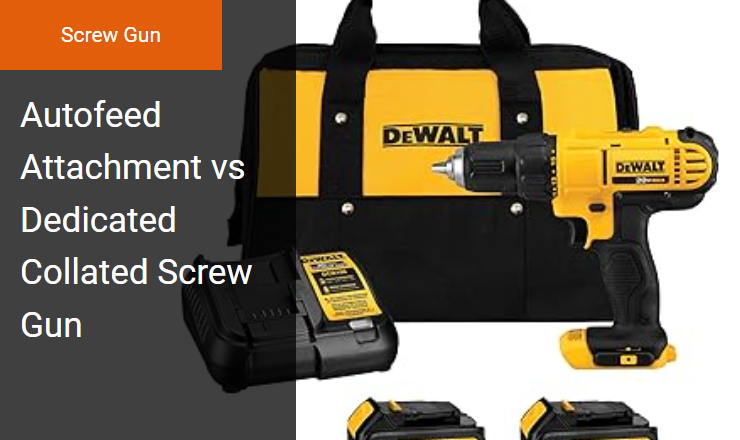
For example, retrofitting a standard DeWalt drywall gun with a removable autofeed attachment offers different mechanical advantages than deploying a dedicated unit like the Makita XR201. This article provides an objective comparison of autofeed attachments versus dedicated collated screw guns, examining duty cycle, ergonomics, and long-term productivity to guide your tooling procurement strategy.
| Factor | Summary |
|---|---|
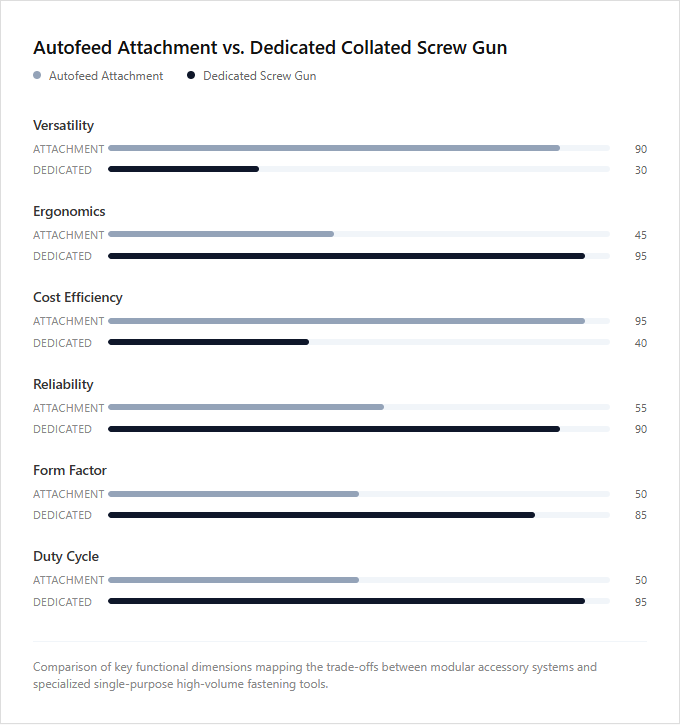
| Versatility | Autofeed attachments allow users to retrofit existing drywall screwdrivers, whereas dedicated collated guns are single-purpose tools optimized exclusively for high-volume fastening. |
| Ergonomics | Dedicated collated screw guns feature an integrated, well-balanced chassis that minimizes operator fatigue, while attachments can alter the tool's center of gravity and cause front-heaviness. |
| Cost Efficiency | Acquiring an aftermarket attachment provides a budget-friendly option for contractors who already own compatible rotary power tools, avoiding the high capital expenditure of a dedicated unit. |
| Reliability | Dedicated tools utilize integrated feed mechanisms designed to minimize indexing failures, whereas detachable systems are more prone to strip misalignment and mechanical jams. |
| Form Factor | The streamlined inline design of a dedicated collated gun provides superior clearance in tight workspaces compared to the bulky snout configuration of an attached system. |
| Duty Cycle | Dedicated units are engineered with high-duty-cycle brushless motors to handle continuous, rapid-fire applications without thermal overloading. |
Rotational Runout: Hex-Shank vs. Direct-Drive Spindles
Autofeed attachments connect to standard drill/drivers via a quick-change hex-shank coupling. This multi-piece interface introduces cumulative mechanical tolerances, resulting in higher rotational runout at the drive bit. The slight wobble can lead to minor screw misalignment, increased bit wear, and less stable engagement during high-speed fastening tasks.
In contrast, dedicated collated screw guns feature an integrated, direct-drive spindle. This solid, single-shaft engineering eliminates coupling play, ensuring minimal runout and precise axial alignment under heavy loads. General remodelers who value tool versatility for occasional boarding will find adaptable autofeed attachments highly practical, while specialized drywall contractors requiring daily, high-speed production and flawless depth consistency are best suited for dedicated units.
Optimizing Motor Gear and RPM for Drywall Applications
Dedicated collated screw guns feature highly optimized motor gear ratios and high RPM ranges-typically exceeding 4,000 RPM-engineered specifically for the rapid torque-drop curve required in professional drywall-to-stud fastening. This integrated system ensures the motor operates at its peak efficiency curve, preventing paper tearing and screw overdrive by instantly disengaging the clutch when the precise depth torque threshold is achieved.
In contrast, autofeed attachments adapt to standard drill-drivers, which utilize broader gear ratios and lower RPM profiles. While versatile, these systems compromise on the specialized speed and torque synchronization necessary for continuous, rapid-fire installation. Dedicated units are ideal for high-volume drywall contractors demanding maximum production speed, whereas autofeed attachments best serve general remodelers seeking tool versatility for occasional mixed-material fastening.
Conserving Platform Battery via Automatic Push-Drive
When comparing autofeed attachments to dedicated collated screw guns, power efficiency remains a key differentiator. Dedicated platforms frequently feature integrated automatic push-drive technology, which engages the motor only when the fastener is pressed against the work surface. This electronic integration drastically conserves battery duty cycle, maximizing runtime per charge compared to standard drill-and-attachment setups that often run continuously during operation.
While versatile attachments offer cost-effective adaptability for existing tools, they lack this seamless, energy-saving synchronization. Dedicated systems optimize ergonomics and power management specifically for continuous, rapid fastening. Autofeed attachments suit general contractors needing occasional collated fastening, whereas dedicated push-drive guns are ideal for high-volume drywall professionals requiring maximum daily productivity.
Micro-adjust nosepiece precision for consistent countersink depth control.
When comparing autofeed attachments to dedicated collated screw guns, precision in depth control remains a defining factor. Dedicated collated screw guns feature integrated micro-adjust nosepieces that offer exceptional stability and precise depth calibration, ensuring every screw sits perfectly flush without tearing the material face. In contrast, autofeed attachments offer excellent versatility but can occasionally experience minor tolerance deviations at the connection point, which slightly impacts the absolute consistency of the countersink depth during high-volume application.
Selecting the ideal tool depends on the frequency and nature of your fastening projects. Dedicated collated screw guns are best suited for high-volume drywall and decking specialists who require relentless, repeatable precision, while autofeed attachments are ideal for general contractors and remodelers who value tool versatility and occasional high-speed fastening.
Center of Gravity Alignment to Reduce Wrist Fatigue
When selecting equipment for high-volume fastening, the tool's center of gravity is a critical factor in mitigating musculoskeletal strain. A standard dry-wall screwdriver fitted with an autofeed attachment shifts the weight forward, creating a front-heavy lever arm that increases torque on the operator's wrist. In contrast, a dedicated collated screw gun is engineered with an integrated drive mechanism, balancing the center of mass closer to the hand to minimize joint fatigue during extended overhead or wall applications.
This physical distribution directly impacts productivity and endurance over long shifts. Remodeling contractors and utility carpenters benefit from the versatility of a modular autofeed attachment for intermittent tasks, while dedicated drywall installers and high-production framing crews require the balanced, integrated tool to sustain rapid, repetitive fastening without injury.
Pawl Feed Track Durability: Universal vs. Dedicated
When evaluating high-volume fastening solutions, the durability of the indexing pawl feed track is a critical differentiator. Universal autofeed attachments must accommodate various screw gun models, often resulting in compromised linkage alignments and increased lateral stress on the feed tracks. Over time, this physical play accelerates wear on the pawl mechanism, leading to frequent misfeeds during intensive applications.
Dedicated collated screw guns feature integrated housings where the indexing pawl and feed track are permanently aligned with the drive axis. This optimized, rigid geometry minimizes torsional flex and reduces friction-induced wear, ensuring consistent, long-term cycling. Remodeling contractors seeking occasional versatility benefit most from adaptable attachments, whereas high-production drywall installers requiring daily, trouble-free repetition should invest in dedicated systems.
Collet quick-release system accessibility for rapid driver bit replacements.
When comparing autofeed attachments to dedicated collated screw guns, driver bit accessibility is a critical efficiency factor. Autofeed attachments, while versatile, often require removing the entire nosepiece assembly to access the collet quick-release system for bit replacements. Conversely, dedicated collated screw guns feature highly integrated, tool-free quick-release collets, allowing operators to swap worn driver bits almost instantly without dismantling the tool housing.
This design integration directly impacts productivity during high-volume fastening tasks. Autofeed attachments suit general contractors who require occasional collated screwing flexibility alongside standard driving functions, whereas dedicated collated screw guns are ideal for drywall specialists and high-production installers who demand rapid, repetitive fastening and minimal downtime.
Leave a comment