
Achieving a flawless surface finish remains a persistent challenge for modern refinishers; selecting the wrong motion profile frequently results in irreversible swirl marks or costly material gouging. While facility managers typically rely on standard equipment capital funding sources to procure workshop machinery, making an uninformed purchase often leads to wasted capital. Selecting the appropriate motion profile grants operators the precise control needed to eliminate hours of manual corrective labor.
However, with the stipulation that even the most advanced tooling requires proper grit progression and speed regulation, professionals must carefully evaluate their specific applications. For example, custom cabinetry makers and automotive restoration shops rely on distinct sanding actions to achieve their signature, high-end finishes. In this guide, we will analyze the mechanical differences between Dual Action and Rotary sanders, evaluate their performance in surface preparation, and outline which tool aligns with your production standards.
| Factor | Summary |
|---|---|
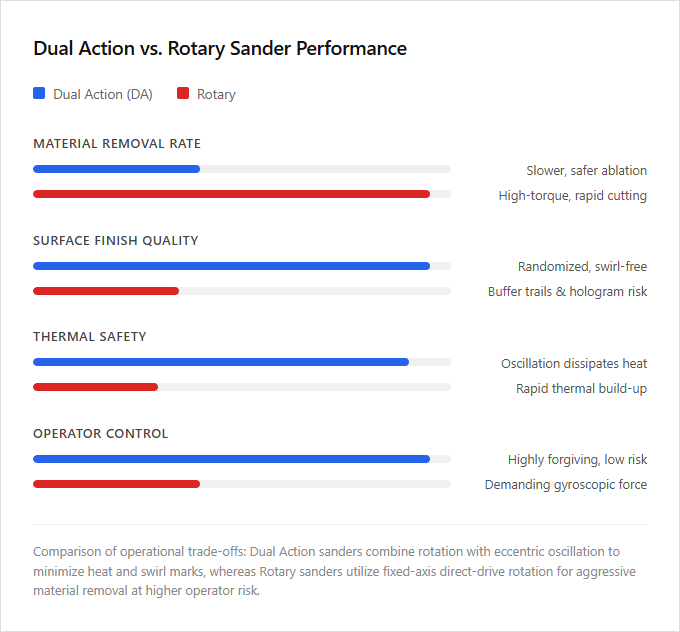
| Motion Mechanics | Dual Action sanders utilize a dual-force mechanism combining rotation with eccentric orbital oscillation, whereas Rotary sanders employ a fixed-axis direct-drive rotation. |
| Material Removal Rate | Rotary sanders provide high-torque, aggressive abrasive cutting action for rapid paint correction or leveling, while Dual Action sanders offer a slower, safer ablation rate. |
| Surface Finish Quality | Dual Action sanders feature randomized pathing that virtually eliminates hologramming and swirl marks, unlike Rotary sanders which can leave noticeable buffer trails. |
| Thermal Dynamics | The concentrated friction of a Rotary sander causes rapid thermal build-up, increasing paint-burning risks, whereas a Dual Action sander dissipates heat through its oscillating movement. |
| Operator Control | Rotary sanders generate a strong gyroscopic effect requiring precise physical manipulation, while Dual Action sanders are highly forgiving with minimal risk of gouging the workpiece. |
Direct-drive spindle rotation for high-torque stock removal
When comparing surface preparation tools, the fundamental distinction between rotary and dual-action sanders lies in their drive mechanisms. Rotary sanders employ a direct-drive spindle rotation that links the motor directly to the backing pad. This engineering ensures uninterrupted, high-torque stock removal that does not stall under heavy pressure, making it exceptionally effective for stripping thick coatings, leveling uneven timber, and correcting severe surface imperfections.
In contrast, dual-action sanders utilize an orbital path alongside rotation to distribute friction and prevent deep swirl marks. Heavy-duty fabricators and restoration specialists favor the aggressive rotary sander for rapid material removal, whereas automotive detailers and finish carpenters rely on the dual-action sander for achieving ultra-smooth, scratch-free final finishes.
Eccentric orbit offset to prevent deep surface gouging
Rotary sanders operate on a fixed axis to deliver rapid material removal, though they carry a high risk of deep surface gouging if misapplied. Conversely, dual action sanders incorporate an eccentric orbit offset, which forces the pad to rotate and oscillate simultaneously. This offset prevents the abrasive from repeating the exact same path, dispersing heat and friction. This design ensures users achieve a smooth, swirl-free finish without the risk of gouging the workpiece.
Dual action sanders are best suited for beginners and automotive detailers seeking a safe, swirl-free finish, while rotary sanders are ideal for experienced professionals undertaking heavy material removal and aggressive stripping.
Revolutions per minute versus orbits per minute speed measurements
Rotary sanders and dual-action sanders utilize distinct speed measurements to define their performance characteristics. Rotary sanders operate using revolutions per minute (RPM), measuring how many times the drive shaft spins the pad on a fixed axis. This direct, high-speed rotation generates significant friction, making the tool highly efficient for rapid material removal.
Dual-action sanders combine rotation with an eccentric path, measured in orbits per minute (OPM). This metric counts how many times the sanding pad completes an orbital loop, which distributes the abrasive action to minimize heat build-up and prevent unsightly swirl marks.
Heavy-duty professionals requiring fast paint stripping find the high-RPM rotary sander essential, whereas woodworkers and detailing hobbyists seeking a flawless, scratch-free finish prefer the precision of the high-OPM dual-action sander.
Thermal buildup mitigation during delicate paint correction
During delicate paint correction, managing thermal buildup is critical to prevent burning through thin clear coats. Rotary sanders employ a direct, single-direction spinning motion that concentrates friction on a localized area. This rapid energy transfer generates high heat quickly, requiring constant movement and precise technique to avoid paint damage.
In contrast, Dual Action (DA) sanders utilize a dual-motion mechanism, combining rotation with orbital oscillation. This design distributes friction over a wider, constantly shifting surface area, inherently mitigating thermal buildup and reducing the risk of paint burns.
Choosing between these tools depends on the technician's experience level and the specific project requirements. Rotary sanders are best suited for experienced professionals tackling heavy defect removal, while dual action sanders are ideal for enthusiasts and detailers seeking safer, more forgiving finish work.
Hologram and swirl mark elimination on clear coats
Rotary sanders operate on a single axis of rotation, generating high friction and heat. While highly efficient for rapid defect removal, this direct spinning motion frequently leaves behind unsightly holograms and micro-swirl marks on delicate clear coats. Dual Action (DA) sanders employ a dual-motion pathway, combining rotation with orbital oscillation. This random, overlapping pattern prevents localized heat buildup and virtually eliminates the risk of buffer trails, making the DA sander the industry standard for achieving a flawless, hologram-free finish.
Achieving the perfect finish depends heavily on the operator's experience and the specific task at hand. Professional detailers seeking rapid correction of deep scratches often rely on the powerful rotary sander, whereas less experienced enthusiasts and refinement specialists prefer the dual action sander for safe, swirl-free finishing.
Material removal rate disparity between direct and random orbital motion
Rotary sanders utilize a direct, fixed-driven rotation that delivers high torque and concentrated friction. This direct drive results in an aggressive material removal rate, making the tool highly efficient for stripping thick coatings and rapidly leveling uneven surfaces. Dual Action (DA) sanders combine rotation with an independent orbital path, creating a random orbital motion. This dual-action mechanism distributes the abrasive force across a wider, shifting pattern, which significantly lowers the rate of stock removal in favor of preventing deep surface scratches.
The mechanical disparity between these drive types dictates their specific application in surface preparation. Professional fabricators requiring rapid material correction benefit most from the high-output rotary sander, whereas detailers and woodworkers seeking flawless, swirl-free finishes are better suited for the precision of the dual-action sander.
Counterweight system implementation for dynamic pad balancing
In power tool engineering, effective vibration management distinguishes Dual Action (DA) sanders from rotary models. DA sanders utilize a precisely calibrated counterweight system to offset the eccentric motion of the backing plate. This dynamic pad balancing neutralizes the centrifugal forces generated by the dual-action orbital path, maintaining stability and reducing hand-arm vibration during operation.
Rotary sanders, by comparison, operate on a direct, fixed axis. Because the rotational mass remains centered, they bypass the need for complex counterweight mechanisms, directing raw motor torque straight to the workpiece. Rotary sanders are ideal for experienced fabricators requiring aggressive material removal, whereas DA sanders are best suited for finish carpenters and automotive detailers seeking a swirl-free finish with maximum control.
Leave a comment