

Every woodworker knows the frustration of a router bogging down mid-cut, leaving behind unsightly burn marks and jagged tear-outs on a valuable workpiece. Traditionally, operators rely on standard speed control dials to pre-set their RPM, a method that unfortunately fails to account for real-time resistance and grain variations. However, transitioning to a router with Electronic Speed Stabilization grants craftsmen the ability to maintain a perfectly consistent cut velocity, regardless of material density. To manage expectations, it is important to understand that this technology does not increase the tool's maximum horsepower, but rather optimizes current distribution to the motor under load. For example, when plunging a profiling bit into dense hard maple or knotty oak, the internal feedback loop instantly compensates to prevent RPM drops. In this analysis, we will compare Electronic Speed Stabilization with standard speed controls, demonstrating how achieving constant RPM directly translates to superior edge finishes and extended tool life.
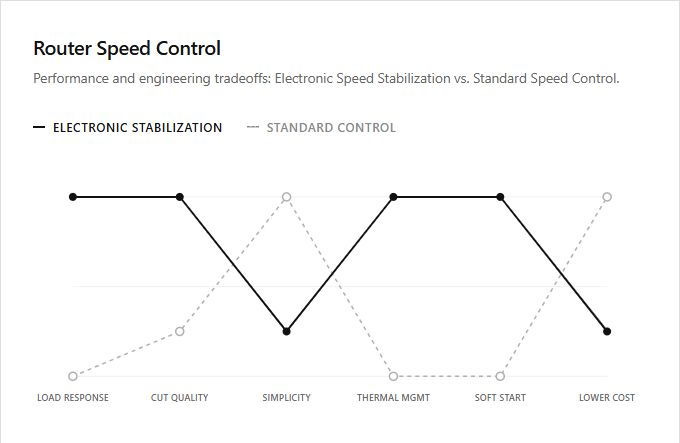
| Factor | Summary |
|---|---|
| Load Response | Electronic speed stabilization utilizes a closed-loop feedback mechanism to maintain constant RPM under load, whereas standard speed control suffers from rotational speed drop when encountering material resistance. |
| Cut Quality | Constant spindle velocity prevents friction-induced burn marks, while the fluctuating speeds of standard controllers often lead to workpiece tear-out. |
| Circuit Complexity | Electronic stabilization relies on microcontrollers and Hall-effect sensors for real-time monitoring, whereas standard control uses simpler analog triac phase-cutting circuitry. |
| Thermal Management | Electronic speed stabilization prevents motor lugging and subsequent armature overheating, whereas standard controllers risk thermal degradation under prolonged heavy loads. |
| Safety Features | Advanced electronic systems incorporate soft-start technology to minimize startup torque reaction, a feature typically absent in basic standard speed control setups. |
| Cost and Repairability | The integrated printed circuit boards in electronic stabilization systems increase initial costs, whereas standard systems utilize inexpensive, easily replaceable potentiometers. |
ESS Closed-Loop vs. Standard Open-Loop Spindle Control
Selecting a routing power tool requires understanding motor speed regulation. Standard speed control operates on open-loop voltage regulation, where the motor's RPM drops under load as material resistance increases. Conversely, Electronic Speed Stabilization (ESS) utilizes closed-loop feedback control via internal sensors to actively monitor and maintain spindle speed, dynamically adjusting power to sustain a constant RPM regardless of the workload.
This technical difference directly affects cutting consistency and edge quality during operation. While standard controllers require manual feed-rate adjustments to prevent wood burning, ESS automatically maintains uniform torque throughout the cut. Standard speed control is ideal for budget-conscious hobbyists undertaking light utility tasks, while ESS is best suited for precision-oriented professionals handling diverse hardwoods and complex profiles.
ESS: Superior Dynamic Power Control via Back-EMF Sensing
In high-performance woodworking routers, maintaining consistent spindle speed is crucial for achieving clean, burn-free cuts. Electronic Speed Stabilization (ESS) achieves this by continuously measuring the motor's back electromotive force (back EMF). When the router encounters dense wood and begins to slow down, the ESS system instantly detects the change in voltage and dynamically increases power delivery to maintain the pre-set RPM. Standard speed control lacks this closed-loop feedback, causing the motor to bog down and lose efficiency under heavy loads.
Standard speed control simply limits input voltage to establish a static baseline speed, meaning it cannot adapt to varying material resistance during operation. ESS is ideal for professional artisans and industrial woodworkers requiring flawless finishes on hardwoods, while standard control is best suited for budget-conscious hobbyists performing light, intermittent tasks.
ESS Maintains Constant RPM Under Heavy Loads
Selecting the right speed regulation system in a wood router directly impacts cut quality and tool longevity. Standard speed control allows operators to select a specific RPM, but it suffers from significant speed droop under heavy loads. As the router bit encounters dense grain or deep passes, resistance causes the motor to slow down, potentially resulting in burn marks and uneven finishes.
Electronic Speed Stabilization (ESS) addresses this limitation by using internal sensors to monitor motor load. When resistance increases, the system automatically provides torque compensation to maintain a constant RPM. Standard speed control is suitable for budget-conscious hobbyists undertaking light, occasional projects, whereas ESS is designed for high-demand professionals who require absolute precision and flawless finishes on heavy-duty production runs.
ESS TRIAC Controller: Millisecond Response to Wood Density
Maintaining consistent rotational speed is critical for achieving clean, burn-free cuts in woodworking. Standard speed controllers are passive, meaning they do not adapt to changing workloads, which often causes the motor to bog down when encountering dense knots. In contrast, Electronic Speed Stabilization (ESS) actively regulates motor performance. This advanced system utilizes a TRIAC-based phase-fired controller to detect load fluctuations and adjust power delivery within milliseconds, preserving constant RPM regardless of wood density variations.
This rapid mechanical response ensures uniform torque and prevents workpiece burning during heavy cuts. Standard speed control is highly suitable for DIY hobbyists performing occasional, light-duty edge profiling, whereas ESS is essential for professional cabinetmakers and production shops requiring absolute precision during continuous, high-volume routing.
How ESS Constant RPM Protects Tools and Workpieces
Standard speed control allows a router's RPM to drop under load, which increases the chip load, accelerates tool wear, and causes friction that burns the workpiece. In contrast, Electronic Speed Stabilization (ESS) actively monitors and maintains a constant motor speed regardless of material density or feed rate. This stabilization optimizes the chip load of the router bit, ensuring clean cuts, extending tool life, and preventing unsightly heat damage on sensitive woods.
By consistently matching power to resistance, ESS delivers predictable results in heavy-duty applications, whereas standard speed control requires manual feed adjustments to compensate for minor RPM drops. Professional woodworkers requiring flawless finishes on dense hardwoods benefit most from ESS, while DIY hobbyists performing basic edge profiling are well-suited for standard speed control.
ESS Stabilizes Cutter Speed for Consistent Wood Finish
When selecting a woodworking router, understanding the distinction between standard speed control and Electronic Speed Stabilization (ESS) is crucial for achieving professional results. Standard speed control allows users to set a baseline RPM, but the motor often slows down when encountering dense knots or hard grains. In contrast, ESS actively monitors load and adjusts power delivery to stabilize the peripheral cutter speed across varying wood densities. This constant velocity prevents burning and ensures a highly consistent surface finish quality.
Maintaining a uniform cutter speed reduces hand fatigue and minimizes the need for corrective sanding. Standard speed control is ideal for hobbyists engaging in light, uniform softwoods, whereas ESS is indispensable for professional cabinetmakers and artisans working frequently with mixed hardwoods and intricate profiles.
ESS Reduces Motor Armature Thermal Stress
When selecting a woodworking router, understanding the difference between Electronic Speed Stabilization (ESS) and standard speed control is crucial for tool longevity. Standard speed controllers regulate velocity under no-load conditions but fail to compensate when the cutter meets resistance, leading to prolonged lugging and excessive heat buildup in the motor armature. In contrast, ESS monitors the load in real time and adjusts power delivery to maintain a constant RPM. This instantaneous regulation significantly reduces thermal stress on the armature, preventing the overheating that typically degrades standard motors during demanding cuts.
The choice between these two systems depends on the user's operational demands. Standard speed control is ideal for hobbyists performing light-duty, intermittent tasks on softer materials, while ESS is designed for high-demand professionals requiring consistent torque and thermal durability during intensive, production-grade routing.
Leave a comment