

Achieving a perfectly flush joint is often disrupted by the frustrating reality of a router bit cutting just a fraction of a millimeter too deep, instantly ruining an expensive workpiece. While woodworkers traditionally rely on standard built-in depth scales and stepped turret stops to get within range, these baseline mechanisms often lack the fidelity required for high-stakes, precision-dependent tasks.
Mastering the transition from rough setups to micro-adjustments grants you absolute control over your cuts, though it is important to stipulate that ultra-fine tuning is only effective once a solid, macro-level baseline is established. This dual-system approach is particularly critical when executing tight-tolerance projects like delicate butterfly inlays or dado joints.
In this article, we will examine the functional differences between macro and micro depth adjustments, detail when to deploy each system, and provide a step-by-step framework for fine-tuning your plunge router to achieve flawless, repeatable depth accuracy.
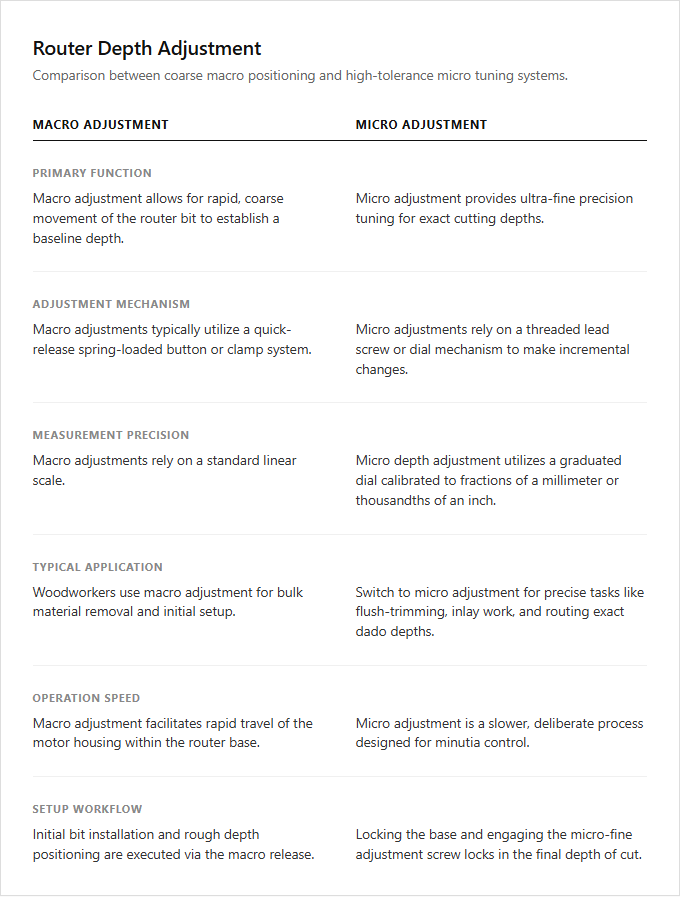
| Factor | Summary |
|---|---|
| Primary Function | Macro adjustment allows for rapid, coarse movement of the router bit to establish a baseline depth, whereas micro adjustment provides ultra-fine precision tuning for exact cutting depths. |
| Adjustment Mechanism | Macro adjustments typically utilize a quick-release spring-loaded button or clamp system, while micro adjustments rely on a threaded lead screw or dial mechanism to make incremental changes. |
| Measurement Precision | Micro depth adjustment utilizes a graduated dial calibrated to fractions of a millimeter or thousandths of an inch for high-tolerance joinery, whereas macro adjustments rely on a standard linear scale. |
| Typical Application | Woodworkers use macro adjustment for bulk material removal and initial setup, then switch to micro adjustment for precise tasks like flush-trimming, inlay work, and routing exact dado depths. |
| Operation Speed | Macro adjustment facilitates rapid travel of the motor housing within the router base, whereas micro adjustment is a slower, deliberate process designed for minutia control. |
| Setup Workflow | Initial bit installation and rough depth positioning are executed via the macro release, followed by locking the base and engaging the micro-fine adjustment screw to lock in the final depth of cut. |
Macro Adjustments via Plunge Lock Lever
Depth adjustment systems on woodworking routers are categorized into macro and micro mechanisms to balance speed and precision. Macro adjustments rely on the plunge lock lever for rapid vertical travel along the guide columns. This mechanism allows operators to quickly set the rough depth of cut, bypassing incremental steps for fast, bulk material removal or initial setups.
Micro depth adjustment systems employ fine-threaded screws or dials to make minute, incremental corrections. This secondary system dials in cuts with extreme precision after the primary depth is set. Professional cabinetmakers requiring exact joint tolerances benefit most from micro adjustments, while general carpenters doing rapid mortising or edge profiling favor the speed of macro systems.
Fine-Pitch Lead Screw for Sub-Millimeter Depth Calibration
Depth adjustment systems in handheld routers are categorized into macro and micro mechanisms, each serving distinct functional requirements. Macro depth adjustment allows operators to make rapid, coarse changes to the cutter height, typically by releasing a motor lock and manually sliding the motor casing within the base. This system is designed for quick initial setups and deep material removal.
Micro depth adjustment systems utilize a fine-pitch lead screw to achieve sub-millimeter depth calibration. This mechanism enables precise, incremental control, allowing the operator to dial in exact cut profiles with high repeatability. Macro adjustments are best suited for general builders performing rough carpentry, while micro adjustments are essential for fine furniture makers executing intricate joinery.
Stepped Turret Stops for Macro System Pass Depths
Depth adjustment mechanisms on wood routers are critical for achieving both efficiency and precision. Macro depth adjustments allow for rapid, large-scale changes to the cutting height. Notably, macro systems utilize a stepped turret stop to establish sequential pass depths, allowing woodworkers to step down a deep cut safely in increments without altering the primary height setting. This mechanism prevents motor strain and ensures clean cuts through dense hardwoods.
In contrast, micro depth adjustments offer ultra-fine control, using threaded dial systems to calibrate the bit height by fractions of a millimeter. This precision is vital for fine-tuning flush trims, rabbets, and delicate joinery. While macro adjustment systems with stepped turrets are ideal for production-focused woodworkers hogging out deep mortises, micro-adjustment systems are best suited for detail-oriented artisans who require absolute dimensional accuracy.
Precision Micro-Adjustments via Graduated Dials
In professional woodworking, mastering depth control is essential for precise results. Macro depth adjustment systems allow operators to make rapid, coarse height changes, moving the router motor quickly within the base to establish a baseline depth for deep cuts or initial material removal.
Micro depth adjustments provide fine-tuning capabilities for critical tolerances. These systems employ a graduated dial for tracking adjustments in thousandths of an inch, allowing operators to make microscopic corrections to the bit height without losing the primary setting.
Macro systems are best suited for construction carpenters who require fast, repeated setups, whereas micro-adjustments are indispensable for instrument makers and fine furniture craftsmen who demand absolute dimensional accuracy.
Macro Pocket Depth Adjustment via Stop Rod
In precision woodworking, mastering both macro and micro adjustment systems is essential for achieving flawless routing results. Macro depth adjustment serves as the primary mechanism, establishing the baseline pocket depth by securing the router's depth stop rod against a stepped turret. This initial phase allows operators to quickly set the rough depth of cut, facilitating rapid material removal without tedious incremental measurements.
Conversely, micro depth adjustment provides ultra-fine calibration, allowing woodworkers to tune the cutting depth by fractions of a millimeter or 1/64-inch increments. This dual-system approach ensures both speed and extreme accuracy during complex joinery tasks. Macro adjustments are ideal for general carpenters executing rapid, deep mortises, while micro adjustments are suited for fine furniture makers requiring absolute precision for flush inlays.
Anti-Backlash Micro-Adjustment Mechanisms
Depth adjustment mechanisms on wood routers dictate the precision and efficiency of your cuts. Macro depth adjustment enables rapid, coarse height positioning of the router bit, which is ideal for initial setup and bulk material removal. In contrast, micro depth adjustment provides ultra-fine control for critical cuts. Premium micro systems feature specialized anti-backlash tension to eliminate thread play during calibration, ensuring that minute dial increments translate to precise bit movement without any mechanical slop.
Selecting between these systems depends heavily on your specific application and workflow. Macro adjustment is best suited for general construction carpenters performing rapid template routing, while micro adjustment is essential for precision furniture makers and luthiers who require exact tolerances.
Precise Micro-Adjustment via Zero-Resettable Collars
Woodworking routers employ two distinct systems for controlling bit depth: macro and micro adjustments. Macro adjustment allows for rapid, coarse movement across a wide range, which is ideal for the initial setup. The micro adjustment system provides fine-tuning capabilities, relying on a zero-resettable collar that allows operators to establish a baseline and make highly accurate relative depth changes measured in fractions of an inch.
While macro adjustments quickly position the motor within the base, micro adjustments dial in the exact cut depth required for flawless joinery. Macro adjustment suits high-volume production workers requiring fast, repetitive setups of standard depths, whereas micro adjustment is essential for precision craftsmen executing detailed inlay work and exact tolerances.
Leave a comment