

Achieving flawless, repeatable depth adjustments in woodworking is a notorious challenge, often resulting in ruined workpieces and wasted workshop hours. While traditional hand chisels or basic laminate trimmers suffice for rudimentary edge treatments, they lack the stability required for complex joinery. Upgrading to a dedicated workshop router grants craftsmen the precise depth control and torque necessary to elevate their cabinetry and furniture making.
However, this precision is stipulative: maximum accuracy is only achievable if you select the correct configuration for your workflow. For example, plunging deep mortises for a dining table requires a vastly different mechanical approach than profiling a repeatable decorative edge on a drawer front.
In this guide, we will compare plunge routers and fixed base routers across key metrics-including depth-adjustment mechanisms, maneuverability, and safety-to help you identify the ultimate precision tool for your workshop.
| Factor | Summary |
|---|---|
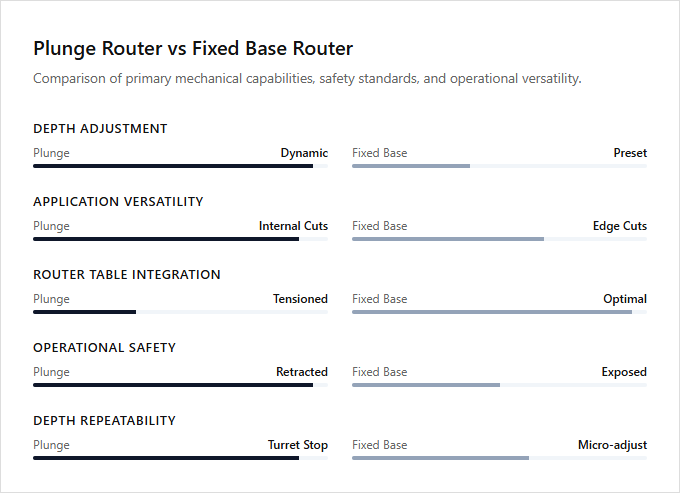
| Depth Adjustment | A plunge router utilizes spring-loaded columns for dynamic vertical depth adjustments during operation, whereas a fixed base router requires manual locking at a preset state before cutting. |
| Application Versatility | Plunge routers excel at internal cuts like mortises and blind grooves by entering the workpiece from above, while fixed base routers are optimized for edge profiling and jointing. |
| Router Table Integration | Fixed base routers are highly preferred for router table mounting due to easy height-adjustment mechanisms, whereas plunge routers suffer from constant spring tension when inverted. |
| Operational Safety | Plunge bases allow the operator to start the motor with the collet retracted, minimizing the risk of kickback, unlike fixed bases where the spinning bit is pre-exposed. |
| Depth Repeatability | Plunge routers utilize a turret stop and depth rod system for sequential stepped cuts, while fixed base routers rely on a threaded ring for micro-adjustments of a single depth. |
Helicoid thread depth adjustment versus spring-loaded plunge guide columns
Fixed-base routers utilize a helicoid thread depth adjustment system, where the motor rotates within the chassis to raise or lower the bit along a threaded groove. This mechanism provides precise, micro-adjustable depth control that remains securely locked during operation, ensuring absolute consistency across flat surfaces.
Plunge routers rely on spring-loaded guide columns that allow the motor to travel vertically on dual shafts. This design enables the operator to lower the spinning bit directly into the workpiece from above. While this configuration offers less static rigidity than threaded adjustments, the spring tension provides the necessary control for stepped cuts and internal mortising.
Precision woodworkers performing repeatable edge profiling benefit most from the stable helicoid system of a fixed base, whereas craftsmen executing complex interior cutouts, templates, and inlay work require the dynamic versatility of a plunge router.
Multi-position turret depth stop with micro-adjustable step rods
When selecting a woodworking router, the depth adjustment mechanism is a key differentiator. Plunge routers feature a multi-position turret depth stop with micro-adjustable step rods, allowing operators to pre-set sequential cutting depths. This mechanism enables precise, incremental passes into the workpiece without stopping the motor, which is essential for deep mortising and stopped grooves.
Fixed base routers, conversely, lock into a single depth setting, offering excellent stability for edge profiling but lacking on-the-fly variability. Plunge routers are best suited for craftspeople undertaking intricate joinery and internal cuts, whereas fixed base routers are ideal for production woodworkers who require reliable consistency for edge-forming and table-mounted applications.
Vernier-scale micro-fine adjustment dial for precise depth calibration
When selecting between a plunge router and a fixed-base router, the depth adjustment mechanism is a critical consideration for woodworking precision. Fixed-base routers frequently utilize a continuous Vernier-scale micro-fine adjustment dial. This system allows operators to calibrate cutting depth with extreme accuracy, often in increments as fine as 1/64 of an inch, ensuring highly consistent and repeatable cuts along the workpiece edge.
In contrast, plunge routers employ a spring-loaded column system with a multi-position turret stop for stepped depth settings. While some plunge models integrate micro-fine dials, the mechanism is designed to facilitate vertical movement during operation rather than maintaining a locked, static position. Fixed-base models with Vernier scales are best suited for production specialists requiring set-and-forget edge profiles, while plunge routers are ideal for versatile craftsmen performing deep mortising, stopped grooves, and template-guided interior cuts.
Plunge lock lever versus fixed-base clamping collar mechanisms
Plunge routers utilize spring-loaded columns regulated by a plunge lock lever. This mechanism allows operators to lower the cutter dynamically into the workpiece and secure it at a precise depth mid-operation. Releasing the lever enables smooth vertical movement, which is essential for executing precise internal cuts such as mortises and stopped grooves.
Fixed-base routers rely on a clamping collar mechanism to lock the motor securely inside the chassis. This design requires manual depth adjustment prior to operation, preventing any vertical movement during the cut. The rigid lock ensures unmatched stability and consistency for edge routing and template guide applications.
Fixed-base models are ideal for production-oriented woodworkers requiring repetitive, highly stable edge profiling, whereas plunge routers are best suited for craftsmen executing intricate, variable-depth joinery.
Through-table height adjustment capability via router lift compatibility
When mounting a router in a table, height adjustment efficiency is a critical consideration. Fixed-base routers are highly compatible with aftermarket router lifts, allowing woodworkers to adjust bit depth directly through the tabletop using a manual crank. This setup provides exceptional precision and stability for stationary profiling, eliminating the need to reach under the table for adjustments.
Plunge routers feature built-in spring-loaded columns that resist the upward force of a lift, making them generally incompatible with standard through-table adjustment systems. While some plunge models offer built-in fine-tuning mechanisms, they lack the seamless, top-side calibration of a dedicated lift paired with a fixed-base motor. Fixed-base setups with lifts are ideal for dedicated workshop crafters prioritizing precision table joinery, whereas plunge routers remain the superior choice for hand-held operators requiring on-the-fly depth changes for mortising.
Ring-and-pinion gearing for controlled vertical travel in fixed bases
Choosing between a plunge router and a fixed base router depends on the specific requirements of your woodworking projects. Fixed base routers often utilize a ring-and-pinion gearing system to enable controlled vertical travel. This mechanical design allows operators to make micro-adjustments to the bit depth with exceptional precision, securing the motor housing firmly within the base once the desired measurement is locked in place.
Plunge routers feature spring-loaded columns that allow the motor to descend dynamically into the workpiece, which is essential for interior cuts like mortises and stopped grooves. Plunge routers are ideal for craftsmen executing varied, freehand joinery, whereas fixed base units with precision gearing are best suited for production woodworkers requiring highly repeatable edge profiles.
Collet immersion depth variation affecting cutter bit shank engagement
Fixed base routers secure the motor in a constant position, maintaining a stable relationship between the collet and the sub-base. This design ensures consistent, maximum shank engagement of the cutter bit throughout the cut. Conversely, plunge routers utilize dynamic vertical movement along spring-loaded columns, meaning the distance between the collet and the workpiece varies continuously during operation.
This variation in collet immersion depth requires careful setup to ensure the router bit shank remains sufficiently gripped, particularly at maximum depth where leverage forces increase. Insufficient shank engagement during deep plunges can lead to vibration or hazardous bit deflection. Woodworkers prioritizing precise, repeatable edge profiles benefit from the stability of fixed bases, while those executing deep mortises or interior cutouts require the versatility of plunge models.
Leave a comment