
Manufacturing and assembly leads frequently struggle to balance operator fatigue with the precise force delivery required for high-volume press runs, often resulting in costly throughput bottlenecks. When upgrading workshop machinery, facilities typically rely on standard capital expenditure budgets or regional industrial development grants to fund these essential tooling acquisitions.
Selecting the right actuation method is critical, as the correct system grants operators a significant boost in mechanical advantage while minimizing physical strain. However, as a key stipulation, managers must recognize that maximizing force delivery always requires a calculated trade-off in cycle speed and tactile feedback. For example, high-precision aerospace component builders and heavy-duty automotive repair shops require vastly different configurations to optimize their daily output.
This article compares hand-operated and foot pedal arbor presses, analyzing their ergonomics, mechanical leverage ratios, and operational footprints to help you select the ideal actuation method for your production line.
| Factor | Summary |
|---|---|
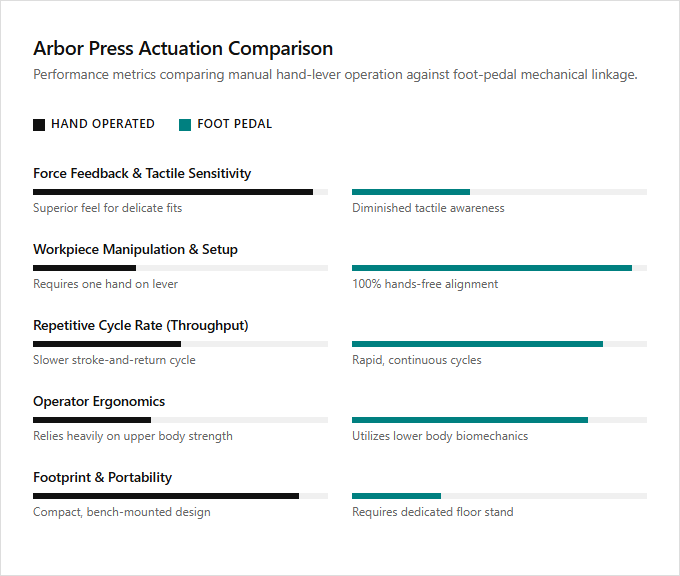
| Actuation Method | Hand operated presses utilize a manual lever rotation to drive the pinion and ram, whereas foot pedal models employ a treadle linkage system to actuate the press downstroke. |
| Operator Ergonomics | Hand operated units rely heavily on upper body strength to apply force, while foot pedal presses reduce repetitive strain by utilizing lower limb biomechanics for force exertion. |
| Workpiece Manipulation | Foot pedal actuation allows hands-free alignment of the workpiece under the ram, whereas hand-operated presses require one hand on the lever, limiting dual-hand material positioning. |
| Cycle Rate | Foot pedal presses generally yield a higher throughput in repetitive assembly operations due to rapid foot-switch cycles compared to the manual stroke-and-return cycle of hand levers. |
| Force Feedback | Hand operated presses provide superior tactile sensitivity through the lever arm, allowing the operator to feel the resistance during delicate interference fits, which is diminished in foot-actuated systems. |
| Footprint and Setup | Bench-mounted hand presses offer high portability and a compact footprint, while foot-operated models typically require a dedicated floor stand to accommodate the mechanical under-table linkages. |
Adjustable Manual Lever vs. Fixed Foot Pedal Leverage
Hand-operated arbor presses utilize a manual lever arm that allows operators to adjust the leverage ratio. By altering the effective length of the handle, users can fine-tune the mechanical advantage to match specific material resistances. This adjustability provides precise, tactile control over force application, which is essential for delicate pressing operations.
Conversely, foot pedal arbor presses employ a fixed mechanical linkage. This configuration delivers a consistent, predetermined stroke and pressure, prioritizing hands-free operation and high throughput over variable force adjustment. Hand-operated units are best suited for precision craftsmen and technicians who require variable force control, while foot-operated models are ideal for production-line workers performing repetitive assembly tasks.
Optimizing Leg Muscle Forces for Foot-Actuated Systems
Hand-operated arbor presses rely heavily on the upper extremity muscle groups, specifically the biceps, brachioradialis, and anterior deltoids, which limits maximum sustainable force and accelerates fatigue during repetitive tasks. In contrast, foot-pedal arbor presses optimize biomechanical input force by leveraging the larger, more powerful lower extremity muscle groups, including the quadriceps femoris and gluteus maximus. This shift utilizes body weight and gravity, significantly reducing upper-body musculoskeletal strain and enhancing mechanical leverage during high-force press operations.
While manual systems offer superior tactile feedback for delicate components, foot-actuated models free both hands for precise workpiece positioning and material handling. Manual hand presses are ideal for laboratory technicians performing low-volume, high-precision prototyping, whereas foot-pedal presses are suited for high-production assembly line workers requiring rapid cycle times and hands-free part manipulation.
Real-Time Tactile Feedback via Manual Pinion Shaft
In precision manufacturing, choosing between a hand-operated and a foot pedal arbor press depends on the required level of force control. Hand-operated presses excel in delicate applications because the operator feels the workpiece's resistance transmitted directly through the lever and pinion shaft. This real-time tactile feedback allows for instantaneous micro-adjustments, preventing part damage during critical press-fit operations.
Conversely, foot pedal arbor presses prioritize hands-free operation and throughput, trading fine tactile sensitivity for speed. While foot-actuated models allow operators to use both hands to align components, they lack the precise force feedback of manual systems. Hand-operated presses are ideal for specialized technicians performing intricate, low-volume assemblies, whereas foot pedal models are best suited for production-line operators executing highly repetitive, standardized fabrication tasks.
Pedal Travel Limits on Ram Stroke and Displacement
Hand-operated arbor presses utilize a manual lever, allowing operators to achieve a full, unrestricted range of ram stroke length. In contrast, foot-pedal operated presses introduce inherent mechanical limitations. The physical travel limit of a foot pedal directly constrains both the maximum ram stroke length and the angular displacement of the driving linkage. Because the human leg has a finite comfortable range of motion, the pedal's arc cannot match the wide rotational sweep of a hand lever, thereby restricting the tool's vertical capacity and pressing depth.
These mechanical differences dictate the ideal workspace integration for each machine. Hand-operated units are suited for precision technicians requiring deep, controlled strokes for varied assembly heights, while foot-pedal models are ideal for high-volume production workers performing repetitive, shallow-pressing tasks that require hands-free material handling.
High-Tonnage Capacity via Manual Compound Leverage
Manual arbor presses rely on mechanical advantage to generate substantial force. Hand-operated configurations often utilize advanced compound leverage gear trains to achieve exceptionally high static tonnage capacity. This specialized gearing multiplies operator input force exponentially, allowing the machinery to perform heavy-duty pressing, bending, and broaching tasks with high precision and minimal physical exertion.
In contrast, foot pedal arbor presses prioritize speed and hands-free operation over extreme force multiplication. While foot-operated models offer lower overall tonnage, they allow operators to use both hands to position and stabilize workpieces during rapid production cycles. Hand-operated compound presses are ideal for toolmakers and maintenance technicians who require maximum force control for heavy interference fits, whereas foot-pedal presses best suit assembly line workers performing high-volume, lighter-duty staking and riveting tasks.
Boosting High-Volume Actuation Efficiency and Reducing Fatigue
In high-volume manufacturing environments, the choice between a hand-operated and a foot-pedal arbor press directly impacts throughput and ergonomics. Traditional hand-operated models require constant manual lever actuation, which limits the overall duty cycle over extended shifts as physical fatigue accumulates in the operator's upper body.
Foot-pedal arbor presses transfer the workload to the lower body, leaving the operator's hands free to align workpieces quickly and safely. This hands-free configuration minimizes repetitive strain, stabilizes cycle times, and maintains a highly efficient workflow during demanding production runs.
Manual hand presses are ideal for specialized technicians performing low-volume, precision adjustments, whereas foot-pedal models are best suited for assembly line workers executing rapid, high-repetition production tasks.
Hand Levers vs. Foot Pedals: Control vs. Speed
Hand-operated arbor presses excel in applications requiring meticulous precision. The manual lever allows operators to manage ram velocity directly and apply metered force with high tactile feedback. This level of control prevents damage to delicate components during pressing, seating, or assembly tasks, making it highly reliable for intricate mechanical work.
In contrast, foot pedal arbor presses prioritize speed and hands-free operation. The foot-activated mechanism triggers a rapid descent of the ram, significantly increasing throughput in manufacturing environments. While this design sacrifices the micro-adjustments of hand leverage, it maximizes efficiency for repetitive, high-velocity tasks.
Manual presses are ideal for specialized technicians performing low-volume, precision assemblies, whereas foot-pedal models suit assembly line workers requiring rapid, high-volume production throughput.
Leave a comment