
Achieving flawless board alignment during complex glue-ups is a persistent challenge for woodworkers, often resulting in frustrating slippage and tedious sanding. Traditionally, craftspeople rely on standard routing profiles, dowel jigs, or pocket screws to bridge these gaps.
However, employing a dedicated biscuit joiner (plate joiner) grants unparalleled lateral adjustability and speed, making perfect alignment effortless. It is important to stipulate that while compressed beechwood biscuits excel at alignment and shear resistance, they do not add immense tensile strength to high-stress joints. Nonetheless, they are highly effective for aligning edge-to-edge tabletop glue-ups and reinforcing cabinet face frames.
This guide will compare biscuit joiners versus routers, analyzing their joint-making capabilities, ease of use, and when to deploy each tool to achieve professional-grade results in your workshop.
| Factor | Summary |
|---|---|
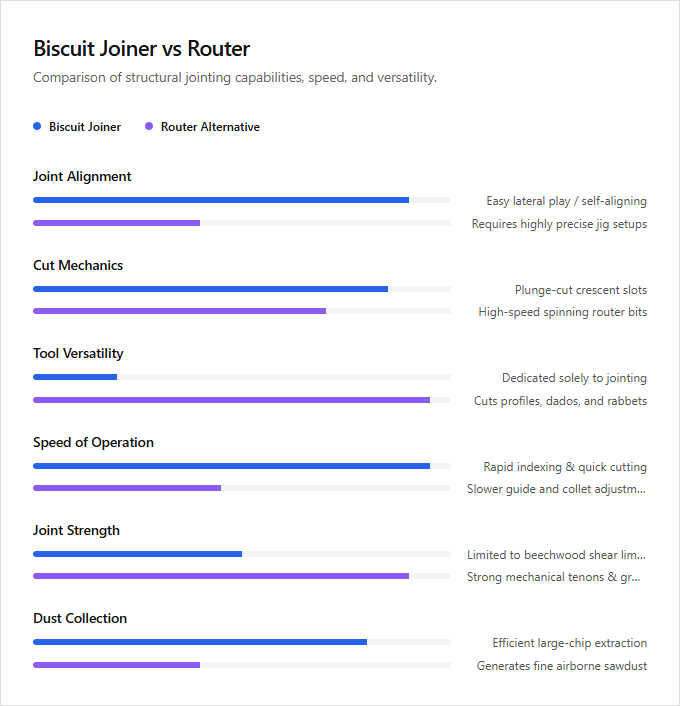
| Joint Alignment | A biscuit joiner utilizes a spring-loaded circular blade to cut crescent-shaped slots allowing lateral play, whereas a router requires highly precise jig setups for perfect alignment. |
| Cut Mechanics | The biscuit joiner operates with a plunge-cutting motion to plunge into the wood face, while a router uses a high-speed spinning router bit to carve channels or profile edges. |
| Tool Versatility | While a biscuit joiner is a dedicated tool designed solely for edge-to-edge joinery, a router is a multi-functional tool capable of cutting dados, rabbets, and decorative profiles. |
| Speed of Operation | Biscuit joiners excel in rapid assembly because of their quick-adjusting indexing fence, whereas routers require longer setup times for collet adjustments and guide templates. |
| Joint Strength | Router-cut joints like mortise-and-tenon or tongue-and-groove offer superior mechanical strength compared to the shear-force limitations of compressed beechwood biscuits. |
| Dust Collection | Biscuit joiners feature integrated dust ports optimized for large chip ejection, whereas routers generate fine airborne sawdust that necessitates high-cfm vacuum extraction. |
Circular Blade Plunge-Cutting vs. High-Speed Routing
A biscuit joiner utilizes a spring-loaded circular blade to plunge-cut precise, crescent-shaped slots into mating workpieces. This dedicated motion is engineered specifically for rapid, accurate alignment in edge-to-edge and miter joints. The resulting pockets accommodate compressed wood biscuits that expand upon contact with glue, creating a strong, hidden bond.
In contrast, a wood router employs high-speed rotational bits to carve out slots, grooves, or mortises. While a router is highly versatile, cutting matching slot joints requires specialized jigs and more setup time compared to the dedicated plunge action of a joiner. Biscuit joiners are ideal for production-oriented cabinetmakers seeking rapid, foolproof alignment, whereas routers best serve general woodworkers who prioritize multi-functional tool utility over single-purpose speed.
Water-Activated Joint Locking via Expanding Beechwood Biscuits
A dedicated biscuit joiner offers a highly specialized method for joining wood, relying on the unique physical properties of compressed beechwood biscuits. When these dry, pre-compressed wooden splines are inserted into the mating slots and exposed to a water-based adhesive, they undergo rapid hygroscopic expansion. The moisture from the glue triggers the beechwood fibers to swell within the pocket, creating a powerful mechanical lock that secures the alignment as the adhesive cures.
A router utilizing a slot-cutting bit can perform similar slotting tasks but lacks the specialized, plunge-and-go speed of a dedicated joiner. While routers offer superior versatility for edge profiling and template routing, they require more setup time for joint alignment. Dedicated biscuit joiners are ideal for production-oriented woodworkers prioritizing rapid, repeatable cabinet and face-frame assembly, whereas versatile routers best suit general hobbyists who require a single tool for diverse shaping and occasional joinery tasks.
Biscuit Slot Tolerance for Easier Glue-Up Alignment
When aligning wood panels during assembly, a biscuit joiner offers a distinct advantage over a router alternative due to its lateral tolerance. A biscuit joiner cuts a slightly oversized, crescent-shaped slot. This specific geometry allows the wooden biscuit to slide slightly left or right within the joint, providing valuable side-to-side adjustability that makes flush face alignment straightforward during glue-up.
A router equipped with a slot-cutting bit produces a precise, tight-fitting channel. While this delivers excellent joint strength, it lacks the forgiving lateral play of a biscuit slot, requiring flawless alignment during the initial cut. A biscuit joiner is ideal for production woodworkers prioritizing fast, forgiving alignment during panel glue-ups, while a router is best suited for detail-oriented craftsmen who require high-strength, multi-purpose joinery and possess the patience for highly precise setups.
Shear Strength: Biscuit vs. Mortise-and-Tenon Joints
When selecting a joinery method for load-bearing projects, the structural difference between a biscuit joiner and a router is significant. A biscuit joiner cuts shallow slots for compressed wooden splines, which excel at board alignment but offer limited resistance to lateral forces. A router utilizes specialized jigs to mill deep, precise mortise-and-tenon joints. This method yields significantly higher shear strength due to the increased glue surface area and deep mechanical interlock within the timber.
While the biscuit joiner excels in speed, it cannot match the structural integrity of router-milled joints. Production-oriented woodworkers focused on rapid cabinetry alignment benefit most from the biscuit joiner, whereas precision furniture makers constructing heavy-duty, heirloom pieces require the robust capabilities of the router.
Preset Fence Detents for Standard Biscuit Sizes
When comparing a dedicated biscuit joiner to a router alternative for wood joining, the primary difference lies in setup efficiency and precision. A specialized plate joiner features an adjustable fence with pre-set detents specifically calibrated for standard #0, #10, and #20 biscuit sizes. This dedicated mechanism allows operators to plunge to the exact required depth instantly, eliminating the need for tedious test cuts and manual measurements.
In contrast, using a router equipped with a slot-cutting bit requires meticulous height adjustments and fence alignment to match these standard biscuit dimensions. While a router offers superior versatility for various workshop tasks, it lacks the streamlined, single-purpose speed of a dedicated plate joiner. A biscuit joiner is best suited for cabinetmakers and production woodworkers who require rapid, repeatable alignment, while a router is ideal for hobbyists and generalists who prefer a single, multi-functional tool for diverse edge-shaping applications.
Cutting Biscuit Slots on a Router Table
While a dedicated biscuit joiner is the traditional tool for creating crescent-shaped mating slots, a router table equipped with a three-wing slot-cutter bit offers a highly precise alternative. By adjusting the bit height and utilizing fence stops, woodworkers can accurately replicate the exact depth and width required for standard wooden biscuits. This stationary setup provides exceptional stability and clean cuts, effectively leveraging the power and speed of an existing workshop router.
This router method requires careful workpiece handling and lacks the portable convenience of a handheld tool. Dedicated biscuit joiners are best suited for production-focused professionals needing rapid, on-site panel alignment, whereas the router table alternative is ideal for budget-conscious hobbyists looking to maximize the versatility of their existing machinery.
Non-Structural Edge-to-Edge Alignment Aid
While both the biscuit joiner and the router join wood, they serve different workshop purposes. A biscuit joiner is engineered specifically for rapid edge-to-edge alignment, keeping adjacent boards perfectly flush during glue-up. Crucially, the wooden biscuits function as an alignment aid rather than a load-bearing structural joint, relying on the glue itself for the actual bond strength.
In contrast, a router is a versatile alternative capable of cutting stronger, load-bearing joints like splines or tongue-and-groove profiles. Although a router requires more setup time, it delivers superior structural integrity. The biscuit joiner is ideal for production woodworkers prioritizing fast panel alignment, whereas the router is best suited for detailed craftsmen requiring high-strength joinery and diverse cutting capabilities.
Leave a comment