
Achieving perfectly flush face joints in biscuit joinery is a persistent challenge, often plagued by minor fence slippage that ruins hours of precision prep work. While professional shops frequently rely on standard funding sources-such as capital equipment loans or workshop upgrade grants-to acquire heavy machinery, optimizing your handheld power tools is the most direct path to flawless alignment. Recognizing that a highly accurate plate joiner grants woodworkers the mechanical consistency needed to eliminate offsets can transform your assembly workflow.
A key stipulation, however, is that the tool's adjustment mechanism must match your specific operational pace; even a premium joiner requires the right interface to maximize efficiency. For example, the widely utilized Porter-Cable 557 illustrates how fence engineering directly dictates joint repeatability on the shop floor.
This article provides an objective, consultative comparison of spring-loaded versus manual fence adjustment systems. We will analyze their stability under pressure, evaluate setup speeds, and determine which system best secures the precise joint alignment your craftsmanship demands.
| Factor | Summary |
|---|---|
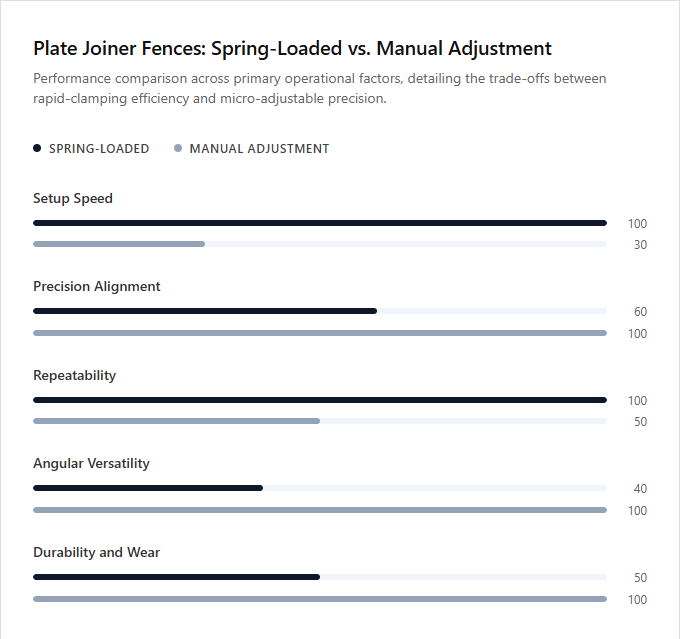
| Setup Speed | Spring-loaded fences utilize rapid-clamping mechanisms for instantaneous height changes, whereas manual fences require loosening and tightening locking knobs, which increases overall cycle time. |
| Precision Alignment | Manual fence adjustments allow for highly precise micro-adjustments along a rack-and-pinion system, while spring-loaded fences rely on pre-set detents that can sometimes exhibit minor play. |
| Repeatability | Spring-loaded fences excel in batch processing due to quick-indexing stops, whereas manual fences require careful verification of the imperial or metric scale to ensure consistent slot registration across multiple workpieces. |
| Angular Versatility | Manual fences typically offer a wider bevel capacity with continuous locking angles, whereas spring-loaded systems often limit specialized miter joint configurations to fixed common increments. |
| Durability and Wear | Manual adjustment mechanisms endure less mechanical fatigue over time because they lack high-tension springs that can lose calibration and tension after prolonged heavy-duty use. |
Spring-loaded dynamic tensioning vs. manual rack-and-pinion height registration
Plate joiners utilize distinct fence mechanisms to establish alignment and depth. Spring-loaded fences employ dynamic tensioning to rapidly conform to the workpiece surface, allowing for swift, automatic clamping and reduced setup times during repetitive assembly. This fluid adjustment style prioritizes speed and adaptability on active jobsites, maintaining constant tension without requiring manual locking steps between cuts.
Manual rack-and-pinion height registration relies on geared precision to deliver highly accurate, lockable vertical adjustments. This rigid mechanism prevents any drift during operation, ensuring flawless alignment for complex, multi-layered joinery. High-production cabinetmakers requiring meticulous accuracy favor the rack-and-pinion system, whereas mobile carpenters and general contractors benefit more from the rapid adaptability of the spring-loaded design.
Self-centering automatic compensation vs. manual vertical offset calibration
Plate joiners rely on precise fence positioning to ensure accurate biscuit slot alignment. Spring-loaded fences feature self-centering automatic compensation, which dynamically adapts to the workpiece thickness to center the slot without manual calculation. This mechanism significantly reduces setup times and eliminates the risk of human error during rapid assembly tasks.
Manual fence adjustment demands precise vertical offset calibration. Operators must manually measure, align, and lock the fence to the desired height, which allows for highly customized, non-centered biscuit placement. Production-oriented woodworkers prioritizing speed and consistency benefit most from the spring-loaded system, while custom furniture makers requiring specialized, off-center joints prefer the meticulous control of manual calibration.
Eliminating Parallax: Spring-Loaded vs. Manual Alignment
Spring-loaded fence systems on plate joiners offer superior precision by referencing directly off the workpiece surface. This mechanical registration eliminates parallax error-the visual misalignment that occurs when reading a manual scale from an angle. By utilizing constant spring tension, the fence automatically flattens against the material, ensuring consistent biscuit slot height regardless of the operator's line of sight.
Manual fence adjustments rely on physical scales and locking knobs. This traditional method requires precise visual alignment, leaving room for parallax discrepancies if the user is not positioned perfectly perpendicular to the scale. Spring-loaded systems are ideal for high-production cabinetmakers who prioritize rapid, error-free setup, while manual fences suit traditional craftsmen who prefer deliberate, tactile control over highly customized height increments.
Datum Stability Under Motor Vibration: Levers vs. Springs
Manual fence adjustment systems utilize robust mechanical locking levers to secure the fence directly to the plate joiner's chassis. Under the high-frequency vibration of the tool's motor, this rigid physical lock ensures the datum surface remains completely static, eliminating the risk of height drift during consecutive cuts.
Spring-loaded fences rely on constant spring tension to maintain position during operation. Although highly efficient for rapid height transitions, continuous motor vibration can induce micro-oscillations in the spring mechanism, potentially compromising alignment precision under heavy lateral loads. Production-oriented woodworkers prioritizing rapid setup changes benefit most from spring-loaded designs, while custom furniture makers demanding absolute joint registration prefer manual locking mechanisms.
Biscuit Setup Speed: Spring-Indexing vs. Thumb-Screws
Plate joiner fence designs significantly impact setup efficiency when transitioning between standard biscuit sizes such as #0, #10, and #20. Spring-loaded, indexing fences provide rapid, positive stops at pre-defined intervals, allowing operators to click directly into the correct height and depth settings instantly. Conversely, manual fence systems utilize thumb-screws that require visual alignment along a scale and manual locking, a process that introduces minor delays when switching workpiece thicknesses.
Although manual adjustments offer infinite micro-adjustments for non-standard offsets, they demand more setup time per joint. High-volume woodworkers prioritizing speed and repetitive standard cuts benefit most from spring-loaded indexing, whereas custom furniture makers requiring specialized, non-standard angles and bespoke alignments are better suited for manual thumb-screw configurations.
Kerf Alignment Repeatability: Spring-Loaded vs. Manual Locking
Spring-loaded fences on plate joiners offer exceptional kerf alignment repeatability across multiple workpieces. By utilizing consistent spring pressure, the fence automatically conforms to the material surface, mitigating human error during repetitive setups. This constant downward force ensures that every plunge cut registers from the exact reference plane, eliminating the microscopic height variations that typically occur when manually repositioning a fence.
In contrast, manual fence adjustment relies on physical locking knobs or levers to secure the height. While manual locking provides a rigid, immovable reference once set, repeating the exact tension across several distinct production runs introduces minor alignment deviations due to varying operator torque. Spring-loaded systems are ideal for high-volume cabinetmakers requiring rapid, identical joints, whereas manual fences are best suited for custom furniture makers who prioritize versatile, one-off angles and maximum rigidity.
Angular Fence Deflection: Manual Stops vs. Spring Tension
Manual fence systems utilize positive mechanical stops and locking knobs to secure the plate joiner at specific angles. This physical locking mechanism minimizes angular deflection, maintaining a highly rigid reference surface even under significant downward pressure during the plunge cut.
Spring-loaded fences rely on continuous pivot tension to allow rapid, tool-free angle adjustments. While this design is highly efficient for shifting between varied bevels, the reliance on spring tension can allow minor deflection if the operator applies uneven force during operation.
Cabinetmakers prioritizing absolute precision for repetitive production runs typically prefer manual positive stops, while trim carpenters requiring rapid, on-the-fly adjustments on active jobsites benefit most from spring-loaded systems.
Leave a comment