
For trade professionals and serious craftspeople, choosing a power saw often involves a frustrating compromise: sacrificing the endless, fade-free torque of a wall outlet or forfeiting the agile mobility required on dynamic job sites. Traditionally, operators bridged this operational gap by relying on standard utility grid connections or noisy site generators, accepting cord-management hazards as an unavoidable cost of doing business.
Fortunately, rapid advancements in high-output battery chemistry now grant users near-parity in raw cutting force, redefining the performance limits of portable tools. Still, an important stipulation remains: cordless systems demand disciplined charging workflows to prevent mid-project stalling during highly demanding applications, such as ripping thick white oak or framing rafters. This guide examines the essential trade-offs between corded and cordless platforms, evaluating sustained torque, runtime logistics, and overall lifetime value to help you select the optimal saw for your specific operational needs.
| Factor | Summary |
|---|---|
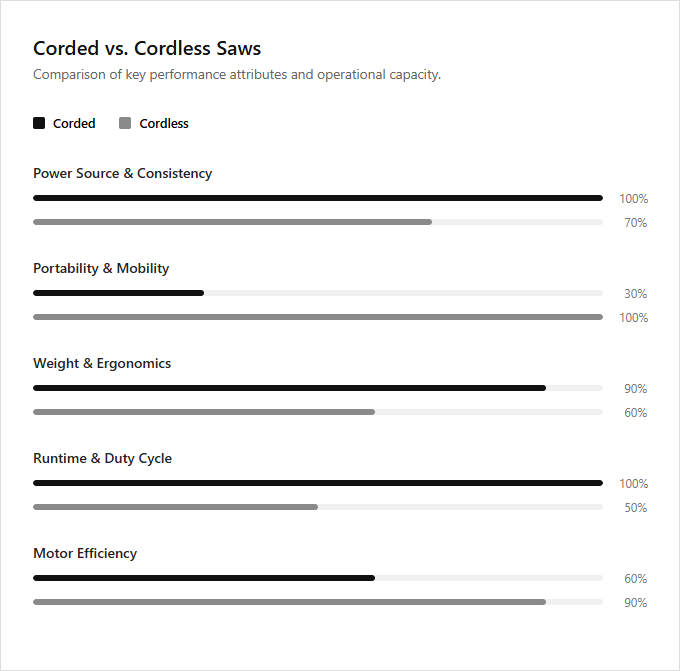
| Power Source and Consistency | Corded saws draw continuous alternating current (AC) directly from mains electricity, preventing the voltage drop-off experienced as battery charge depletes in cordless models. |
| Portability and Mobility | Cordless saws leverage high-capacity lithium-ion battery packs to offer unrestricted maneuverability on remote jobsites without the hazard of extension cords. |
| Weight and Ergonomics | Corded models are generally lighter and easier to handle during extended use because they lack the heavy onboard battery cell configuration required by cordless alternatives. |
| Runtime and Duty Cycle | Corded saws offer infinite duty cycles for continuous heavy-duty cutting, whereas cordless saws are limited by the milliampere-hour (mAh) capacity of their power source. |
| Motor Efficiency | Modern cordless saws frequently utilize highly efficient brushless motors to maximize torque and conserve energy, while corded models rely on traditional brushed universal motors for sustained high-amperage output. |
Corded Saws: Unlimited Grid Power for Consistent Output
When selecting a power saw, the choice between corded and cordless models depends largely on power requirements and mobility. Corded saws draw unlimited amperage directly from the AC grid, ensuring consistent, high-torque output that does not fade during heavy-duty cutting. This continuous electrical supply allows operators to tackle dense materials without the risk of performance drops.
In contrast, cordless saws offer unmatched portability and convenience, utilizing advanced battery technology for remote job sites. While modern batteries provide impressive power, they remain limited by run-time and gradual discharge. Stationary workshop professionals undertaking prolonged, heavy-duty fabrication benefit most from corded models, whereas mobile contractors requiring quick, agile cuts in diverse locations are best suited for cordless alternatives.
Brushless Motors Boost Cordless Saw Battery Efficiency
When selecting between corded and cordless power saws, power delivery and mobility are the primary considerations. Cordless saws have closed the performance gap significantly due to the integration of brushless DC motors. These motors optimize battery efficiency by reducing friction and heat loss, allowing the tool to adjust its power output dynamically based on the resistance of the material. This technological advancement ensures prolonged runtime and consistent torque without the constraint of a power cord.
In contrast, corded saws offer uninterrupted, high-capacity output directly from electrical outlets, eliminating concerns over battery degradation or charging downtime. High-demand professionals working in stationary workshops benefit most from the limitless power of corded models, while mobile contractors and DIY enthusiasts requiring maximum portability are ideal candidates for cordless alternatives.
Corded models maintain higher stall torque under prolonged heavy-duty cutting
When selecting between corded and cordless power saws, the primary distinction lies in the nature of power delivery. Corded models excel in high-demand environments due to their uninterrupted electrical supply. This constant connection allows corded saws to maintain higher stall torque under prolonged, heavy-duty cutting tasks, preventing motor deceleration when processing dense materials.
While cordless saws offer exceptional portability and convenience, their performance can fluctuate as battery reserves deplete under sustained resistance. Corded tools are best suited for stationary workshop professionals who require relentless power for continuous timber ripping, whereas cordless options are ideal for mobile contractors who prioritize agility and rapid deployment across diverse jobsites.
Cordless portability is dictated by lithium-ion battery amp-hour ratings
When selecting a power saw, the choice between corded and cordless models hinges on your operational environment. Corded saws deliver constant, uninterrupted power for demanding tasks, relying entirely on proximity to an electrical outlet. In contrast, cordless saws offer superior maneuverability, freeing users from the constraints of power cords.
The portability and runtime of cordless saws are directly dictated by the lithium-ion battery's amp-hour (Ah) rating. Higher amp-hour capacities provide extended operation on a single charge, which is crucial for remote job sites, though they increase the overall weight of the tool. Corded saws are best suited for high-volume workshop professionals, while cordless saws are ideal for mobile tradespeople needing maximum jobsite flexibility.
How Battery Weight Affects Cordless Saw Power-to-Weight
When comparing corded and cordless saws, the primary differentiator lies in power delivery and tool ergonomics. Cordless models offer unparalleled portability, but their power-to-weight ratio is heavily impacted by battery pack mass. High-capacity batteries provide the voltage required for demanding cuts, yet this added weight can increase user fatigue during prolonged operation. Conversely, corded saws deliver constant, unrestricted power without the physical burden of an onboard energy source, maintaining a highly favorable power-to-weight ratio.
Choosing between these configurations depends on the specific operational environment and workflow requirements. Corded saws are ideal for high-volume workshop professionals requiring continuous, heavy-duty cutting, while cordless models suit mobile contractors and DIY users who prioritize maneuverability and remote site accessibility.
Improper Extension Cords Cause Saw Voltage Drop
When selecting between corded and cordless saws, power delivery remains a critical performance factor. Corded saws offer continuous runtime but are highly sensitive to their power source infrastructure. Operating a corded saw with an incorrect American Wire Gauge (AWG) extension cord over long distances causes a significant voltage drop. This restriction starves the motor of necessary power, resulting in overheating, decreased torque, and premature tool failure.
Cordless saws bypass this specific vulnerability by utilizing high-capacity lithium-ion batteries, though they require managed charging intervals to maintain productivity. Stationary workshop professionals requiring uninterrupted, heavy-duty cutting benefit most from corded models, whereas mobile contractors needing maximum agility on dynamic jobsites are better served by cordless alternatives.
How Cordless Saws Regulate RPM Under Load
When selecting between corded and cordless saws, power consistency remains a primary consideration for trade professionals. Historically, corded models delivered uninterrupted power, while cordless alternatives experienced performance drops under heavy resistance. Modern cordless saws mitigate this limitation through advanced electronic speed control, which actively regulates revolutions per minute under load. This technology ensures the motor maintains a consistent cutting velocity even when encountering dense knots or thick timbers, effectively narrowing the performance gap between the two power sources.
While corded saws offer limitless runtime for high-volume, stationary cutting stations, cordless options provide unmatched portability on active jobsites. Heavy-duty framing carpenters requiring continuous, high-capacity output benefit most from the relentless power of corded saws, whereas finish carpenters and mobile contractors prioritizing maneuverability and quick setups are ideal candidates for cordless versatility.
Leave a comment