
Few workshop frustrations match the sudden jolt of "bottoming out" mid-bore-a common pain point for craftspeople whose drill presses lack the depth capacity to finish a cut, often resulting in misaligned holes or ruined workpieces. While standard workarounds, such as repeatedly adjusting the table height or relying on shorter, specialized drill bits, can temporarily bridge the gap, they ultimately disrupt workflow and compromise accuracy.
Fortunately, investing in a machine with generous quill travel grants you the uninterrupted capability to execute deep bores in a single, fluid pass. It must be stipulated, however, that greater spindle stroke requires a more rigid column design to prevent deflection. For example, heavy-duty applications like boring deep mortises in oak or drilling through thick steel plate demand this exact combination of depth and stability.
Below, we will compare high versus low quill travel, analyze how spindle stroke dictates your tool's capacity, and help you select the ideal depth configuration for your specific trade.
| Factor | Summary |
|---|---|
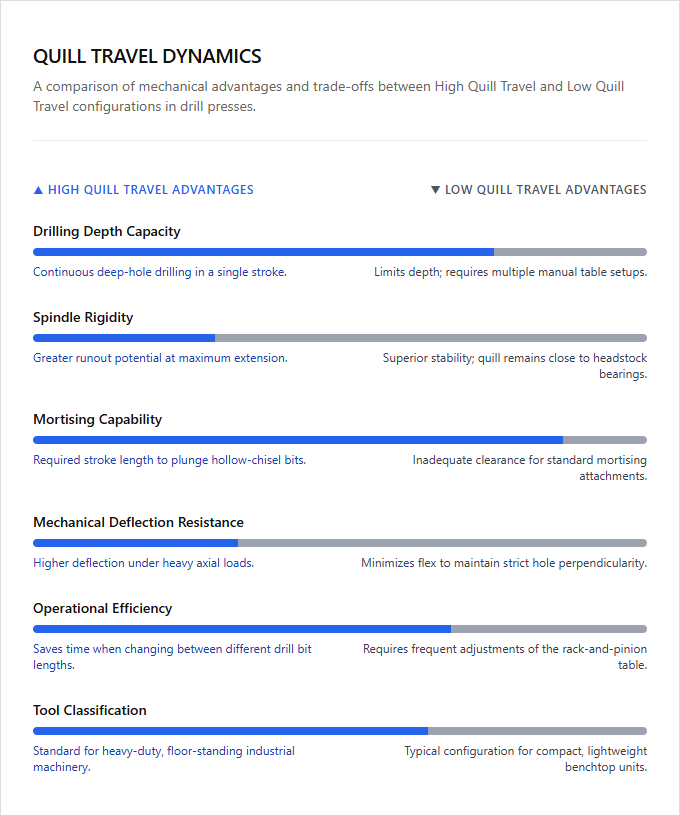
| Drilling Depth Capacity | High quill travel allows for deep-hole drilling in a single continuous stroke, whereas low quill travel limits the depth of cut and requires multiple manual setup adjustments. |
| Spindle Rigidity | Low quill travel inherently provides superior spindle rigidity and minimizes runout because the quill remains fully supported closer to the headstock bearings. |
| Mortising Capability | High quill travel is critical for utilizing mortising attachments, as it provides the necessary stroke length to plunge hollow-chisel mortising bits through thick wood stock. |
| Mechanical Deflection | Low quill travel reduces mechanical deflection under high axial load, ensuring greater hole perpendicularity and accuracy during high-tolerance operations. |
| Operational Efficiency | High quill travel increases workshop throughput by reducing the frequency of raising or lowering the rack-and-pinion table when changing drill bit lengths. |
| Tool Classification | Low quill travel is typical of compact, lightweight benchtop drill presses, whereas high quill travel is a key specification of heavy-duty, floor-standing industrial machines. |
Deep-Hole Drilling Without Table Adjustments
When selecting a drill press, quill travel dictates maximum drilling depth. High quill travel models offer an extended spindle stroke that significantly enhances efficiency during deep-hole drilling. By providing greater reach in a single plunge, these machines eliminate the need to pause for mid-operation table adjustments, which preserves workpiece alignment and reduces production time.
In contrast, low quill travel restricts the depth of a single stroke, often requiring operators to stop and manually raise the table for deeper bores. While high-travel options excel in heavy-duty fabrication, lower-travel alternatives remain a practical choice for shallow, repetitive tasks. High quill travel is best for professional machinists and woodworkers undertaking deep-bore projects, whereas low quill travel is suited for hobbyists executing standard, shallow-hole applications.
Quill Extension Increases Spindle Deflection and Runout
Quill travel dictates the maximum depth a drill press can plunge in a single stroke. While high quill travel offers superior versatility for deep-boring operations, it introduces mechanical vulnerability at its lowest point. As the spindle extends to its maximum limit, the increased leverage significantly magnifies spindle deflection and radial runout, which can compromise workpiece tolerances.
In contrast, low quill travel limits depth capacity but maintains superior rigidity and concentricity throughout the entire stroke. High quill travel is best suited for woodworkers and general fabricators needing deep-hole capacity, whereas low quill travel is ideal for precision machinists and instrument makers who prioritize absolute accuracy over plunge depth.
Threaded Stop Calibration for Precise Blind-Hole Depth
Quill travel determines the maximum depth a drill press can plunge in a single downward stroke. High quill travel models offer versatility for deep-boring operations, whereas low quill travel units are engineered for shallower, highly repetitive tasks. In both configurations, a threaded depth stop calibration ensures precise blind-hole depth control across extended stroke ranges, eliminating guesswork and maintaining strict dimensional tolerances during production.
Selecting the appropriate stroke capacity depends entirely on the scale and variety of your projects. Heavy-duty fabricators and furniture makers require the high-travel option for boring through thick hardwoods and deep metal channels, while model makers and precision electronics technicians are better served by the rapid, controlled stroke of low-travel machines.
Stronger Quill Return Springs for High-Travel Models
Quill travel determines the maximum depth a drill press can plunge in a single stroke. High quill travel models accommodate deeper boring tasks but require a significantly heavier spindle assembly. To compensate for this increased mass, these heavy-duty machines utilize a much higher quill return spring tension to ensure the spindle retracts safely and reliably after each plunge.
Low quill travel models feature lighter spindles, allowing for a softer spring tension that reduces operator fatigue during repetitive tasks. High travel machines are ideal for professional fabricators and woodworkers executing deep-boring operations, while low travel units best suit hobbyists and precision crafters performing standardized, shallow drilling.
Rack and Pinion Leverage in Deep-Hole Operations
High quill travel allows a drill press to bore deeper holes in a single stroke. During these deep-hole operations, the rack and pinion feed mechanism experiences greater mechanical leverage. This mechanical advantage ensures consistent downward force and smoother penetration through thick workpieces, which helps maintain tool alignment and minimizes operator fatigue during extended drilling cycles.
Conversely, low quill travel offers a more compact spindle movement, prioritizing rigidity and rapid repetition for shallow drilling tasks. High quill travel models are ideal for heavy-duty woodworkers and industrial fabricators who regularly bore deep mortises, while low quill travel units suit hobbyists and precision technicians performing repetitive, shallow-depth operations.
Morse Tapers and Keyless Chucks Reduce Quill Clearance
Quill travel dictates the maximum depth a drill press can plunge in a single stroke, directly impacting the machine's versatility. On machines with low quill travel, maintaining adequate vertical workpiece clearance becomes a major challenge when utilizing specialized accessories. Integrating Morse taper tooling or heavy-duty keyless chucks substantially extends the spindle assembly downward, consuming vital vertical capacity. This stack-up height severely restricts the thickness of the materials and fixtures that can fit beneath the spindle.
Conversely, high quill travel machines accommodate these bulky tooling systems without compromising the working envelope, allowing for deep-hole drilling in thick stock. High quill travel models are ideal for industrial machinists who require diverse tooling setups for heavy fabrication, whereas low quill travel units are best suited for hobbyists performing shallow, straightforward drilling on thin workpieces.
Lever Angle Impacts Torque Consistency in Spindle Strokes
In drill press operations, the length of quill travel directly dictates the angular displacement of the feed lever. High quill travel requires a wider rotational sweep of the handles to achieve full spindle extension, which continuously alters the operator's leverage and mechanical advantage throughout the stroke. This shifting physical angle makes maintaining consistent manual torque transmission challenging during deep, continuous cuts. Conversely, low quill travel minimizes feed lever displacement, ensuring a highly stable and uniform leverage profile from start to finish.
Selecting the appropriate configuration depends on your specific workflow and tolerance requirements. High quill travel machines are engineered for heavy-duty fabricators and deep-hole drilling specialists requiring maximum stroke depth, whereas low quill travel models are suited for precision craftsmen and repetitive assembly operators who prioritize tactile feedback and consistent plunge resistance.
Leave a comment