
For workshop operators and pneumatic technicians, few setbacks are more frustrating than unexpected tool stalls or compressor overheating midway through a critical project. While buyers traditionally rely on standard metrics like horsepower or tank size to guide their purchasing decisions, these specifications alone cannot guarantee sustained productivity.
True operational efficiency rests on understanding the compressor's duty cycle-a vital specification that grants users the ability to prevent premature motor wear and optimize tool performance. As a crucial stipulation, this metric is not a measure of raw power, but rather a ratio of safe run-time to rest-time. For example, continuous-use tools like sandblasters require a 100% duty cycle, whereas intermittent tools like impact wrenches thrive on a 50% cycle.
In this guide, we will analyze the functional differences between continuous and intermittent duty cycles, explain how to calculate these requirements, and outline how to select the right system for your specific workflow.
| Factor | Summary |
|---|---|
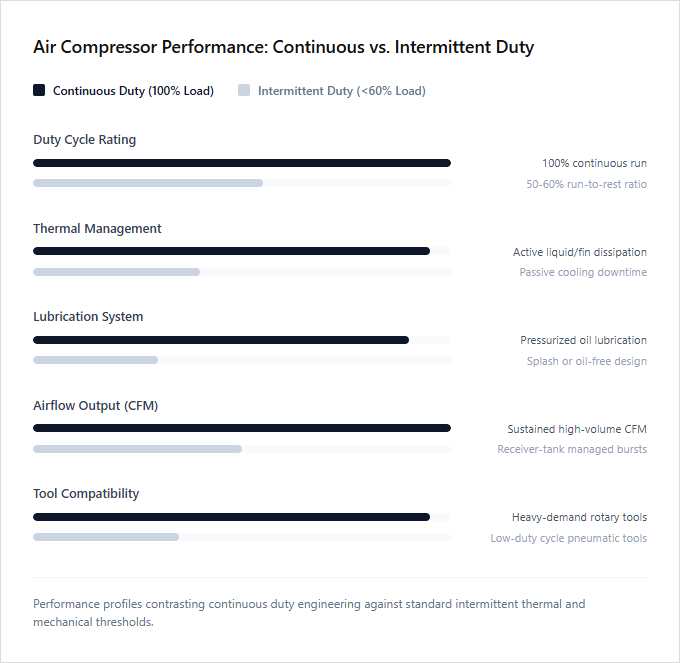
| Duty Cycle Rating | Continuous duty compressors are engineered to run indefinitely at a 100% duty cycle under full load, whereas intermittent duty compressors require periodic rest phases, typically operating on a 50% to 60% duty cycle. |
| Thermal Management | Continuous duty systems utilize advanced cooling jackets and cast-iron fins for heat dissipation, while intermittent models rely on passive ambient cooling during scheduled downtime to prevent thermal overload. |
| Lubrication System | Continuous duty compressors generally employ pressurized oil lubrication systems to minimize friction during prolonged operation, whereas intermittent units often feature splash lubrication or oil-free configurations. |
| Airflow Output (CFM) | Continuous duty compressors deliver a sustained Cubic Feet per Minute (CFM) rate for demanding industrial applications, while intermittent compressors are designed for short, high-flow bursts managed by a receiver tank. |
| Tool Compatibility | Intermittent compressors are best paired with low-duty cycle pneumatic tools like staple guns, whereas continuous duty models are required for high-demand pneumatic equipment such as rotary sanders and air grinders. |
Duty cycle percentage calculation based on a ten-minute standard interval
The duty cycle of an air compressor determines its operational limits within a standard ten-minute interval. To calculate this percentage, divide the compressor's maximum safe run time by the ten-minute window. For example, a compressor with a 50% duty cycle can run continuously for five minutes but must rest for the remaining five minutes to cool down. Continuous duty compressors are rated at 100%, meaning they can operate constantly without any cooling intervals during operation.
Intermittent duty compressors typically feature duty cycles ranging from 20% to 60%. Operating these units beyond their specified thermal limits leads to premature wear, whereas continuous duty models utilize robust cooling systems to handle sustained pneumatic demands. Intermittent models are ideal for DIY hobbyists and framing contractors who require occasional bursts of air, while continuous duty systems are designed for industrial manufacturers and auto body technicians who need constant, uninterrupted power.
100% Continuous Duty Rotary Screw Compressors
Selecting the right air compressor requires understanding duty cycles, which dictate how long a machine can operate under load. While intermittent duty compressors require periodic rest to prevent overheating, rotary screw compressors are engineered for a one hundred percent continuous duty cycle. These advanced systems utilize a continuous sweeping motion to compress air, dissipating heat efficiently and allowing them to run uninterrupted without thermal degradation.
In contrast, reciprocating models typically operate on a limited duty cycle, making them ideal for fluctuating demands. Continuous-duty rotary screw units are essential for industrial manufacturers and automotive shops requiring constant, high-volume airflow, whereas intermittent-duty models are best suited for construction contractors and DIY enthusiasts with periodic tool usage.
Reciprocating Compressors: 50% Duty Cycle Limit
When selecting an air compressor, understanding the distinction between continuous and intermittent duty cycles is critical for operational efficiency and equipment longevity. Reciprocating piston compressors typically operate under an intermittent duty cycle, which is frequently restricted to a fifty percent limit. This specification dictates that for any given period of operation, the pump should only run for half of that time, requiring equal rest periods to dissipate heat and prevent thermal damage to the internal components.
In contrast, continuous duty compressors, such as rotary screw systems, are engineered with advanced cooling mechanisms that allow them to run constantly without interruption. Intermittent duty models are best suited for automotive hobbyists and small workshop technicians performing periodic tasks like pneumatic fastening, while continuous duty machines are designed for industrial manufacturers requiring a constant, high-volume air supply for automated production lines.
Matching CFM to Pneumatic Tool Requirements
Selecting an air compressor requires matching its volumetric flow rate, measured in cubic feet per minute (CFM), to the demands of your pneumatic tools. Continuous duty compressors deliver a steady, uninterrupted CFM under full load without overheating. Intermittent duty models operate on a cycle, requiring periodic rest to cool down, which means their CFM output is designed for brief, non-continuous usage.
High-demand tools like sanders necessitate continuous duty systems to prevent performance drops, while low-demand tools like nailers pair well with intermittent systems. Continuous duty units are best suited for industrial manufacturers requiring constant production, whereas intermittent compressors are ideal for home mechanics and contractors performing occasional assembly work.
Thermal overload protection systems preventing motor damage from excessive run-times
Air compressor duty cycles dictate how long a motor can safely operate before requiring a cooling period. Continuous duty compressors are engineered to run indefinitely under full load, utilizing advanced cooling designs to manage heat build-up. Conversely, intermittent duty models require scheduled rest periods. In both systems, thermal overload protection serves as a critical safety mechanism. This sensor automatically interrupts power if the motor temperature exceeds safe operating thresholds, effectively preventing catastrophic winding damage from excessive run-times.
While continuous duty machines rarely trigger this protection due to superior thermal management, intermittent units rely on it to survive demanding workloads. Selecting the correct configuration prevents unnecessary operational downtime and premature tool failure. Continuous duty models are ideal for industrial professionals requiring constant, uninterrupted airflow, whereas intermittent duty units best suit home hobbyists and DIY enthusiasts executing periodic tasks.
Enhancing Heat Dissipation: Liquid Cooling or Cast Iron Cylinders
Selecting the right air compressor depends heavily on duty cycle requirements and the corresponding thermal management systems. Continuous duty models are engineered to run indefinitely under load, relying on advanced heat dissipation features like liquid-cooling loops or integrated cast iron cylinders to mitigate extreme thermal stress. In contrast, intermittent duty compressors operate on a fractional run-time schedule, utilizing simpler air-cooling methods that require regular shutdown periods to safely dissipate heat.
The integration of cast iron cylinders significantly enhances heat absorption and structural integrity, extending the operational lifespan of high-demand systems. Industrial operators requiring uninterrupted airflow for heavy manufacturing thrive with continuous duty systems, whereas automotive hobbyists and residential contractors performing sporadic tasks are better suited for cost-effective intermittent duty models.
Forced pressure lubrication vs splash lubrication systems dictating operational endurance
The operational endurance of an air compressor is fundamentally dictated by its lubrication design. Continuous-duty compressors utilize forced pressure lubrication, where an oil pump actively delivers a steady flow of lubricant to high-friction components, preventing thermal overload during non-stop operation. Conversely, intermittent-duty compressors rely on splash lubrication, a passive system where a spinning crankshaft splashes oil onto internal parts. This passive method requires regular cooling intervals to prevent heat buildup and mechanical wear.
Continuous-duty, pressure-lubricated models are ideal for industrial manufacturing teams requiring uninterrupted pneumatic power, while intermittent-duty, splash-lubricated units are best suited for home hobbyists and light-duty contractors performing sporadic tasks.
Leave a comment