
Industrial plant managers frequently struggle with unexpected system downtime and pressure losses in pneumatic conveying lines-issues often traced back to selecting an incompatible blower configuration. While traditional capital expenditure budgets and standard equipment procurement channels typically focus on minimizing upfront acquisition costs, this narrow view overlooks critical lifecycle dynamics.
Choosing the correct drive configuration grants operators significant long-term maintenance savings and optimized energy efficiency. However, as an essential stipulation, neither design is a universal solution; performance is strictly bound by specific operational parameters. For instance, in high-demand environments like plastics compounding or food-grade powder conveying, a mismatch can quickly lead to belt degradation or motor strain.
To guide your next system upgrade, this article provides an objective comparison of direct-drive and belt-drive regenerative blowers, analyzing their mechanical efficiency, maintenance profiles, and spatial footprints to help you make an informed procurement decision.
| Factor | Summary |
|---|---|
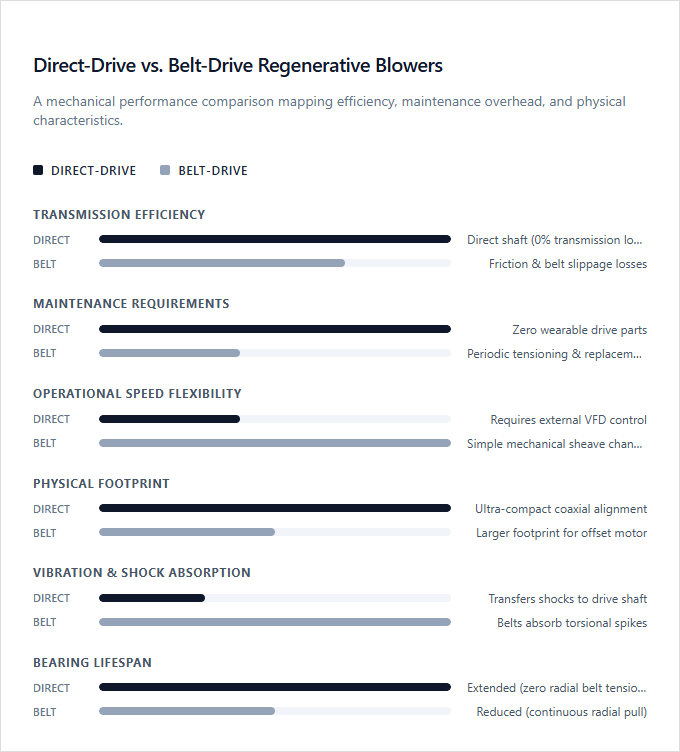
| Transmission Efficiency | Direct-drive blowers eliminate mechanical transmission loss by connecting the motor shaft directly to the impeller, whereas belt-drive systems experience energy dissipation through belt slippage. |
| Maintenance Requirements | Belt-drive blowers require periodic belt tensioning and replacement to prevent degradation, while direct-drive units minimize maintenance by eliminating consumable drive components. |
| Operational Speed Flexibility | Belt-drive blowers allow operators to easily adjust rotational speed by changing the sheave ratio, whereas direct-drive blowers must rely on a variable frequency drive to alter motor speed. |
| Physical Footprint | Direct-drive configurations feature a highly compact coaxial design, whereas belt-drive systems require a larger footprint to accommodate the belt guard and offset motor mounting. |
| Vibration and Shock Absorption | Belt-drive systems naturally cushion the motor from sudden load spikes by absorbing torsional vibration through the flexible belts, while direct-drive units transfer these mechanical shocks directly down the drive shaft. |
| Bearing Lifespan | Direct-drive blowers experience lower radial load on the bearings because there is no belt tension pulling on the shaft, resulting in an extended mean time between failures. |
Direct-drive eliminates parasitic energy losses to maximize mechanical transmission efficiency.
Regenerative blowers are vital in industrial air-moving applications, with direct-drive and belt-drive configurations offering distinct operational benefits. Direct-drive models connect the motor shaft directly to the impeller. This design eliminates parasitic energy losses from belt slippage and friction, maximizing mechanical transmission efficiency while ensuring a compact physical footprint.
Belt-drive systems provide flexibility by allowing operators to alter blower speed through different pulley ratios. This versatility comes at the cost of periodic belt replacements and minor transmission power losses, making the choice between the two designs highly dependent on maintenance capabilities and efficiency goals.
Direct-drive units are ideal for facility managers prioritizing maximum energy efficiency and maintenance-free continuous operation, whereas belt-drive configurations suit industrial operators who require custom performance tuning and have dedicated maintenance staff.
Belt-Drive Radial Loads Accelerate Bearing Wear
Regenerative blowers are critical for high-volume air delivery, utilizing either direct-drive or belt-drive configurations to power the impeller. Direct-drive models couple the motor directly to the blower shaft, ensuring highly efficient power transmission and a compact design. In contrast, belt-drive systems introduce overhung radial loads due to the tension of the belts. These continuous lateral forces put unequal stress on the shaft bearings, which accelerates bearing fatigue wear and increases the frequency of necessary maintenance.
Selecting the right configuration depends on your operational environment and maintenance capabilities. Direct-drive blowers are ideal for facility managers seeking reliable, low-maintenance, and continuous-duty operation, whereas belt-drive options are best suited for specialized industrial operators who require customizable flow rates and have the staff to perform routine drivetrain upkeep.
Direct-Drive: VFDs Replace Pulleys for Speed Control
Regenerative blowers are configured as either direct-drive or belt-drive systems, each offering distinct operational advantages. Direct-drive models connect the motor shaft directly to the impeller, which eliminates transmission losses and reduces ongoing maintenance. To adjust the operating speed of a direct-drive blower, operators must utilize a variable frequency drive (VFD) to alter the electrical frequency, whereas belt-drive systems achieve speed variation mechanically through physical pulley ratio changes.
Belt-drive blowers provide flexibility in speed customization through hardware modifications, though they introduce more wear components. Direct-drive systems equipped with VFDs offer precise, automated speed control and superior energy efficiency. Facilities prioritizing low-maintenance, automated, and dynamic flow control benefit most from direct-drive systems, while operations requiring simple, cost-effective, and fixed-speed adjustments through manual hardware changes prefer belt-drive models.
How Blower Belt Slippage Affects Conveying Velocity
Regenerative blowers are essential in pneumatic conveying, where maintaining a precise air velocity is critical. Belt-drive systems offer speed flexibility but introduce the risk of belt slippage over time. When a belt slips, the blower's rotational speed decreases, dropping the conveying air velocity below the critical saltation velocity. This velocity reduction causes suspended solids to fall out of the airstream, leading to line blockages and costly system downtime.
Direct-drive blowers eliminate this risk by coupling the motor directly to the impeller, ensuring a constant, reliable speed and consistent airflow. Direct-drive units are ideal for facility managers seeking low-maintenance, continuous operations with zero tolerance for velocity drops, while belt-drive models suit operators who require adjustable performance parameters and have the technical resources for regular belt tensioning.
Direct-Drive: Compact, Maintenance-Free Configurations
Direct-drive regenerative blowers connect the motor shaft directly to the impeller, eliminating the need for belts or external couplings. This configuration offers a significantly smaller spatial footprint and completely removes the need for routine coupling alignment maintenance, ensuring high reliability in confined spaces.
In contrast, belt-drive regenerative blowers utilize a system of pulleys and belts to transmit power, which demands more physical space and periodic tension adjustments. This design allows operators to alter blower speed and performance characteristics simply by changing the pulley ratio. Direct-drive systems are ideal for facility managers seeking compact, maintenance-free operations, whereas belt-drive configurations best serve industrial technicians who require customizable performance curves and field-adjustable flow rates.
Precise Airflow and Pressure Tuning with Belt-Drives
Regenerative blowers are vital for industrial aeration and vacuum applications, categorized into direct-drive and belt-drive configurations. Direct-drive models connect the motor shaft directly to the impeller, providing a highly compact, efficient design with fewer moving parts. This setup ensures consistent performance and requires minimal maintenance over its operational lifespan.
Belt-drive regenerative blowers offer distinct advantages in versatility. By adjusting pulley sizes, operators can achieve precise performance tuning to match specific volumetric flow rate and static pressure demands. Direct-drive systems are best suited for facilities prioritizing low maintenance and standard continuous duty, whereas belt-drive configurations are ideal for specialized engineers who require customized, variable-output performance for complex system integration.
Direct-Drive Eliminates Belt Maintenance and Downtime
When selecting regenerative blowers, the drive configuration significantly impacts long-term operational efficiency. Direct-drive models connect the motor shaft directly to the impeller, eliminating the energy losses and mechanical vulnerabilities of belt-driven systems. This streamlined configuration completely avoids the routine system downtime required for belt tensioning, pulley alignment, and wear-induced replacement schedules, ensuring continuous performance in demanding industrial applications.
Belt-drive regenerative blowers offer flexibility in speed adjustment and airflow customization through interchangeable pulleys, though they require regular maintenance monitoring. High-volume industrial facilities seeking maintenance-free, continuous operations benefit most from direct-drive units, whereas engineering teams requiring precise, adjustable performance tuning and possessing dedicated service staff are well-suited for belt-drive systems.
Leave a comment