
Designing efficient industrial air systems often presents a frustrating compromise between maximizing volumetric flow and achieving necessary system pressure. While standard capital funding sources typically support straightforward equipment replacements, securing budget approval for complex system upgrades requires demonstrating clear operational returns.
Properly selecting a regenerative side channel blower configuration grants engineers the ability to significantly lower lifecycle costs while boosting throughput. However, this optimization is contingent upon the stipulation that the blower's stage configuration is precisely matched to the system's specific resistance curve. For example, in high-demand applications like wastewater aeration basins or precise pneumatic conveying, selecting the wrong stage configuration can lead to premature motor overload or inadequate pressure delivery.
To assist in your system design, this article will analyze the critical differences between single-stage and double-stage regenerative blowers, evaluating how each configuration handles pressure and flow to help you maximize your system's performance.
| Factor | Summary |
|---|---|
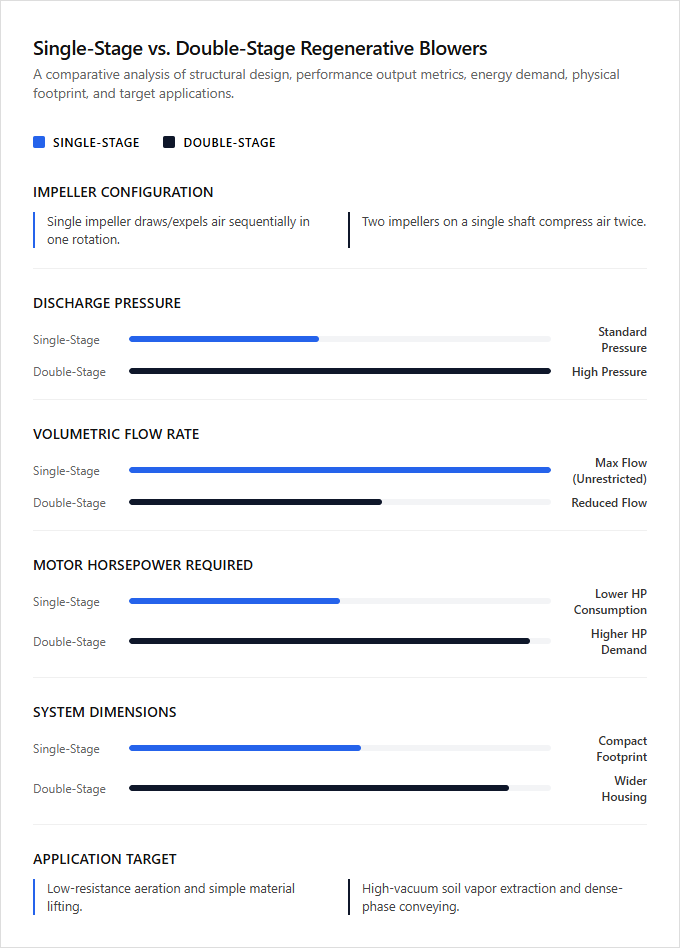
| Impeller Configuration | Single-stage blowers utilize a single impeller to draw in and expel air, while double-stage blowers employ two impellers on a single shaft to compress the air twice sequentially. |
| Discharge Pressure | Double-stage blowers generate significantly higher static pressure compared to single-stage models by routing the kinetic energy of the airflow through consecutive compression chambers. |
| Volumetric Flow Rate | Single-stage blowers deliver a superior maximum volumetric flow rate, measured in cubic feet per minute, because they do not restrict airflow through a secondary compression stage. |
| Motor Horsepower | Double-stage blowers require greater brake horsepower to rotate the additional impeller, resulting in higher energy consumption than single-stage units. |
| System Dimensions | Double-stage models feature a wider blower housing to accommodate the dual-impeller assembly, leading to a larger physical footprint than their single-stage counterparts. |
| Application Target | Single-stage blowers are optimized for low-resistance aeration systems, whereas double-stage blowers are essential for high-vacuum soil vapor extraction and dense-phase pneumatic conveying. |
Volumetric flow rate maximization in single-stage configurations
Regenerative blowers are essential assets in industrial fluidics, categorized primarily into single-stage and double-stage designs. In single-stage configurations, the primary engineering objective is the maximization of the volumetric flow rate. By utilizing a single impeller to move air directly from the inlet to the outlet, these units minimize internal resistance and maximize the volume of air displaced, making them highly efficient for low-pressure demands.
Double-stage blowers compress the air twice through successive impellers, which raises the pressure capability but reduces the overall flow rate. Selecting the appropriate technology depends entirely on your specific system impedance and volume requirements. Single-stage models are ideal for operators needing high-volume ventilation or surface drying, while double-stage blowers are best suited for technicians managing deep-vacuum filtration or high-resistance pneumatic conveying.
Differential pressure amplification through series configuration in double-stage units
Regenerative blowers are vital assets in industrial fluidics. While single-stage models utilize a single impeller to compress air in one rotation, double-stage units leverage two impellers configured in series. This series arrangement directs the exhaust of the first stage into the intake of the second stage, resulting in significant differential pressure amplification. By compounding the kinetic energy, the double-stage design achieves nearly twice the pressure or vacuum capacity of a single-stage system within a comparable footprint.
Single-stage models are suitable for facility managers seeking cost-effective solutions for high-flow, low-resistance tasks like sewage aeration, whereas double-stage blowers are ideal for process engineers requiring high-pressure capabilities for deep-water sparging or dense-phase pneumatic conveying.
Compression ratio escalation via successive impeller stages
Regenerative blowers utilize non-contact impellers to transfer kinetic energy to the processing gas. In a single-stage configuration, the air travels through a single impeller ring before discharge, delivering high volumetric flow rates at moderate pressure levels. This design offers a highly efficient, reliable solution for straightforward moving air applications.
Double-stage blowers escalate the compression ratio by routing the partially compressed air through a successive second impeller stage. This series configuration compounds the kinetic energy transfer, significantly boosting the discharge pressure to overcome high system resistance. The successive acceleration of the air stream allows these units to achieve much higher differential pressures without increasing the physical footprint proportionally.
Single-stage models are best suited for facility operators managing low-resistance ventilation and dust collection, while double-stage units are designed for industrial professionals requiring high-pressure pneumatic conveying or deep-water aeration.
Volumetric efficiency variations under high backpressure conditions
Regenerative blowers generate pressure through centrifugal forces within precisely engineered impellers. In single-stage configurations, a single impeller compresses the air, which delivers exceptional flow rates but suffers a notable decline in volumetric efficiency under high backpressure. This efficiency loss occurs because high differential pressure forces compressed air to slip backward across the impeller blades, reducing net output.
Double-stage blowers mitigate this limitation by routing the airflow through two successive impellers in series. Splitting the pressure workload across two stages reduces the pressure differential over each individual impeller, minimizing internal slippage and maintaining high volumetric efficiency at elevated system pressures. Single-stage blowers are ideal for facilities managers requiring high-volume displacement at lower resistance, whereas double-stage models are essential for process engineers managing high-vacuum or deep-sparging operations.
Thermodynamic heating and heat dissipation requirements in double-stage compression
Single-stage regenerative blowers move air through a single impeller cycle, generating moderate pressure with minimal thermal buildup. In contrast, double-stage blowers route air through two consecutive impellers to significantly increase discharge pressure. This multi-stage compression process intensifies thermodynamic heating, as compressing the gas twice rapidly elevates the discharge temperature and reduces air density within the second chamber.
Managing this increased thermal load in double-stage systems necessitates robust heat dissipation features, such as integrated cooling fins or external heat exchangers, to prevent motor fatigue and maintain operational efficiency. Single-stage blowers are suitable for operators requiring high-volume airflow at lower pressures, whereas double-stage models are ideal for industrial engineers demanding high-pressure performance for heavy-duty pneumatic conveying.
Parallel configuration utilization for maximizing inlet suction capacity
In regenerative blower technology, the choice between single-stage and double-stage configurations depends on the specific pressure and airflow requirements of the application. While standard double-stage blowers typically route air in series to achieve higher pressures, utilizing these units in a parallel configuration redirects airflow through both impellers simultaneously. This parallel setup maximizes the inlet suction capacity, effectively doubling the volumetric flow rate compared to a standard series configuration.
Maximizing inlet suction through parallel configuration is highly effective for high-volume, low-resistance air handling systems. This design optimizes efficiency without requiring a physically larger, single-stage unit. Single-stage blowers are ideal for facility operators needing straightforward high volume at low pressure, whereas parallel-configured double-stage blowers suit specialized technicians requiring adaptable, high-flow capacity with moderate pressure flexibility.
Isentropic efficiency differences affecting motor power requirements
Single-stage regenerative blowers utilize a single impeller to move air, offering high isentropic efficiency at lower pressure differentials. When application demands force a single-stage unit to operate at higher pressures, internal air slippage increases. This slippage degrades the blower's isentropic efficiency, requiring a significantly larger motor to compensate for the lost energy and maintain flow.
Double-stage blowers mitigate this efficiency loss by compressing the air twice through two sequential impellers. This configuration maintains high isentropic efficiency at elevated pressures, drastically reducing the motor power required compared to an overloaded single-stage counterpart. Single-stage units are ideal for facility managers seeking cost-effective, high-volume displacement at low pressures, whereas double-stage models are best suited for industrial engineers requiring consistent, high-pressure performance for demanding vacuum or aeration tasks.
Leave a comment