
For many trim carpenters, nothing is more frustrating than watching a costly piece of molding split during final assembly, or realizing too late that a fastening joint lacks the structural holding power to withstand natural wood movement. While standard equipment procurement budgets are typically prioritized for major stationary machinery, investing in the correct secondary fastening system is just as vital to a project's success. Mastering this selection grants craftsmen the ability to achieve flawless, paint-ready finishes without compromising structural integrity.
Crucially, we must stipulate that no single nailer serves as a universal solution; material density and trim weight must dictate your tool choice. For example, utilizing a delicate 18-gauge brad nailer for heavy door jambs leads to joint failure, whereas deploying a robust 15-gauge finish nailer on thin shoe molding will inevitably shatter the workpiece.
This article will analyze the core differences between brad and finish nailers, evaluate gauge-specific capabilities, and provide a clear framework to help you select the optimal tool for your next trim carpentry project.
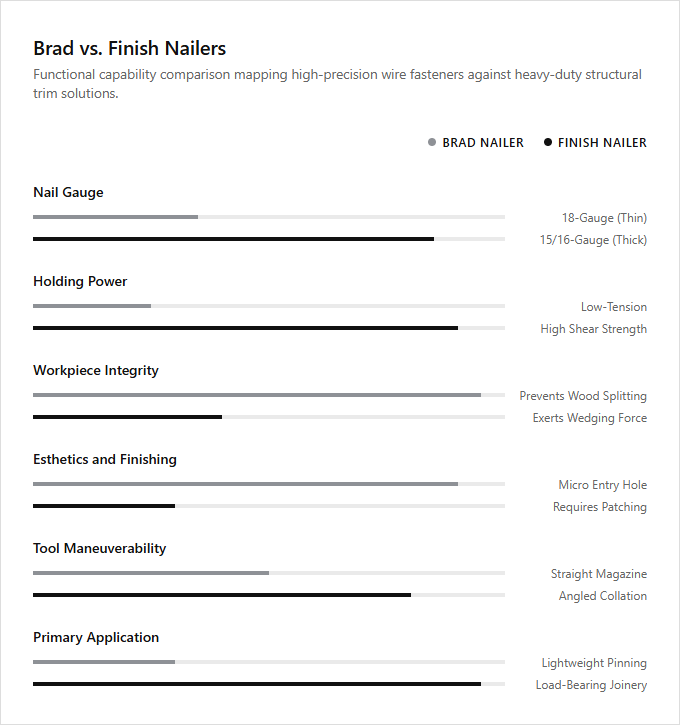
| Factor | Summary |
|---|---|
| Nail Gauge | Brad nailers utilize thin 18-gauge wire nails, whereas finish nailers deploy thicker 15-gauge or 16-gauge fasteners to achieve higher shear strength. |
| Holding Power | Finish nailers provide superior holding capacity for heavy trim installations, while brad nailers are designed for delicate, low-tension assemblies. |
| Workpiece Integrity | The ultra-thin profile of a brad nail preserves workpiece integrity by preventing wood splitting in delicate molding, whereas a finish nail exerts more wedging force. |
| Esthetics and Finishing | Brad nails leave micro-sized entry holes, while the larger countersink indentations left by finish nails must be patched with wood filler before painting. |
| Tool Maneuverability | Finish nailers often feature an angled magazine collation for reaching tight corners, whereas brad nailers typically utilize a standard straight magazine configuration. |
| Primary Application | Finish nailers are preferred for load-bearing structural joinery like door casings, while brad nailers excel in temporary pinning and lightweight trim attachment. |
18-Gauge Brad Nailers Prevent Splitting in Delicate Trim
When selecting between a brad nailer and a finish nailer, material thickness and the risk of splitting dictate the choice. An 18-gauge brad nailer is engineered for precision, utilizing thin wire nails with small heads. This design prevents splitting in delicate shoe molding and thin medium-density fiberboard, ensuring a clean finish with minimal wood filler required.
Finish nailers utilize thicker 15-gauge or 16-gauge nails to provide superior holding power for heavy casing, baseboards, and cabinetry. The selection between these tools depends on the specific structural demands of the project. Brad nailers are ideal for DIY hobbyists and trim carpenters performing delicate detail work, while finish nailers are suited for professional remodelers and installers managing heavy-duty trim applications.
15-Gauge Finish Nailers for Structural Door Jambs
When selecting between brad and finish nailers, the primary distinction lies in holding power and fastener thickness. Brad nailers utilize thin 18-gauge wire nails, which are ideal for delicate trim work where wood splitting is a concern. In contrast, finish nailers deploy thicker fasteners designed for load-bearing joints. Specifically, 15-gauge finish nailers deliver the high shear strength required for structural door jamb installation and heavy trim, securing these assemblies firmly to the wall framing.
While the larger finish nails provide superior mechanical holding power, brad nailers excel at temporarily holding light moldings without leaving noticeable holes. Finish nailers are best suited for professional carpenters undertaking structural installations, whereas brad nailers are ideal for hobbyists and DIYers executing delicate cabinetry and craft projects.
Angled Magazines Optimize Tight-Corner Clearance
When selecting between a brad nailer and a finish nailer, understanding their physical design and capability is essential for precise craftsmanship. Brad nailers typically utilize thin 18-gauge wire nails, which are ideal for delicate, split-prone materials. In contrast, finish nailers drive thicker 15- or 16-gauge nails for stronger structural holding power. A key advantage of 15-gauge finish nailers is their angled design; this angled magazine collation optimizes nosepiece clearance when fastening in tight inside corners, allowing the tool to reach restricted areas that obstruct straight-magazine brad nailers.
The choice between these two fastening systems ultimately depends on the material thickness and the spatial constraints of the assembly. Casual DIY enthusiasts tackling lightweight crafting or thin birdhouse assembly benefit most from the discreet footprint of a brad nailer, whereas professional finish carpenters installing heavy crown molding or cabinetry require the structural strength and tight-corner accessibility of an angled finish nailer.
DA Fasteners: Maximum Pull-Through Resistance for Thick Casing
When choosing between brad and finish nailers, understanding fastener design is crucial for structural integrity. Brad nailers utilize thin 18-gauge wire ideal for delicate moldings without splitting the wood, whereas finish nailers deploy heavier gauges for load-bearing trim. Within the finish category, DA-style fasteners offer a round head configuration that maximizes pull-through resistance in thick casing, providing superior holding power for demanding installations.
Selecting the right tool depends on the project scope and material density. Brad nailers are best suited for hobbyists and DIYers performing intricate detail work, while finish nailers remain the preferred choice for professional contractors and renovators securing heavy architectural trim.
18-Gauge Fasteners Require Less Wood Filler
When selecting between a brad nailer and a finish nailer, the primary consideration lies in balancing holding power with the aesthetic impact on the wood surface. The 18-gauge brad nailer utilizes thinner fasteners that leave significantly smaller entry holes. The minimal head profile of 18-gauge fasteners reduces the volume of cosmetic wood filler needed during prep, which streamlines the finishing process and preserves the wood's natural appearance.
In contrast, finish nailers employ thicker 15-gauge or 16-gauge nails to provide the structural integrity required for heavier trim and cabinetry. While these larger fasteners necessitate more extensive patching, their superior holding strength is essential for secure installations. Brad nailers are ideal for DIY enthusiasts performing delicate crafting and light trim work, while finish nailers are suited for professional carpenters installing heavy baseboards, casing, and crown molding.
16-Gauge Straight Finish Nails for Baseboard Installation
When choosing between a brad nailer and a finish nailer, the decision hinges on the material thickness and structural requirements of your project. For general baseboard installation, 16-gauge straight finish nails provide a versatile balance of strong holding power and a thin gauge. This specific fastener size secures heavy trim pieces reliably while leaving small, easily concealable holes that do not compromise the wood finish.
Brad nailers utilize thin 18-gauge wire nails, making them ideal for delicate trim work, thin plywood, and temporary pinning where splitting is a major concern. Finish nailers handle thicker 15- or 16-gauge nails, which are necessary for load-bearing trim and larger woodworking projects. Hobbyists and detailed crafters will find the brad nailer best suited for light-duty projects, whereas professional carpenters and home renovators tackling heavy-duty trim installations will require the robust strength of a finish nailer.
Depth Adjustment for Consistent, Mark-Free Countersinking
When selecting between a brad nailer and a finish nailer, understanding their mechanical differences is essential for achieving flawless results. Both tools utilize an integrated depth-of-drive adjustment, a critical feature that prevents driver blade marks on delicate trim surfaces. This adjustment mechanism ensures consistent countersinking by allowing precise control over how deep the fastener is driven into the wood, regardless of material density.
While the 18-gauge brad nailer is designed for thin moldings and temporary holding without splitting wood, the larger 15- or 16-gauge finish nailer provides the structural holding power needed for heavy casings. Brad nailers are ideal for hobbyists and furniture makers working on delicate cabinetry, whereas finish nailers are suited for professional contractors installing substantial interior trim, baseboards, and hanging doors.
Leave a comment