
Contractors and fabricators often face the frustrating reality of a rotary drill stalling mid-operation when boring through dense timber or masonry. Balancing the demand for raw, sustained torque against jobsite mobility remains a persistent challenge. Typically, operators rely on standard capital equipment budgets and traditional utility-grid power to ensure reliable tool performance.
However, recent advancements in high-voltage brushless technology grants modern cordless platforms the capacity to rival tethered tools, offering unprecedented operational flexibility. Under the stipulation that battery amp-hour capacity directly dictates sustained peak torque under heavy load, users must carefully weigh these specifications.
Whether you are boring large-diameter holes with self-feeding spade bits or utilizing SDS-plus rotary hammers for concrete masonry, selecting the correct drivetrain is critical. Below, we analyze the torque curves, thermal efficiency, and power-to-weight ratios of both configurations to help you select the optimal rotary drill for your high-torque demands.
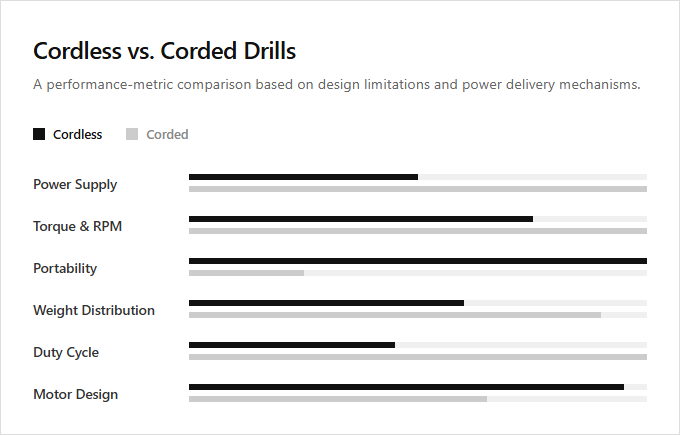
| Factor | Summary |
|---|---|
| Power Supply | Cordless drills utilize rechargeable lithium-ion battery packs for energy storage, whereas corded drills rely on continuous alternating current from an electrical outlet. |
| Torque and RPM | Corded drills offer consistent, high torque and maximum revolutions per minute because they are not subject to the voltage drop of a depleting battery. |
| Portability | Cordless drills provide superior maneuverability and spatial freedom because they operate independently of a power grid or restrictive extension cords. |
| Weight Distribution | Corded drills are generally lighter and more ergonomically balanced because they lack the heavy, base-mounted battery pack found on cordless models. |
| Duty Cycle | Corded drills support an infinite duty cycle for uninterrupted heavy-duty drilling, while cordless drills are limited by the amp-hour capacity of their cells. |
| Motor Design | Modern cordless drills frequently employ brushless motors to maximize battery efficiency, while corded drills typically utilize traditional carbon-brush motors. |
Corded Drills: Constant Torque Without Battery Sag
When selecting between corded and cordless drills, power consistency remains a critical factor for demanding tasks. Corded drills connect directly to an electrical outlet, ensuring a continuous supply of electricity that prevents performance drops. This direct connection allows corded models to maintain consistent torque output throughout operation, as they do not suffer from the battery voltage sag that cordless models experience as their charge depletes.
Cordless drills offer unmatched mobility and convenience, though their torque output can gradually decline during heavy use as the battery drains. Choosing the right tool depends on your work environment and project demands. Professionals requiring uninterrupted, high-torque power for heavy masonry or woodworking benefit most from corded drills, while DIY enthusiasts and contractors prioritizing portability on dynamic jobsites are ideal candidates for cordless models.
Cordless drills utilize brushless DC motors to maximize torque-to-weight ratio
When selecting a drill, the choice between cordless and corded models depends heavily on your specific operational needs. Modern cordless drills represent a significant technological advancement, utilizing brushless DC motors to maximize their torque-to-weight ratio. By eliminating physical brushes, these motors deliver exceptional efficiency and power output while maintaining a lightweight, highly maneuverable frame that reduces operator fatigue during prolonged use.
Conversely, corded drills offer uninterrupted power and consistent performance without the limitation of battery runtime or degradation. They excel in heavy-duty, stationary applications where high-amperage drilling is required over extended periods. Cordless drills are ideal for mobile trade professionals requiring maximum portability on dynamic jobsites, whereas corded models are best suited for workshop craftsmen who prioritize endless, high-demand power over mobility.
Corded Drills: Sustained Max Power Without Thermal Throttling
When selecting between cordless and corded drills, power consistency remains a primary technical differentiator. Corded drills connect directly to electrical grids, allowing them to sustain maximum amperage draw continuously without thermal throttling. Unlike battery-operated counterparts that may suffer from voltage drops or heat buildup under heavy loads, corded models maintain peak torque during prolonged, demanding applications.
Cordless drills offer unparalleled mobility and convenience, utilizing lithium-ion technology that serves well for quick, remote tasks. Professionals requiring uninterrupted, high-torque performance for heavy masonry or timber framing will benefit most from a corded drill, whereas general contractors and DIY enthusiasts seeking portability and ease of movement will find cordless models more suitable for their daily projects.
Why Cordless Drills Need High-Discharge Batteries
When selecting between corded and cordless drills, the primary consideration centers on power delivery and mobility. Cordless drills rely on advanced, high-discharge lithium-ion battery packs to deliver the substantial peak current required for demanding drilling tasks. These specialized battery cells ensure the motor maintains consistent torque under heavy loads, closely rivaling the reliable performance of traditional corded tools.
Conversely, corded drills draw continuous AC power directly from the grid, offering unlimited runtime and constant power output without the risk of voltage drop. Professionals requiring sustained, high-torque operation on heavy-duty construction sites typically prefer corded models, whereas maintenance technicians and DIY enthusiasts benefit more from the portability of cordless designs.
Planetary Gear Reduction for Maximum Torque
Selecting between a cordless and corded drill requires an understanding of their shared mechanical foundation. While their power sources differ, both systems employ planetary gear reduction to convert high motor RPM into maximum torque. This internal gearing system ensures that whether the tool relies on a lithium-ion battery or a continuous electrical outlet, the rotational energy is efficiently multiplied to drive large fasteners and bore through dense materials.
Cordless models offer unparalleled mobility and convenience on active jobsites, whereas corded drills deliver uninterrupted, consistent power for sustained, heavy-duty applications. Cordless drills are ideal for tradespeople and DIY enthusiasts requiring portability across various locations, while corded drills best serve workshop professionals and masonry specialists who demand constant, high-demand performance without the limitation of battery runtime.
Cordless Models: Electronic Clutches Prevent Kickback
When choosing between cordless and corded drills, the decision often hinges on power delivery and user control. Modern cordless drills offer significant safety and precision advantages through integrated electronic clutches. These advanced systems actively manage reaction torque, disengaging the motor when sudden resistance is met to prevent dangerous kickback and protect the user from injury.
Conversely, corded drills deliver continuous, uncompromised power without the risk of battery depletion, making them highly effective for heavy-duty, repetitive applications. Heavy-duty construction professionals requiring uninterrupted, high-torque output will benefit most from a corded model, while DIY enthusiasts and field technicians prioritizing portability, precision, and enhanced safety features will find the cordless drill more suitable.
How Extension Cords Reduce Corded Drill Torque
Selecting between cordless and corded drills requires a clear understanding of power delivery. Cordless drills offer unparalleled portability, powered by modern lithium-ion batteries that provide consistent voltage until depletion. In contrast, corded drills are valued for their continuous run-time, yet their performance remains highly sensitive to the electrical delivery infrastructure.
When a corded drill is paired with a long, high-resistance extension cord, a significant voltage drop occurs. This reduction in voltage directly diminishes the motor's torque output, compromising the tool's effectiveness during heavy-duty drilling tasks. Professionals requiring uninterrupted, high-torque drilling in fixed workshops benefit most from corded models, whereas field technicians needing maximum mobility across dynamic jobsites are ideal candidates for cordless alternatives.
Leave a comment