
Every operator knows the frustration of a drill bit seizing mid-cut while the chuck spins uselessly, marring the shank and ruining the workpiece. Historically, professionals bridged this gap by relying on standard three-jaw chuck tensioning or upgrading to heavy-duty keyed systems.
However, selecting the precise shank geometry-hex versus round-grants operators direct control over mechanical lock and torque efficiency without over-tightening. Under this stipulation, it is critical to note that optimized shank selection merely maximizes energy transfer; it cannot exceed the underlying torque thresholds of your power tool's motor. This is why high-demand industries rely on specialized 1/4-inch hex shanks in quick-change impact drivers to eliminate slippage entirely.
In this guide, we will analyze the mechanical differences between hex and round shanks, compare their torque transmission limits, and help you select the ideal interface for your specific drilling applications.
| Factor | Summary |
|---|---|
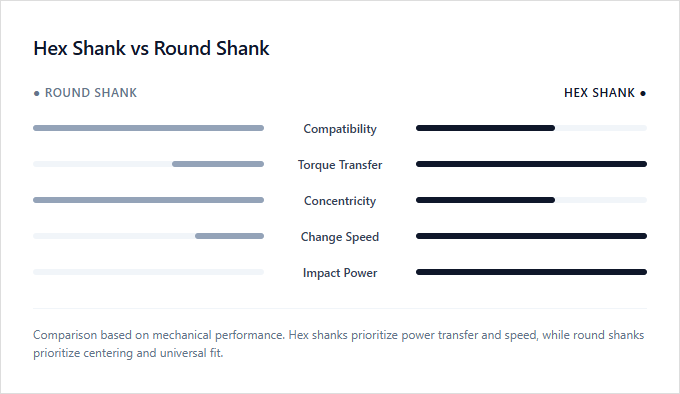
| Chuck Compatibility | Round shanks are universally compatible with standard three-jaw chucks, whereas hex shanks require a dedicated quick-change chuck or compatible multi-jaw system. |
| Torque Transfer | Hex shanks utilize their flat sides to prevent rotational slippage, ensuring highly efficient torque transfer compared to round shanks that can slip under high resistance. |
| Concentricity | Round shanks offer superior concentricity because they are perfectly centered by the chuck jaws, which minimizes rotational runout during high-precision drilling. |
| Change Efficiency | Hex shanks allow for rapid, one-handed bit swaps when paired with a quick-release collet, drastically reducing downtime compared to tightening a standard chuck. |
| Impact Driver Compatibility | Hex shanks are specifically designed to withstand and lock into the high-torque anvil mechanism of impact drivers, whereas round shanks will slip and cannot be used in these tools. |
Hexagonal Geometry Prevents Rotational Slippage
When selecting drill power tool accessories, the choice between hex shanks and round shanks directly impacts operational efficiency, chuck compatibility, and torque transmission. Traditional round shanks offer excellent centering capabilities within standard three-jaw chucks, though they are prone to slipping when encountering high-resistance materials.
Hex shanks resolve this limitation through their engineered design. The hexagonal geometry provides a positive mechanical interlock to prevent rotational slippage under high load, ensuring maximum power transfer from the drill to the workpiece. This flat-sided profile also enables seamless compatibility with quick-release impact drivers.
Round shanks are best suited for DIY enthusiasts performing precise, light-duty drilling, whereas hex shanks are ideal for professional contractors requiring rapid bit changes and slip-free performance under heavy loads.
Frictional Clamping of Cylindrical Shanks
When selecting drill bits, the shank design determines how torque is transferred from the power tool to the workpiece. Round, cylindrical shanks rely entirely on frictional engagement from the chuck jaws' clamping force. Under heavy loads, this friction-based grip can slip, though it offers a safety benefit by allowing the bit to spin harmlessly if it encounters a sudden obstruction, preventing tool kickback.
Conversely, hex shanks feature six flat sides that lock mechanically into the chuck, eliminating slippage under high torque and making them ideal for impact drivers. Traditional round shanks are suited for precision machinists requiring high concentricity, while hex shanks are preferred by high-volume contractors needing rapid bit changes and maximum torque.
Round Shanks for High-Precision Drilling
When selecting drill bits, the choice between hex and round shanks depends on the application's tolerance requirements. Round shanks are engineered for high-precision tasks, delivering superior concentricity and minimal radial runout. Because they sit flush within a standard three-jaw chuck, they maintain a perfectly centered axis, which is essential for drilling clean, accurate holes without deviation.
Hex shanks feature a six-sided design that prevents slippage under high torque, making them ideal for rapid changes in impact drivers. While they offer excellent power transfer, they lack the extreme rotational precision of their round counterparts. Professional machinists requiring exact tolerances rely on round shanks, whereas general contractors and DIY enthusiasts benefit more from the quick-change efficiency of hex shanks.
How Hex Shanks Distribute Force in Three-Jaw Chucks
When selecting drill bits, the choice between hex and round shanks significantly impacts torque transmission and operational efficiency. Hexagonal shanks are engineered to utilize a flat-on-flat contact surface area, which effectively distributes radial force within standard three-jaw chucks. This mechanical design prevents the bit from slipping under high-torque loads, ensuring a secure grip and more efficient power transfer during demanding drilling tasks.
In contrast, round shanks offer superior centering and concentricity, making them ideal for high-speed, precision applications, though they are more prone to spinning under heavy resistance. Round shanks are best suited for machinists and woodworkers requiring meticulous accuracy, while hex shanks are ideal for construction professionals and DIY enthusiasts who prioritize rapid bit changes and high-torque fastening.
Passive Motor Protection via Round Shank Slip
In the selection of drill bits, the design of the shank fundamentally impacts both tool performance and motor safety. While hex shanks provide a positive, non-slip lock in compatible chucks, round shanks offer a distinct mechanical safeguard under high resistance. When a drill bit encounters a sudden obstruction, the rotational slip of round shanks acts as a passive torque-limiting mechanism to protect the motor from destructive electrical overload and minimize sudden physical kickback.
Hex shanks eliminate slippage entirely to maximize torque transmission, which is highly efficient but transfers all mechanical stress directly to the power tool. Precision tradespeople requiring rapid bit swaps and high-torque fastening are ideal candidates for hex shanks, whereas general maintenance technicians and metalworkers seeking to extend tool lifespan during heavy drilling benefit most from round shanks.
Quick-Change Hex Designs for High-Torque Drivers
When selecting drill bits, the shank design determines both tool compatibility and operational efficiency. Hex shanks are specifically engineered for high-torque applications, offering a secure, non-slip grip within the chuck. This six-sided design is optimized for rapid-insert quick-change couplers commonly found in modern impact drivers, allowing operators to swap bits instantly without a chuck key.
Round shanks offer precise centering in standard three-jaw chucks, making them ideal for traditional rotary drills where concentricity is paramount. Heavy-duty construction professionals requiring fast, high-torque driving benefit most from hex shanks, whereas woodworkers and machinists seeking precision drilling on stationary presses are better suited for round shanks.
Hex Shanks Prevent Torsional Deformation Better Than Round
When selecting drill bit shanks, the mechanical design dictates performance under load. Hexagonal shanks feature flat surfaces that allow the chuck to grip securely, distributing high torsional stress evenly across the six flats. This specific geometry prevents the shank from spinning within the chuck and significantly reduces the risk of shank deformation compared to round variants.
In contrast, round shanks rely entirely on rotational friction within a three-jaw chuck. Under high torque, this contact can slip, causing frictional heat and potential damage to the bit. Round shanks remain ideal for general-purpose DIY enthusiasts requiring high concentricity in standard drilling, whereas hex shanks are better suited for professional contractors performing heavy-duty, high-torque fastening applications.
Leave a comment