
Contractors and masonry professionals frequently struggle with costly project delays and premature diamond blade wear simply because they deployed the incorrect power source to the jobsite. Selecting the right concrete saw is a high-stakes decision where unexpected downtime directly erodes profit margins. Typically, procurement managers rely on standard equipment financing or traditional capital budgets to source these heavy-duty tools, assuming any premium model will suffice.
However, choosing the precise power configuration grants operators the exact torque and emission-free performance required to maximize blade longevity and safety. This choice comes with the vital stipulation that even the most powerful saw underperforms if the diamond blade's bond hardness is mismatched to the local aggregate. For instance, while a heavy-duty Stihl TS 420 gas saw excels in outdoor roadwork, deploying it for indoor trenching is hazardous, whereas utilizing a Husqvarna K 4000 electric saw ensures safe, compliant indoor operation.
To help you optimize your fleet, this article provides a comprehensive comparison of gas and electric concrete saws, evaluating their power output, portability, and operational costs for diamond blade cutting.
| Factor | Summary |
|---|---|
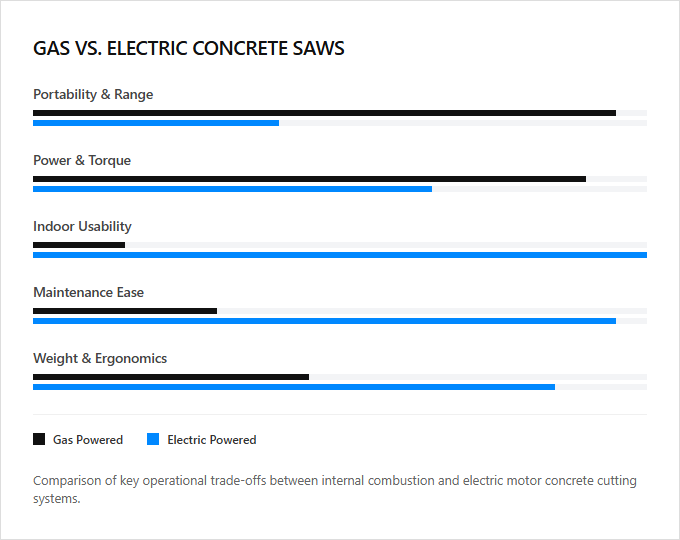
| Power Source & Portability | Gas saws utilize internal combustion engines for unrestricted jobsite mobility, whereas electric saws require proximity to electrical outlets, extension cords, or generator units. |
| Power and Torque Output | Gas-powered models deliver higher maximum horsepower and torque for deep cutting of heavily reinforced concrete, while electric models provide constant RPMs but may stall under extreme loads. |
| Emissions and Indoor Usability | Electric saws generate zero exhaust emissions, making them ideal for indoor excavation, unlike gas saws which produce hazardous carbon monoxide and require high-volume ventilation. |
| Maintenance Requirements | Gas saws require regular spark plug, air filter, and carburetor maintenance, whereas electric models feature brushless motors that are virtually maintenance-free. |
| Weight and Ergonomics | Electric concrete saws feature a much lighter chassis that minimizes operator fatigue and reduces the gyroscopic effect during directional cuts. |
Two-stroke internal combustion engine displacement versus brushless electric motor wattage
When selecting a concrete saw, the primary power differentiator lies between the displacement of gas-powered two-stroke engines and the wattage of brushless electric motors. Gas saws typically feature displacements ranging from 70cc to over 90cc, delivering the high torque and sustained mechanical power necessary for deep, continuous cutting through reinforced concrete without relying on an external power grid.
Conversely, electric concrete saws utilize brushless electric motors rated by wattage, generally operating between 1,800 and 3,200 watts. These brushless motors provide high energy efficiency, instant torque, and emission-free operation, which eliminates fuel mixing and minimizes the maintenance overhead associated with carburetor-driven systems.
Gas-powered saws are best suited for heavy-duty infrastructure contractors requiring maximum portability on remote, outdoor jobsites, while electric models are ideal for indoor renovation specialists and residential contractors who prioritize low noise, clean air quality, and plug-and-play convenience.
Carbon monoxide exhaust emissions safety versus indoor zero-emission operation
Gas-powered concrete saws offer unmatched mobility and high-performance cutting capacity on demanding jobsites. Because their internal combustion engines produce carbon monoxide and other harmful exhaust emissions, their use is strictly restricted to outdoor environments or open-air job sites to prevent dangerous gas accumulation and protect operator health.
Conversely, electric concrete saws deliver zero-emission operation, making them the industry standard for indoor renovations, trenching, and confined space projects where air quality is paramount. Gas models are ideal for heavy-duty infrastructure contractors requiring cord-free portability, while electric models best serve interior demolition specialists and residential contractors working in enclosed areas.
Spindle RPM and peripheral blade speed variance under high-load torque
When comparing gas and electric concrete saws, the variance in spindle RPM and peripheral blade speed under high-load torque is a critical performance differentiator. Gas-powered saws rely on internal combustion engines that deliver high peak torque but often experience noticeable RPM drops when encountering dense reinforcement or deep aggregates. In contrast, modern electric concrete saws, particularly high-voltage brushless models, utilize smart electronic feedback loops to maintain a nearly constant spindle speed. When subjected to high-torque resistance, the electric motor draws additional current to prevent bogging down, ensuring a highly consistent peripheral blade speed throughout the cut.
Gas saws are ideal for independent utility contractors requiring maximum mobility on remote, outdoor job sites, whereas electric saws are best suited for indoor renovation specialists and masonry professionals who demand fume-free operation, low maintenance, and highly precise, constant-speed cutting.
Integrated water-feed dust suppression systems for wet diamond blade cooling
Both gas and electric concrete saws utilize integrated water-feed dust suppression systems to cool the wet diamond blade and control hazardous silica dust. On gas-powered saws, these systems typically connect to external, pressurized water sources to match the high-RPM demands of heavy-duty outdoor cutting. In contrast, electric concrete saws often feature highly controlled, compact water hookups designed to minimize slurry runoff, which is essential for maintaining a clean and safe indoor workspace.
Directing water to both sides of the spinning blade ensures even temperature regulation, preventing blade warping and extending tool longevity. Gas-powered saws with high-volume water feeds are best suited for infrastructure contractors requiring maximum outdoor mobility and deep-cutting capabilities, while emission-free electric models with precise water-flow controls are ideal for indoor renovation specialists working in confined, poorly ventilated spaces.
Electrical Constraints vs. Refueling Downtime
Electric concrete saws offer consistent indoor performance but face distinct power delivery constraints. Operating on standard jobsite power requires careful monitoring of voltage drop, especially when using long extension cords that can degrade motor performance. High amperage draw under heavy loads can also trip breakers, necessitating dedicated circuits or specialized generators to maintain optimal cutting torque.
In contrast, gasoline-powered saws provide unrestricted mobility free from electrical tethers. However, they demand strict adherence to precise fuel-mix ratios and introduce regular refueling downtime, alongside necessary engine maintenance. Electric models are ideal for indoor renovation contractors seeking emission-free operation near reliable power sources, while gas models best serve heavy-duty roadwork crews requiring maximum portability and continuous outdoor cutting power.
Carburetor and air filtration maintenance versus stator and armature wear-and-tear
Gas-powered concrete saws deliver high mobility and power but require rigorous engine upkeep to combat abrasive concrete dust. Maintaining these units demands frequent air filter cleanings and precise carburetor adjustments to prevent fuel system clogging, cylinder scoring, and engine power loss.
Electric concrete saws eliminate fuel-related maintenance but remain susceptible to stator and armature wear-and-tear. Fine dust can bypass internal seals, degrading the motor windings and carbon brushes, which necessitates regular electrical inspections to prevent motor burnout under heavy loads.
Gas models are ideal for infrastructure crews requiring maximum field independence on outdoor jobsites, while electric saws best suit indoor renovation contractors prioritizing low maintenance and zero-emission operation.
Determinants of Maximum Cutting Depth
When selecting between gas and electric concrete saws, the maximum cutting depth is strictly governed by the interaction of arbor size and blade guard clearance. The arbor size dictates the maximum blade diameter the spindle can safely support, while the physical shroud of the blade guard limits how much of that blade can actually penetrate the substrate. Gas-powered saws typically feature larger arbors and spacious guards to accommodate blades up to 16 inches, maximizing cutting depth for heavy-duty slabs.
Electric concrete saws usually employ smaller arbors and tighter guard clearances to optimize motor efficiency, restricting their maximum cutting depth to shallower limits. Heavy-duty infrastructure contractors require the deep-cutting capacity of gas saws, whereas indoor renovation specialists and residential operators are best served by the emissions-free, shallower precision of electric models.
Leave a comment